May, in the Regent’s Park
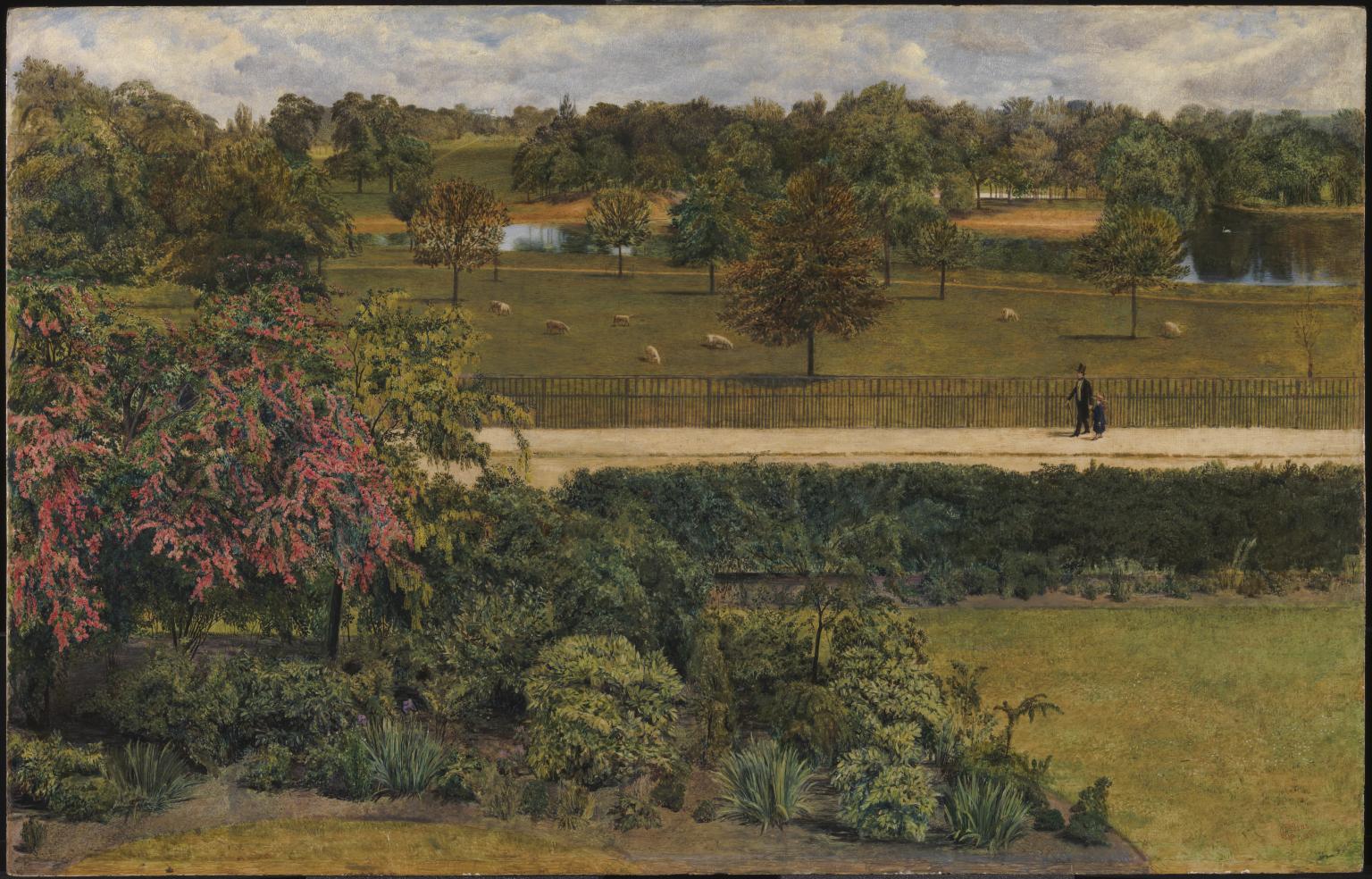
- Artist: Charles Allston Collins
- Date: 1851
- Medium: Oil paint on mahogany
- Dimensions: support: 445 x 692 mm
- Museum: Tate Britain
- Collection record: Tate Britain website
Listen to the free audio guide
About this artwork
This is the “May, in the Regent’s Park” by Charles Allston Collins. Painted in 1851, Collins worked on this oil on mahogany panel from a view outside his family home at 17 Hanover Terrace. He looks east across Regent’s Park, capturing the park’s lake, hedges, and a prominent pink hawthorn bush that the title hints at, as well as the light spring day.
Collins’ style is a hallmark of the Pre‑Raphaelites—every leaf, stone and fence is rendered with meticulous, almost geometric precision. The result was a flat, window‑pan view that critics in 1852 slammed as “useless and absurd” for its lack of depth and emphasis on minutiae. Publications like The Athenæum and the Art Journal called it a “bald design” and a “tea‑tray, not a picture‑frame.” Yet the painting was displayed at the Royal Academy that year, making it one of the first landscapes associated with the Brotherhood to be exhibited.
By the late 1850s Collins had left painting to focus on writing novels and essays. “May, in the Regent’s Park” is the only surviving example of his brief landscape work, a snapshot of Victorian urban leisure and a testament to the intense detail that defined his era.
See it in person
May, in the Regent’s Park is in the collection of Tate Britain on Millbank, London — free to enter. Point your phone at any artwork there and audioguide.london plays a free audio guide in six languages — no app download needed.