Man with a Newspaper
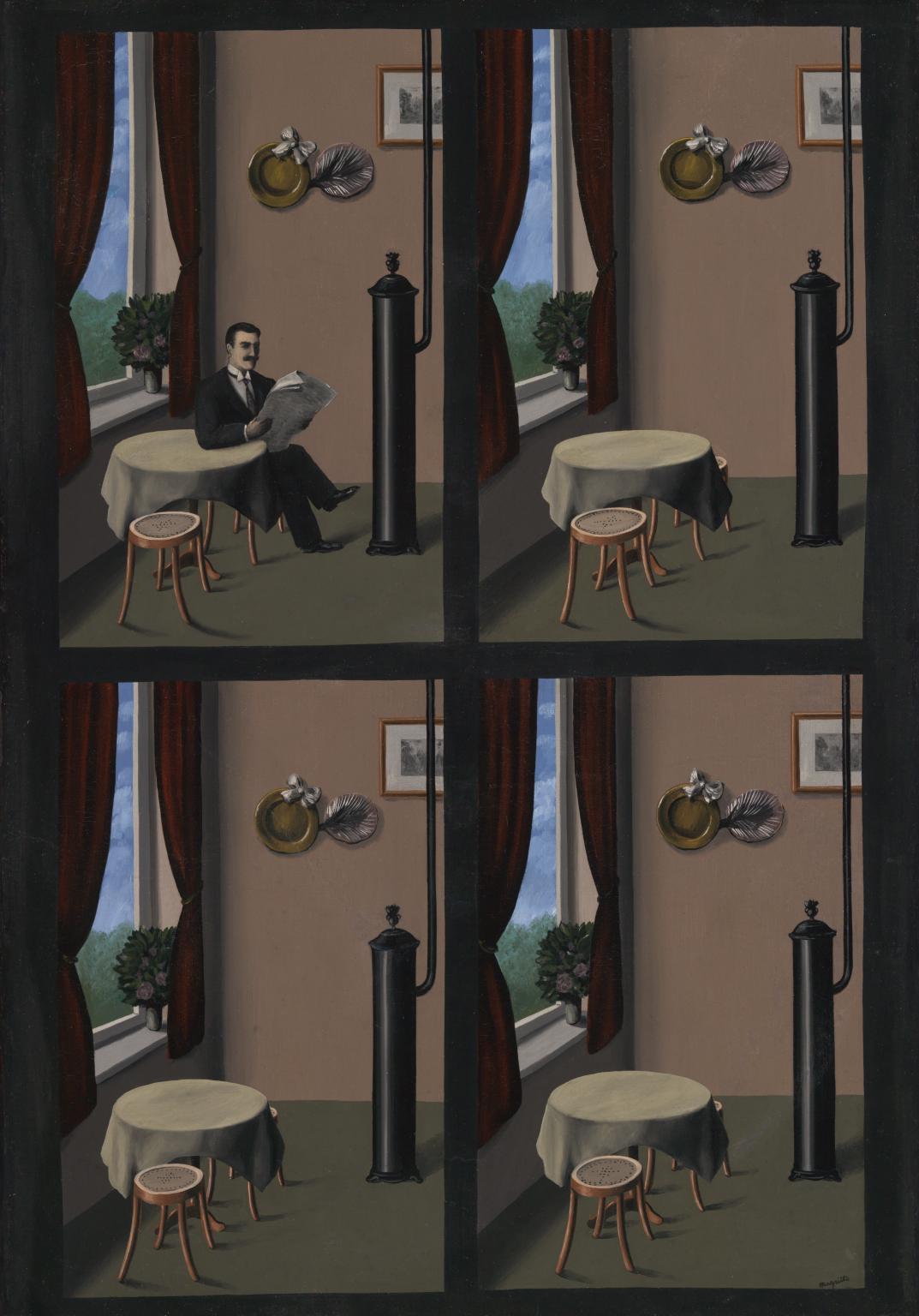
- Artist: René Magritte
- Date: 1928
- Medium: Oil paint on canvas
- Dimensions: support: 1156 × 813 mm
- Museum: Tate Modern
- Collection record: Tate Modern website
Listen to the free audio guide
About this artwork
This is the “Man with a Newspaper” by René Magritte, painted in 1928. It’s an oil on canvas that appears as four small, identical rooms stitched together. The first panel shows a man hunched over a newspaper, but in the other three the man simply vanishes—just a table, a stove, a window and a stool. The scene is flat and deadpan, the hallmark of Magritte’s early surrealist work.
What makes it tick is the subtle shift in perspective between the panels. If you focus on the windows, the angles tilt just enough to create a faint 3‑D feel, like a primitive stereoscope. That small change gives the whole image an unsettling, almost uncanny quality. Magritte was a master at quietly subverting the everyday; he preferred this quiet trickery over loud political gestures.
The painting was presented to the collection by the Friends of the Tate Gallery in 1964. It sits in the International Surrealism collection, a perfect example of how repetition and a missing figure can turn a mundane domestic scene into a puzzle about perception and mystery.
See it in person
Man with a Newspaper is in the collection of Tate Modern on Bankside, London — free to enter. Point your phone at any artwork there and audioguide.london plays a free audio guide in six languages — no app download needed.