Dish of Pears
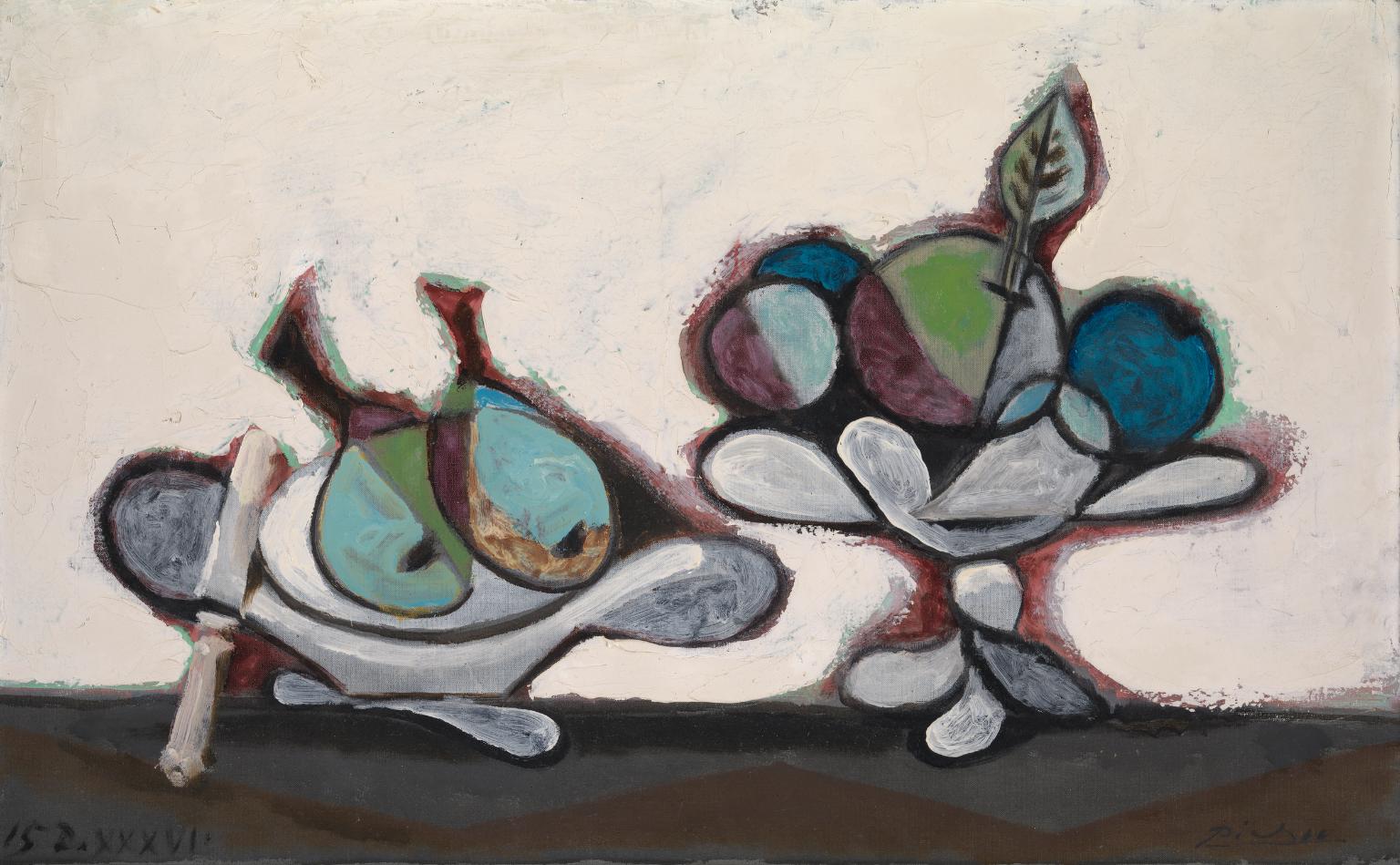
- Artist: Pablo Picasso
- Date: 1936
- Medium: Oil paint on canvas
- Dimensions: support: 380 x 610 mm
- Museum: Tate Modern
- Collection record: Tate Modern website
Listen to the free audio guide
About this artwork
This is the “Dish of Pears” by Pablo Picasso. It’s a still life painted in oil on canvas in 1936. Picasso laid out the bowls and pears with flat, graphic shapes. The background that looks white isn’t there from the start – it was added as the final layer, giving the fruit an implied space behind them instead of just a plain colour.
You’ll notice thick black lines around each bowl, pear and even inside the fruit. Those bold outlines separate the elements neatly, creating an almost abstract pattern of colours and shapes. It’s very characteristic of Picasso’s experimentations with Cubism: the surfaces feel like a collage made up of flat planes.
The piece measures 380 × 610 mm on canvas – a compact format that keeps the composition tight. The artist added inscriptions at the bottom left and right corners, marking it as “15D. XXXVI.” This work has been in the collection since Mrs A.F. Kessler bequeathed it in 1983.
In Picasso’s long career he returned to still lifes many times, always reworking his approach. Here we see one of those moments where simplicity and geometry meet – a quick snapshot into the artist’s evolving visual language.
See it in person
Dish of Pears is in the collection of Tate Modern on Bankside, London — free to enter. Point your phone at any artwork there and audioguide.london plays a free audio guide in six languages — no app download needed.


