Marilyn Diptych
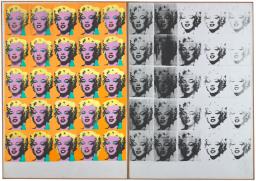
- Artist: Andy Warhol
- Date: 1962
- Medium: Alkyd ink, acrylic paint, oil ground and graphite on two canvases
- Dimensions: support (each): 2054 x 1448 x 20 mm
- Museum: Tate Modern
- Collection record: Tate Modern website
Listen to the free audio guide
About this artwork
This is the “Marilyn Diptych” by Andy Warhol, painted in 1962. In August that year Warhol was experimenting with screenprints in his New York studio. When Marilyn Monroe died the same month, he was shocked. He took a publicity photo of her from the 1953 film Niagara, shot by Gene Kornman, cropped the face and turned it into a series of graphic prints. He hand‑painted some and then over‑printed her face again and again. The result is two canvases: one in bright colour, the other in stark black and white. Each panel holds twenty‑five images in five rows, making the diptych a striking visual echo of Monroe’s own image.
Originally separate, the two panels were first purchased by collectors Burton and Emily Tremaine. Together they become a powerful meditation on celebrity, repetition, and mortality, hinting at a life lived both in front of and behind the spotlight.
See it in person
Marilyn Diptych is in the collection of Tate Modern on Bankside, London — free to enter. Point your phone at any artwork there and audioguide.london plays a free audio guide in six languages — no app download needed.