Long Grass with Butterflies
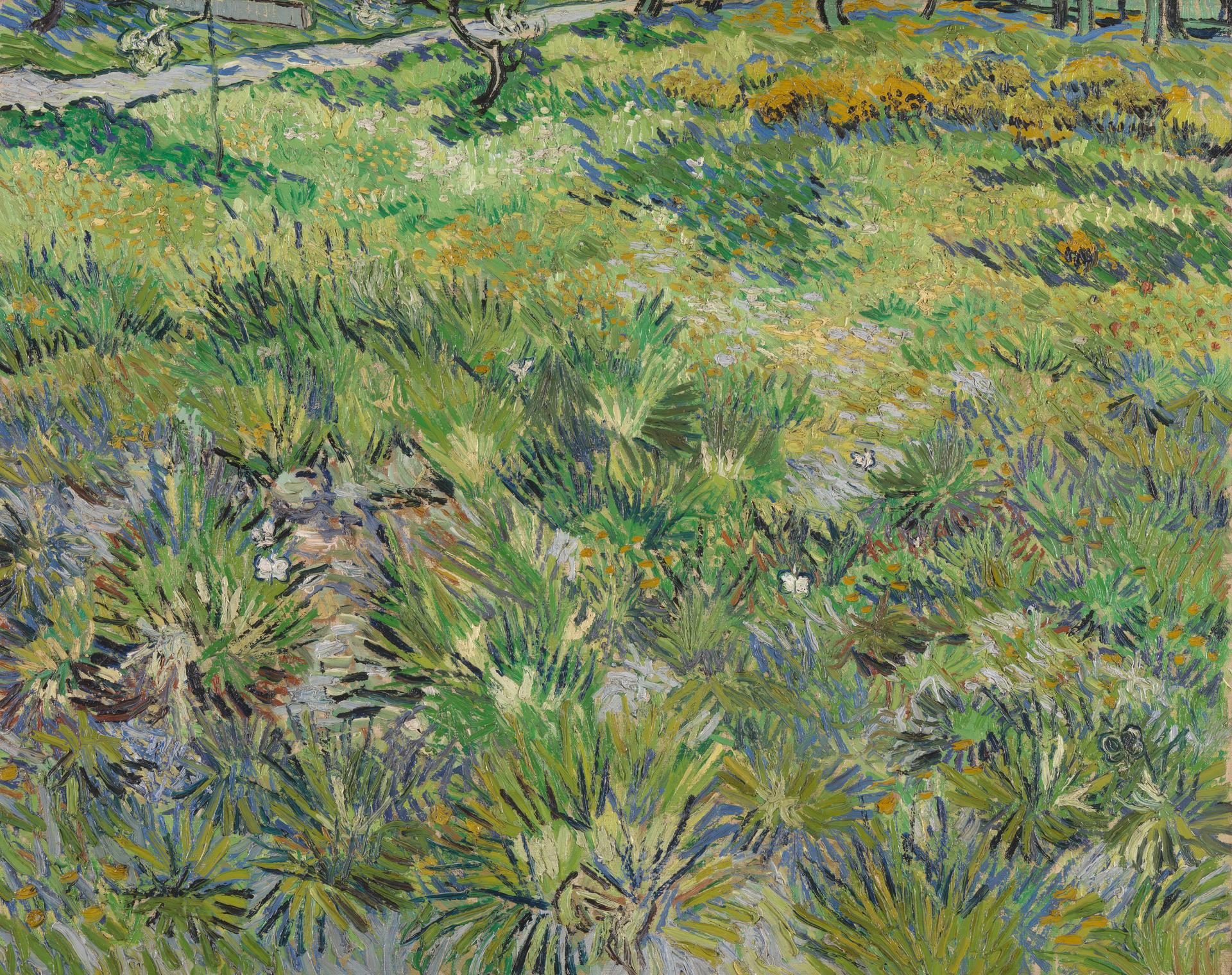
- Artist: Vincent van Gogh
- Date: 1890
- Medium: oil on canvas
- Museum: The National Gallery
- Collection record: The National Gallery website
Listen to the free audio guide
About this artwork
This is the "Long Grass with Butterflies" painted by Vincent van Gogh. Created in 1890, this work showcases Van Gogh's fascination with nature and his desire to capture its intricate details. When he was a patient at the psychiatric hospital at Saint-Paul de Mausole near St-Rémy in France, Van Gogh produced several sketches and paintings that focused on small areas of meadow or undergrowth.
In this painting, we see an enlarged detail of one of these grassy areas, with a path running almost parallel to the top edge of the canvas. This creates an effect of spatial depth, contrasting with the open space beyond the boundary formed by the path. The grass itself is painted with distinct brushstrokes of varying length, laid down in clusters that describe the clumps they depict.
Van Gogh's interest in nature was likely influenced by his reading about Japanese culture, where the 'wise Japanese man' studies a single blade of grass to understand its connection to the natural world. This painting reflects Van Gogh's own attempt to capture the beauty and complexity of nature through detailed brushwork and vivid colors.
Throughout this painting, we see an emphasis on texture and form, with the use of various greens, yellows, ochres, and whites to create a sense of depth and dimensionality. The short dashes and dots in the distance add to the overall effect of spatial depth.
See it in person
Long Grass with Butterflies hangs in The National Gallery on Trafalgar Square, London — free to enter. Point your phone at any artwork there and audioguide.london plays a free audio guide in six languages — no app download needed.