Late Medieval throne
- Gallery: Room 40
- Culture: Late Medieval
- Made in: Scandinavia
- Date: 1150 (circa); 14thC (mounts)
- Object type: throne
- Materials: walrus ivory; gold; metal; mineral
- Museum number: 1959,1202.1
- Museum: The British Museum
- Collection record: British Museum website
- Image © The Trustees of the British Museum, shared under a CC BY-NC-SA 4.0 licence.
Listen to the free audio guide
About this object
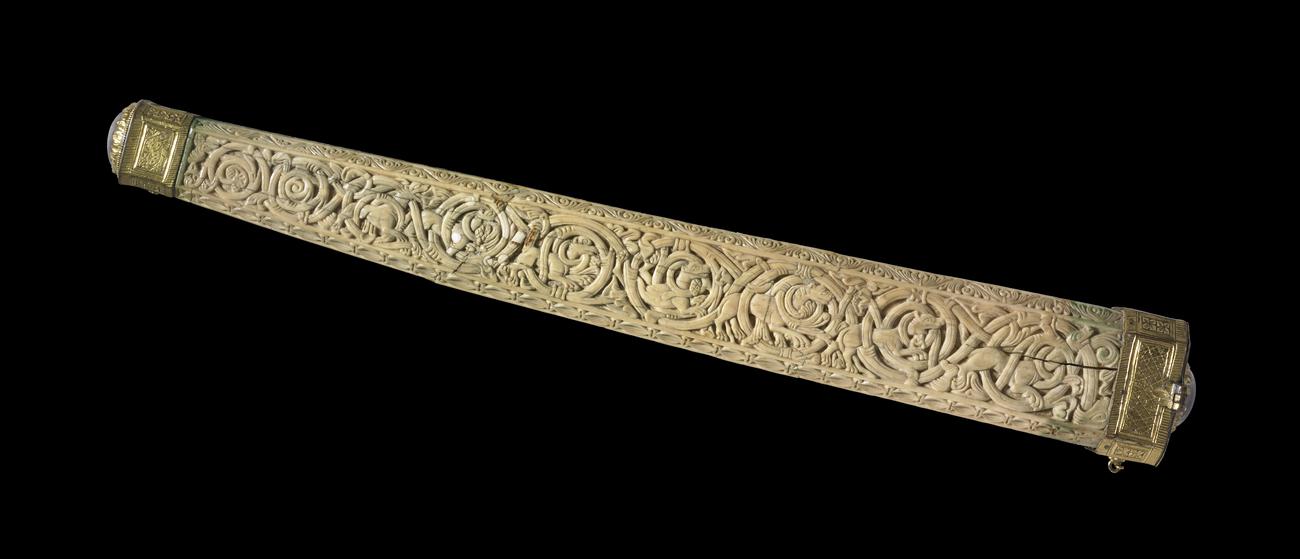
This is a piece of a Late Medieval throne, believed to come from Scandinavia. What you’re looking at is a fragment—possibly a leg—carved from a whole walrus tusk. At one end, the tusk was hollowed out and inlaid with bronze-gilt mounts, including a hinged lid secured by a pin and decorated with a crystal. Another crystal sits in the center.
The tusk shows signs of early repair. Green stains suggest copper was wrapped around the ends to strengthen them, likely because the tusk had already cracked before the bronze additions. The corners are neatly shaped, and all four sides are richly decorated with carved, scrolling patterns.
This kind of ornate decoration is similar to the famous Lewis Chessmen and other finds from the region. Around the middle of the 12th century, this may have been part of an ivory chair or throne. By the 14th century, it was repurposed—perhaps as a reliquary. It tells us much about medieval Scandinavian craftsmanship and the adaptation of decorative objects over time.
See it in person
Late Medieval throne is on display in Room 40 at the British Museum on Great Russell Street, Bloomsbury, London — free to enter. Choose British Museum on audioguide.london and take a photo of it to hear this free audio guide in six languages — no app download needed.
New, in beta. British Museum support has just launched and is still improving: over 1,000 objects so far, with more added all the time.