Lady Bampfylde
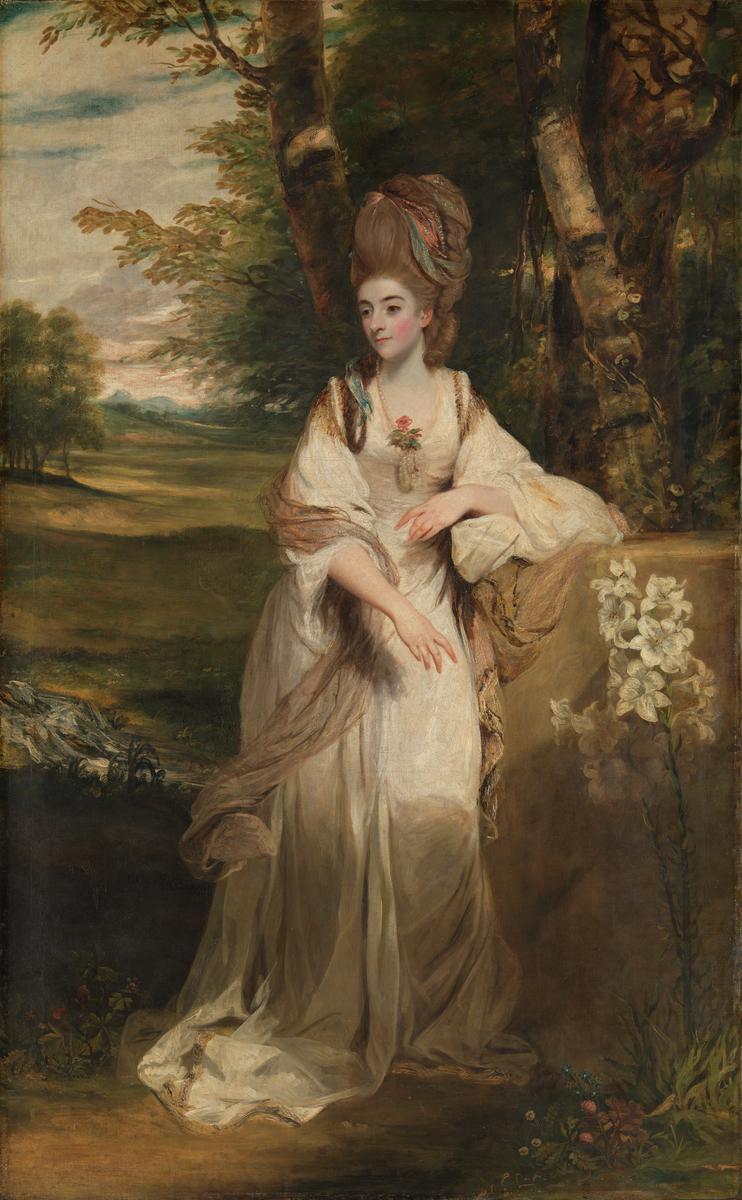
- Artist: Sir Joshua Reynolds
- Date: 1776–7
- Medium: Oil paint on canvas
- Dimensions: support: 2381 x 1480 mm
- Museum: Tate Britain
- Collection record: Tate Britain website
Listen to the free audio guide
About this artwork
This is the "Lady Bampfylde" by Sir Joshua Reynolds. The portrait captures Catherine Moore, who became Lady Bampfylde when she married Charles Warwick Bampfylde in 1776. Reynolds painted her with an unpowdered face but hair piled high, a fashion of the 1770s, and her right hand gestures toward a lily, the classic symbol of purity. Her pose echoes the Venus de’ Medici, with the left arm resting on a stone pedestal, creating a subtle echo of classical modesty and strength.
Reynolds noted only one meeting with her in his pocket book in April 1777, so the painting was probably completed quickly after their wedding. The rich white draperies and the delicate floral arrangement—lily, daisies, gentians, and tiny dahlia—add to the idealized wedding scene.
Despite the flattering image, her marriage was troubled. Rumors of extravagance and infidelity surfaced by 1778, and she and Charles separated after their son’s birth in 1787. In 1823, a servant murdered Charles, and Lady Bampfylde never remarried, passing away in 1832. The painting, therefore, stands as a contrast between public grace and private hardship.
See it in person
Lady Bampfylde is in the collection of Tate Britain on Millbank, London — free to enter. Point your phone at any artwork there and audioguide.london plays a free audio guide in six languages — no app download needed.