Hope
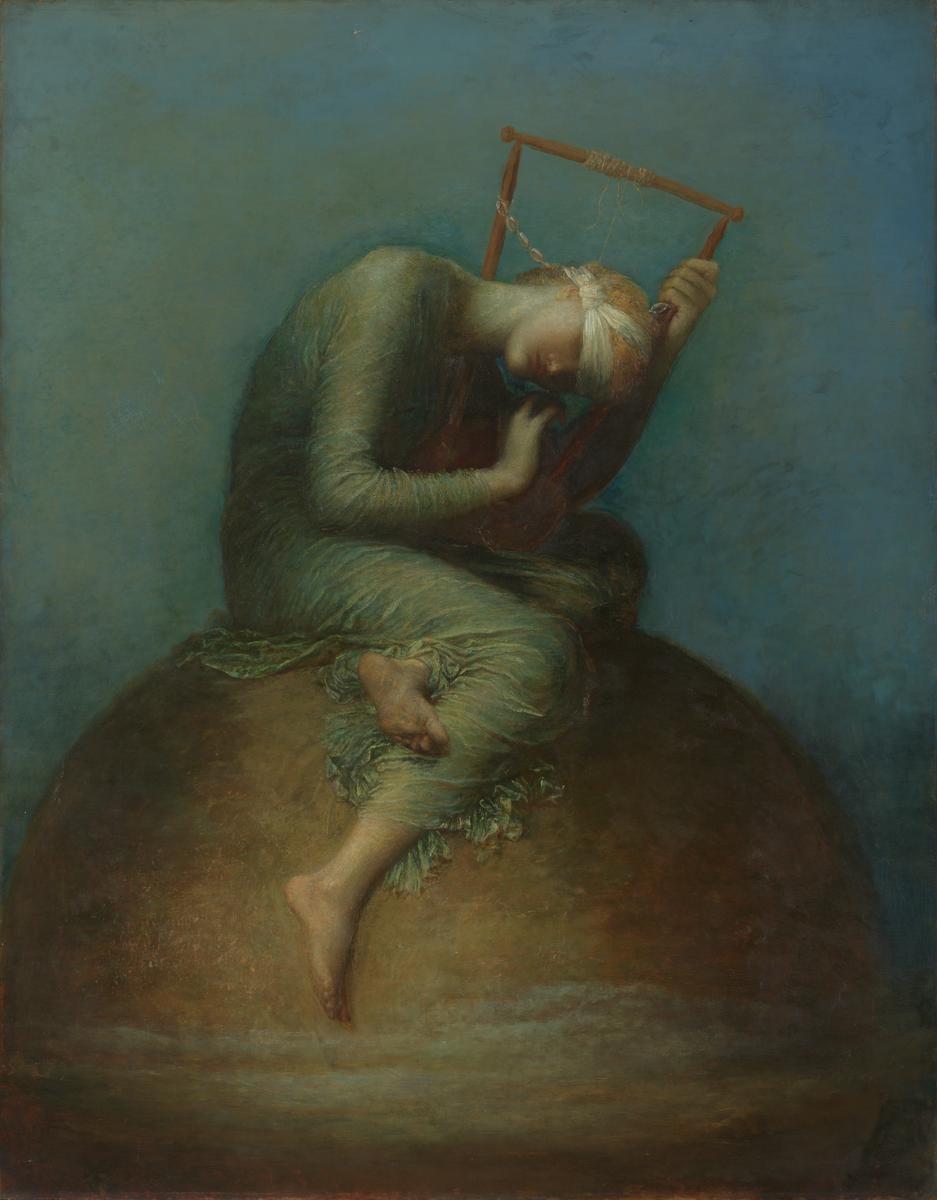
- Artist: George Frederic Watts and assistants
- Date: 1886
- Medium: Oil paint on canvas
- Dimensions: support: 1422 x 1118 mm
- Museum: Tate Britain
- Collection record: Tate Britain website
Listen to the free audio guide
About this artwork
This is the “Hope” by George Frederic Watts and assistants, painted in 1886. In the canvas, a blindfolded woman sits on a floating globe, clutching a lyre whose strings are all broken except one. Her head is bowed, ears cupped, listening to the faint chord that the sole string produces. Watts wanted to move beyond the usual anchor symbol and showed Hope as a quiet, almost mournful musician, hinting that true hope can be found in the music that survives the ruins.
Critics at the time argued the work felt more like “Despair.” Watts responded that the piece speaks not of expectancy but of the song that can arise from a single surviving note. The painting was a hit at the 1889 Paris Exposition Universelle, winning admiration worldwide and becoming a common motif in Victorian homes. Its influence spread far: Pablo Picasso drew from it when creating *The Old Guitarist* (1903–04), and, oddly enough, former President Barack Obama later said it helped inspire his entry into politics.
The work is oil on canvas, roughly 1.4 m wide, and exemplifies Watts’s penchant for allegory and subtle melancholy, all wrapped in soft brushwork and translucent mists that give the globe a dreamlike quality.
See it in person
Hope is in the collection of Tate Britain on Millbank, London — free to enter. Point your phone at any artwork there and audioguide.london plays a free audio guide in six languages — no app download needed.