Homer Reciting his Poems
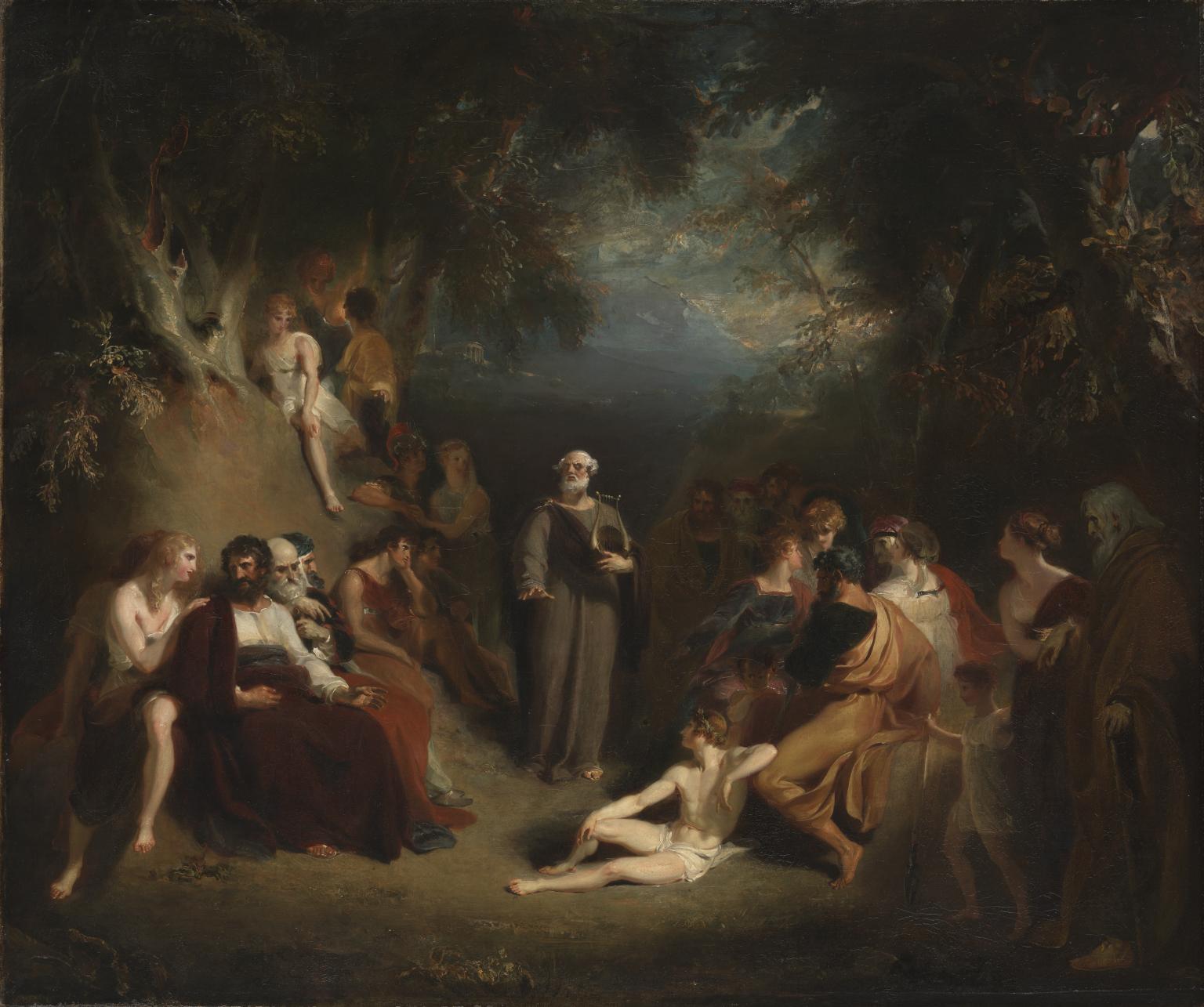
- Artist: Sir Thomas Lawrence
- Date: 1790
- Medium: Oil paint on canvas
- Dimensions: support: 940 x 1111 mm
- Museum: Tate Britain
- Collection record: Tate Britain website
Listen to the free audio guide
About this artwork
This is “Homer Reciting his Poems” by Sir Thomas Lawrence, painted in 1790. It’s an early oil‑on‑canvas that shows the famed Greek poet standing in a sun‑dappled woodland, delivering lines from the Iliad to a small, attentive audience. Lawrence’s choice of a natural setting echoes the classical landscape tradition, while the surrounding figures reflect his aspiration to history painting – a goal that was still in development at the time.
In the foreground you’ll notice a striking nude youth. That figure is not a fanciful ideal but a portrait of the well‑known pugilist John Jackson, whose muscular form Lawrence captured with a painterly reverence for Michelangelo’s figures. The pose and the careful rendering of muscle groups nod to the classical canon, lending the scene a sculptural quality that would become a hallmark of Lawrence’s later portraiture.
Lawrence painted this work for the connoisseur Richard Payne Knight, whose taste for antiquity shaped the subject choice. The painting first appeared in a Royal Academy exhibition in 1791, where it received mixed reviews—some praised its drawing and colour, others felt it lacked sentiment. Despite the criticism, the fluid brushwork and glowing palette presage the elegant, luminous style that Lawrence would master in his mature portraits.
See it in person
Homer Reciting his Poems is in the collection of Tate Britain on Millbank, London — free to enter. Point your phone at any artwork there and audioguide.london plays a free audio guide in six languages — no app download needed.