Hélène Rouart in her Father's Study
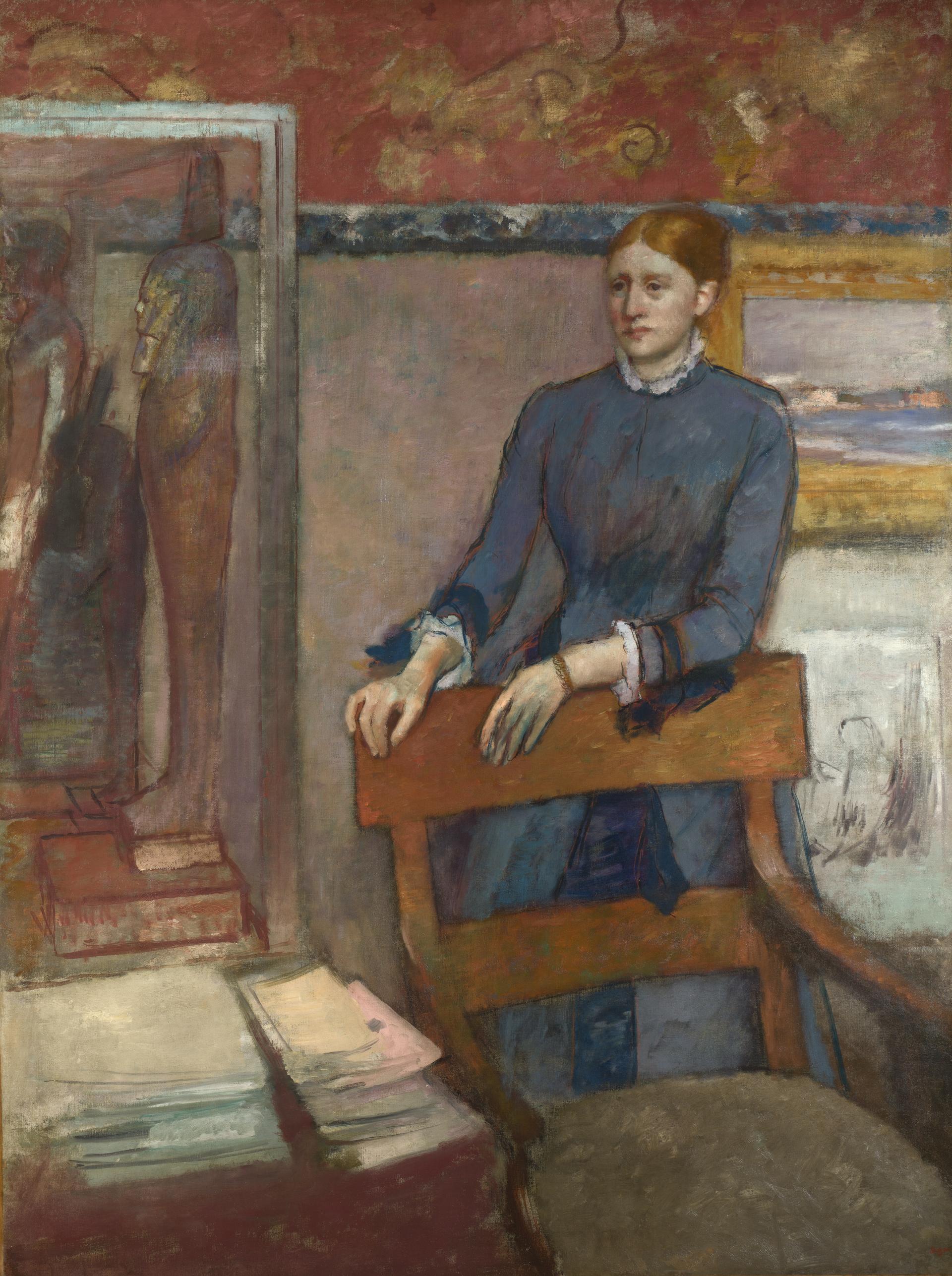
- Artist: Hilaire-Germain-Edgar Degas
- Date: about 1886
- Medium: oil on canvas
- Museum: The National Gallery
- Collection record: The National Gallery website
Listen to the free audio guide
About this artwork
This is the Hélène Rouart in her Father's Study by Degas. Painted around 1886, it's a beautiful example of his work from this period. The painting shows Hélène standing in her father's study, her hands resting on the back of his empty chair. You can see works from her father's art collection behind her - three Egyptian statues in a glass case and a Chinese wall hanging above.
The chair itself has an interesting history. It came from Madame Rouart's father, a cabinet maker. Degas may have also been inspired by portraits by Van Dyck that show women standing by chairs. The empty chair is a clever way to refer to an absent loved one.
Notice the carefully chosen works from Henri Rouart's collection behind Hélène. There's Corot's Castel dell'Ovo in Naples, which was likely known to Degas and the Rouarts. Below it is a drawing by Millet of a peasant girl, which may have inspired the choice of Hélène's blue dress.
The Chinese silk wall-hanging at the top of the picture helps bind the composition together with its warm red tones. On the left side are three wooden Egyptian statues in a glass case - Degas exaggerated their size for dramatic effect.
This is a painting of paradoxes, really. While it's a portrait of Hélène, her environment says more about her father and Degas himself. The slight tilt of her stance and position of her head echo the Egyptian statues. She doesn't meet our gaze, instead looking into the distance with an air of sadness - possibly a reference to the recent death of her mother.
See it in person
Hélène Rouart in her Father's Study hangs in The National Gallery on Trafalgar Square, London — free to enter. Point your phone at any artwork there and audioguide.london plays a free audio guide in six languages — no app download needed.