Group of Peasants
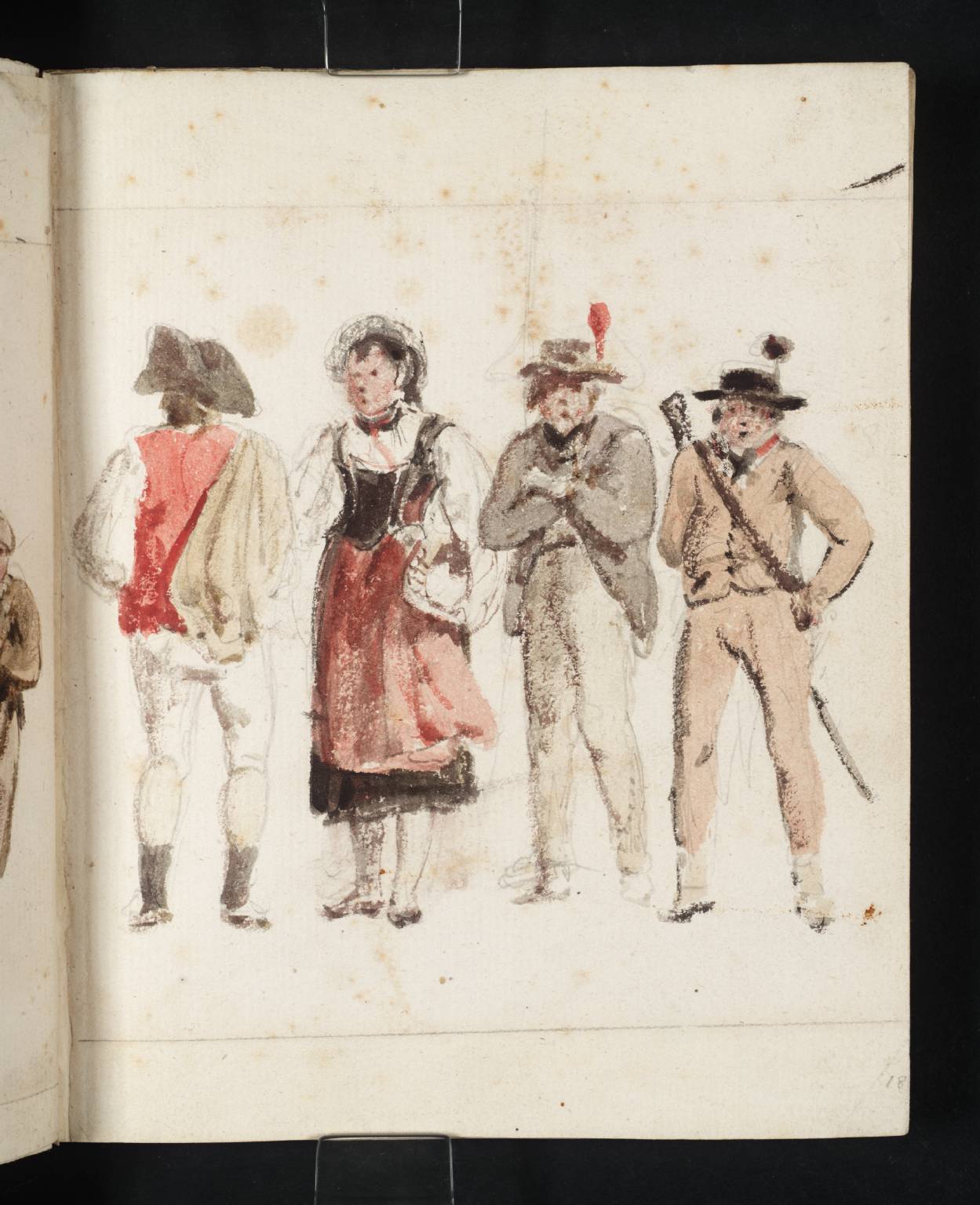
- Artist: Joseph Mallord William Turner
- Date: 1802
- Medium: Graphite and watercolour on paper
- Dimensions: support: 198 x 163 mm
- Museum: Tate Britain
- Collection record: Tate Britain website
Listen to the free audio guide
About this artwork
This is the “Group of Peasants” by Joseph Mallord William Turner, drawn in 1802. It’s a quick graphite and watercolour sketch, only 198 by 163 mm, a tiny study that captures a lively scene from a Swiss village. Turner, who was traveling through Switzerland at the time, records the villagers in their everyday dress: a woman in a simple apron, a man holding a rifle, a few men and a woman wearing hats that hint at local fashion. Their postures are natural—some standing, others leaning on a post—showing Turner’s interest in motion and the way light falls on ordinary people.
The work is part of Turner’s “Swiss Figures Sketchbook,” a collection of sketches that he made while exploring the countryside. It shows how he observed everyday life, not just grand landscapes, and how he could translate that observation into a subtle blend of graphite strokes and delicate washes. The piece was later accepted into the Turner Bequest in 1856, cementing its place in the national collection. It’s a wonderful example of Turner’s early ability to capture character and atmosphere in a single, modest sheet of paper.
See it in person
Group of Peasants is in the collection of Tate Britain on Millbank, London — free to enter. Point your phone at any artwork there and audioguide.london plays a free audio guide in six languages — no app download needed.