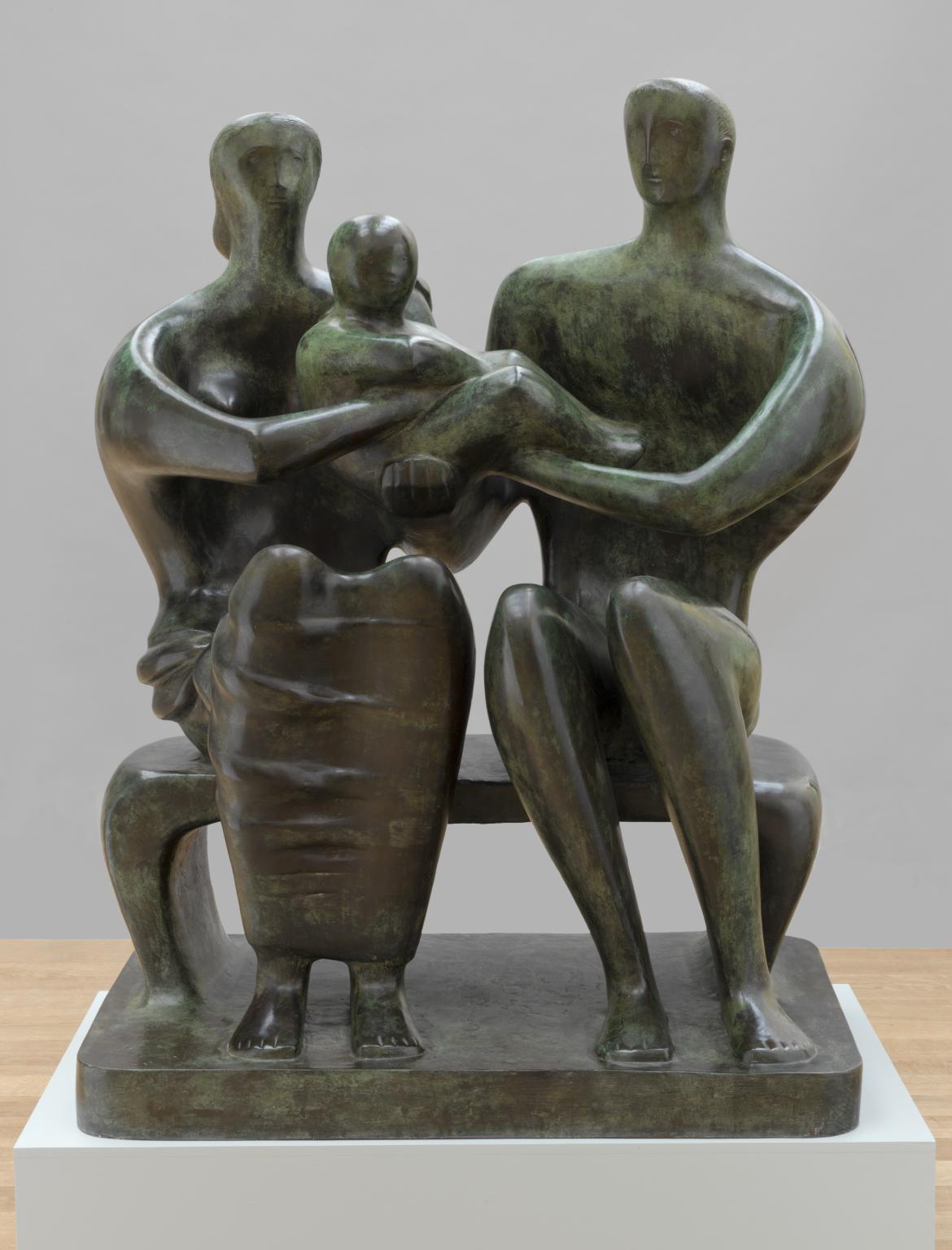
Family Group
- Artist: Henry Moore OM, CH
- Date: 1949, cast 1950–1
- Medium: Bronze
- Dimensions: object: 1540 x 1180 x 700 mm, 475 kg
- Museum: Tate Britain
- Collection record: Tate Britain website
Listen to the free audio guide
About this artwork
This is “Family Group” by Henry Moore OM, CH. The sculpture comes from a series of maquettes Moore created in the late 1940s while working on a design for Impington Village College in Cambridgeshire; none of those early models were accepted. A few years later he was asked to produce a work for Barclay Secondary School in Stevenage, and he returned to the same family theme. The bronze figures were cast in an edition of four between 1950 and 1951. One piece remains at the school, another went to the Museum of Modern Art in New York, a third to Nelson D Rockefeller, and the fourth is here in the collection.
Moore’s figures sit close together on a shallow platform; each body has the sculptor’s characteristic flattened planes and elongated limbs. The three adults—man, woman, and child—are arranged in a relaxed stance that suggests intimacy, while two little boys sit cross‑legged to the right of a bench, adding a touch of domestic rhythm. The cast is a light bronze with subtle patina from exposure; its weight, 475 kg, gives it a solid presence on the floor.
The piece was purchased in 1950 and has been displayed in several shows over the decades, including a 2002–2003 exhibition that highlighted Moore’s work in the 1940s. The sculpture exemplifies his move toward simplified human form and his fascination with domestic scenes, making it one of the most accessible works from his later period.
See it in person
Family Group is in the collection of Tate Britain on Millbank, London — free to enter. Point your phone at any artwork there and audioguide.london plays a free audio guide in six languages — no app download needed.