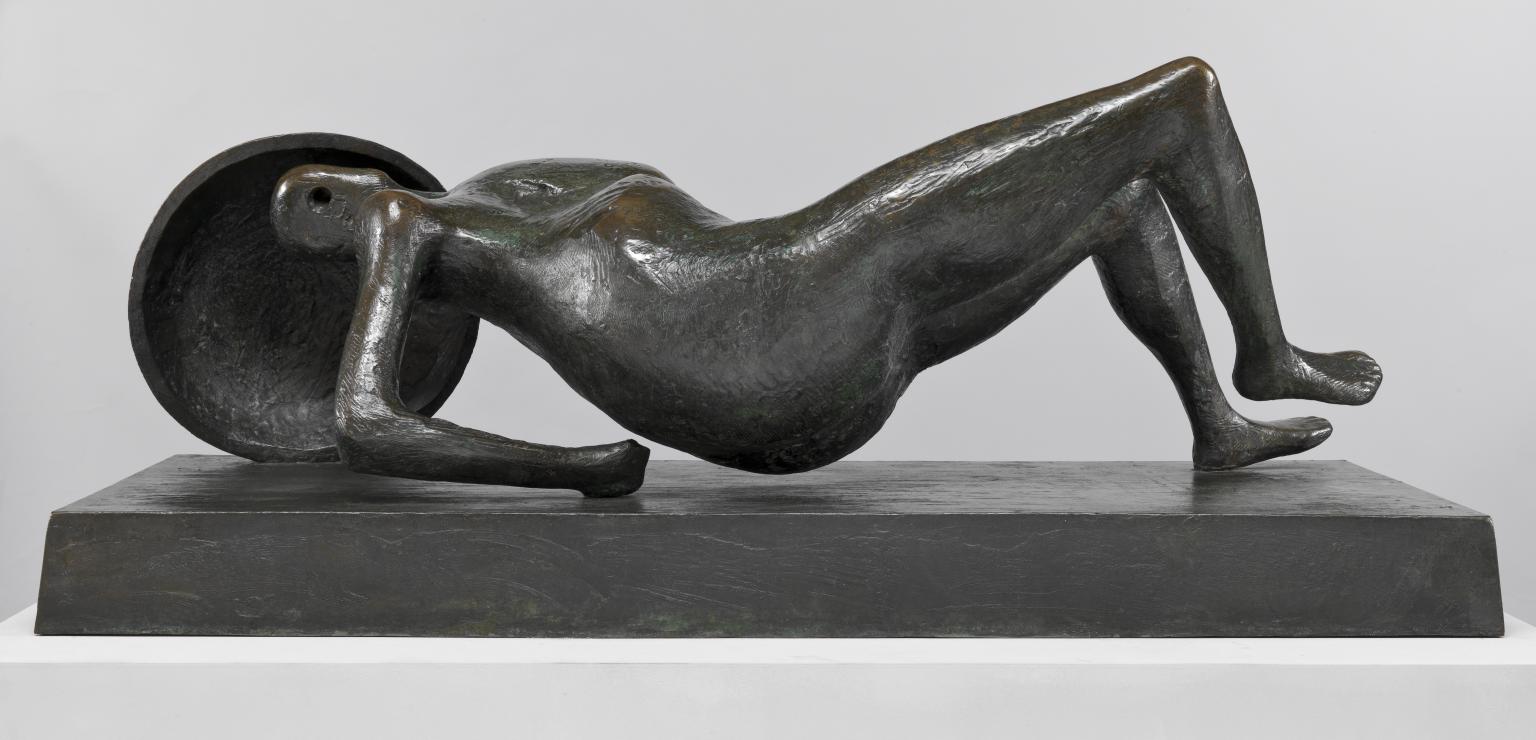
Atom Piece (Working Model for Nuclear Energy)

- Artist: Henry Moore OM, CH
- Date: 1964–5, cast 1965
- Medium: Bronze
- Dimensions: object: 1270 x 920 x 920 mm
- Museum: Tate Britain
- Collection record: Tate Britain website
Listen to the free audio guide
About this artwork
This is the “Atom Piece (Working Model for Nuclear Energy)” by Henry Moore. Cast in bronze in 1965, the sculpture measures about 1.27 m long, 0.92 m high and 0.92 m wide—an impressive scale for a working model. In 1963 the University of Chicago invited Moore to create a piece commemorating its first controlled nuclear reaction, carried out there in 1942. The result was a large-scale prototype for his later work *Nuclear Energy*, unveiled in 1967.
Moore intended the form to capture “a contained power and force” appropriate to the subject. Its upper mass echoes both a human skull and a mushroom cloud, hinting at the duality of creation and destruction. One of seven casts was bought by the city of Hiroshima in 1987, linking the piece directly to the place forever marked by nuclear fire.
The sculpture now rests in the Henry Moore room (room 22) of Tate Britain, where visitors can appreciate its robust bronze surface and the way its silhouette sweeps toward a high point that suggests both the atom’s core and an upward burst. This work exemplifies Moore’s ability to fuse large-scale abstraction with concrete historical reference, making it a striking anchor in the collection.
See it in person
Atom Piece (Working Model for Nuclear Energy) is in the collection of Tate Britain on Millbank, London — free to enter. Point your phone at any artwork there and audioguide.london plays a free audio guide in six languages — no app download needed.