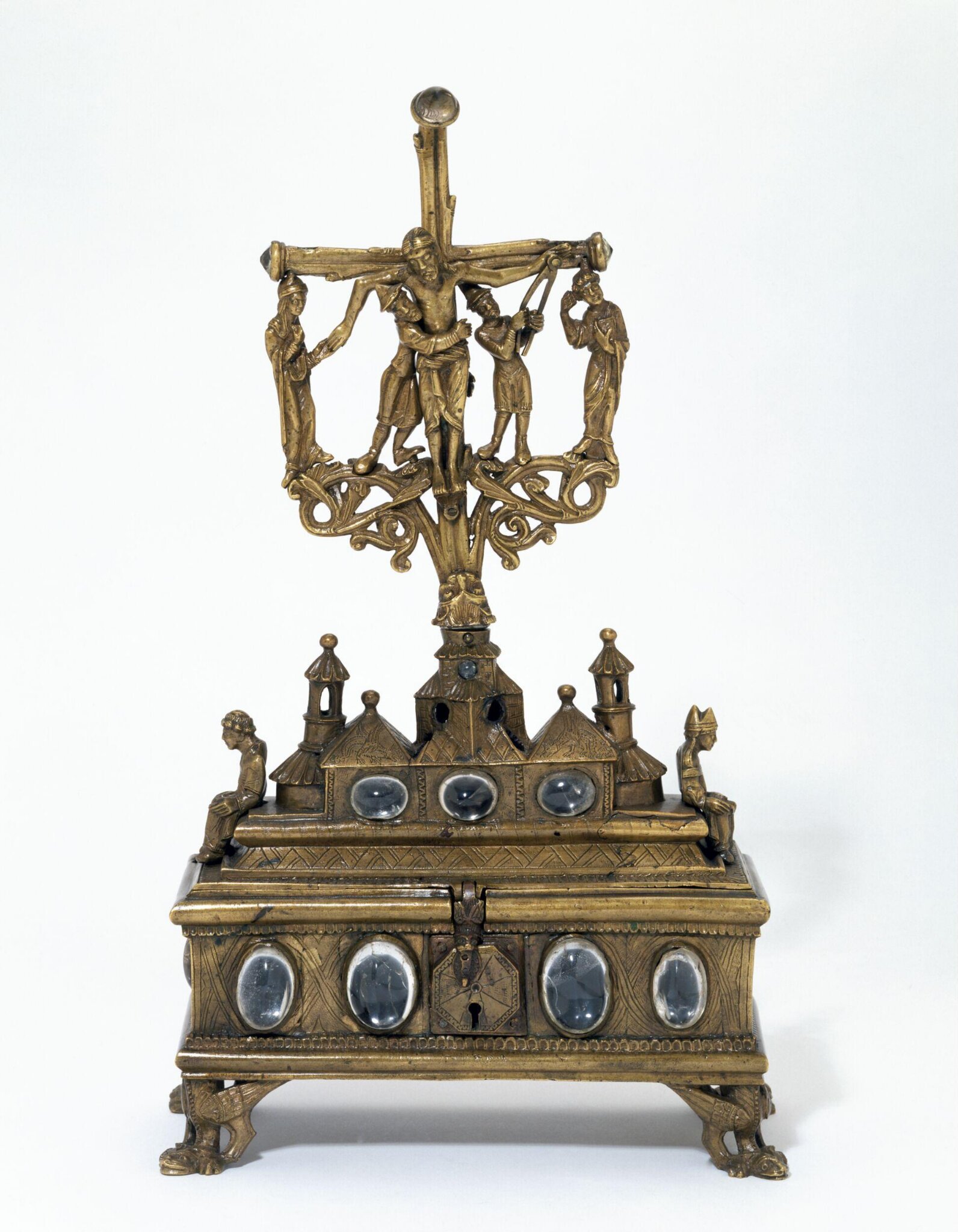
Eucharistic container with Deposition
- Gallery: Medieval & Renaissance, Room 8, The William and Eileen Ruddock Gallery
- Made in: Mosan
- Date: ca. 1150
- Object type: Reliquary
- Materials: Bronze, rock crystal, silk and gilt
- Dimensions: Height 44.5 cm; Width 25.5 cm; Depth 11.6 cm
- Museum: V&A South Kensington
- Collection record: V&A website
- Image © Victoria and Albert Museum, London.
Listen to the free audio guide
In the museum now? Point your phone at the next object and hear its guide.
About this object
Before you is a remarkable bronze container from the Mosan region, dating to around 1150. While often described as a reliquary, it likely functioned as a vessel for the consecrated bread used during the Mass.
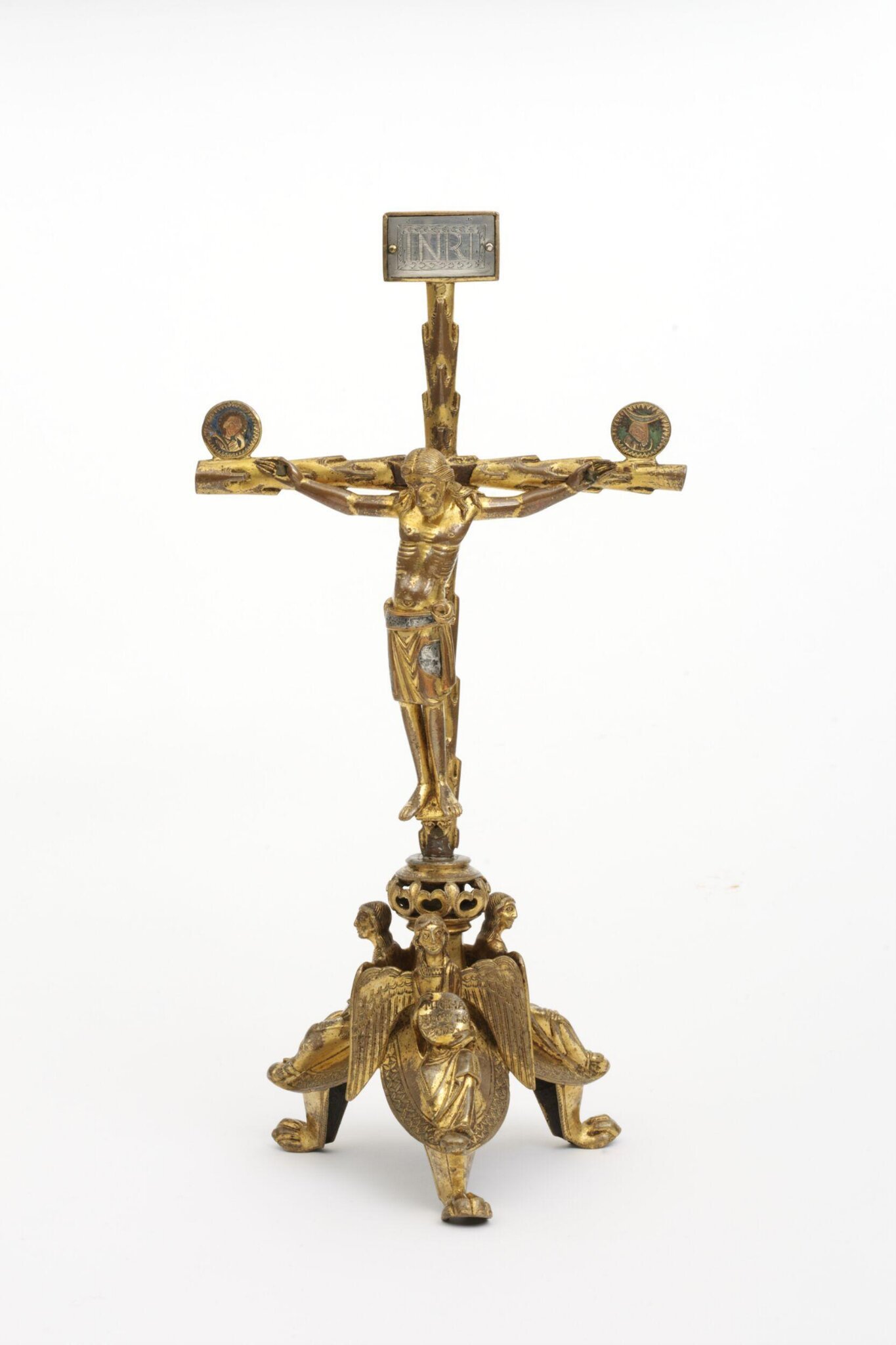
The object is composed of two main parts. At the top, a sprouting cross represents the Tree of Life. This symbolizes Christ's sacrifice as redemption for original sin. You can see the Deposition scene unfolding here: Joseph of Arimathea supports Christ's waist, while Nicodemus uses pliers to remove a nail from his hand. They are flanked by the mourning Virgin Mary and Saint John.
The lower section is a rectangular chest shaped like a sarcophagus, representing Christ's tomb. The lid is decorated with small buildings and rock crystal buds, while the base features large, oval crystals and four feet shaped like winged monsters. Inside the chest, you can still see traces of silk. This entire piece, once gilded, serves as a powerful visual connection between the liturgy of the Mass and the Holy Sepulchre.
See it in person
Eucharistic container with Deposition is on display in Medieval & Renaissance, Room 8, The William and Eileen Ruddock Gallery at the V&A South Kensington on Cromwell Road, London — free to enter. Choose V&A South Kensington on audioguide.london and take a photo of it to hear this free audio guide in six languages — no app download needed.
New, in beta. V&A support has just launched and is still improving: 1,000 objects with audio so far, with more added all the time.