Dido and Aeneas
- Artist: Joseph Mallord William Turner
- Date: exhibited 1814
- Medium: Oil paint on canvas
- Dimensions: support: 1460 x 2372 mm
- Museum: Tate Britain
- Collection record: Tate Britain website
Listen to the free audio guide
About this artwork
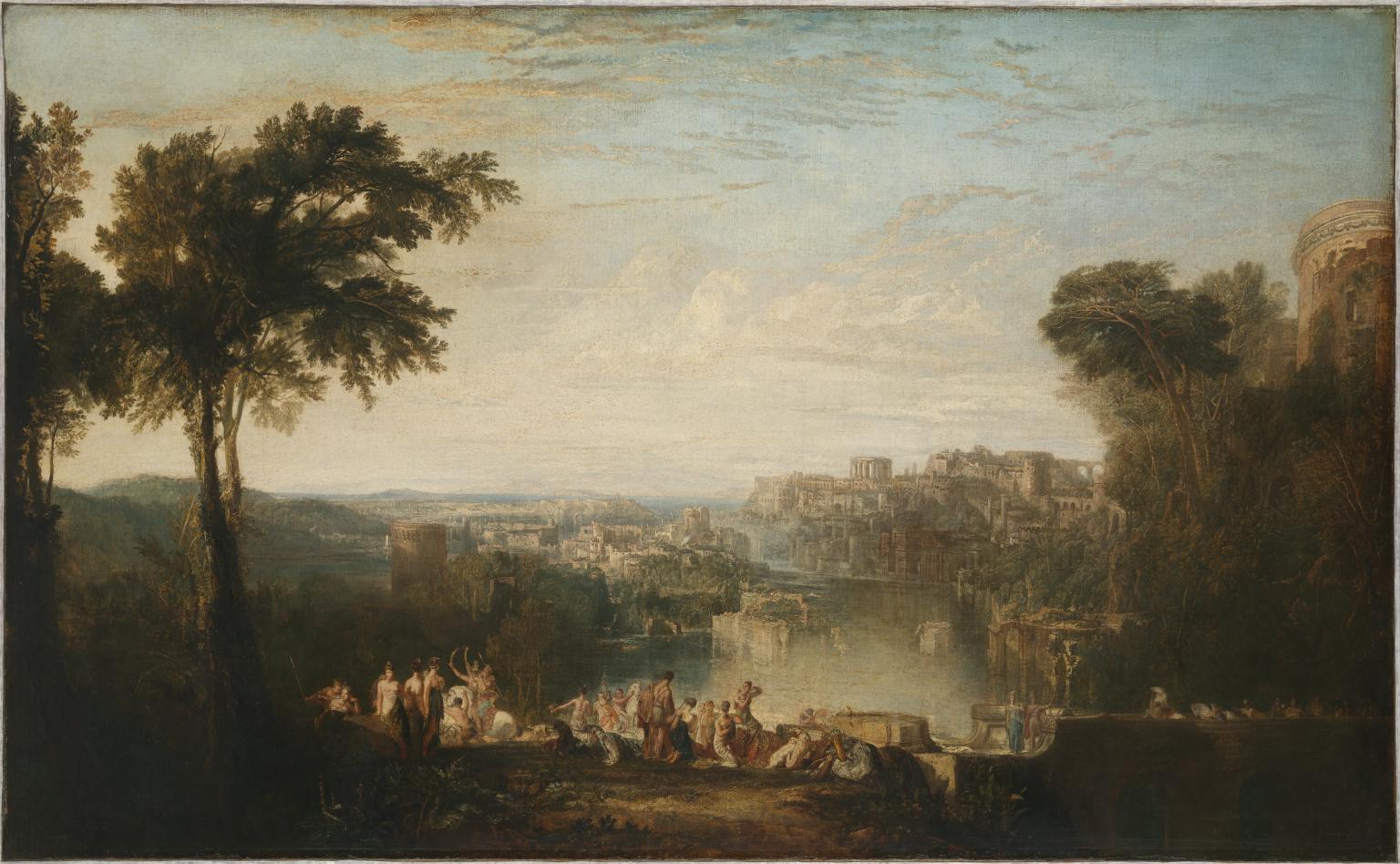
This is the “Dido and Aeneas” by Joseph Mallord William Turner, painted in 1814. It’s a massive oil on canvas – about 1460 mm by 2372 mm – a size that shows Turner was already a major figure and could set out a big statement about landscape. The golden glow and tall trees framing the horizon nod to Claude Lorrain, a lifelong influence on Turner, and give the scene a classical, almost timeless feel.
Turner imagines the city of Carthage on the North African coast, a dramatic backdrop for the story from Virgil’s *Aeneid*. In the lower right corner you’ll spot Dido, Queen of Carthage, and the heroic Aeneas, rendered in cool blues and pale reds. The composition balances the bustling city with the tranquil sea, showcasing Turner’s belief that landscape could be both grand and intimate.
The work was exhibited in 1814, when Turner was solidifying his reputation. It later entered the Tate’s Turner Bequest in 1856, a testament to its importance. The painting captures both a historical moment and Turner’s innovative approach to light and atmosphere, making it a cornerstone of early 19th‑century British art.
See it in person
Dido and Aeneas is in the collection of Tate Britain on Millbank, London — free to enter. Point your phone at any artwork there and audioguide.london plays a free audio guide in six languages — no app download needed.