Childe Harold’s Pilgrimage - Italy
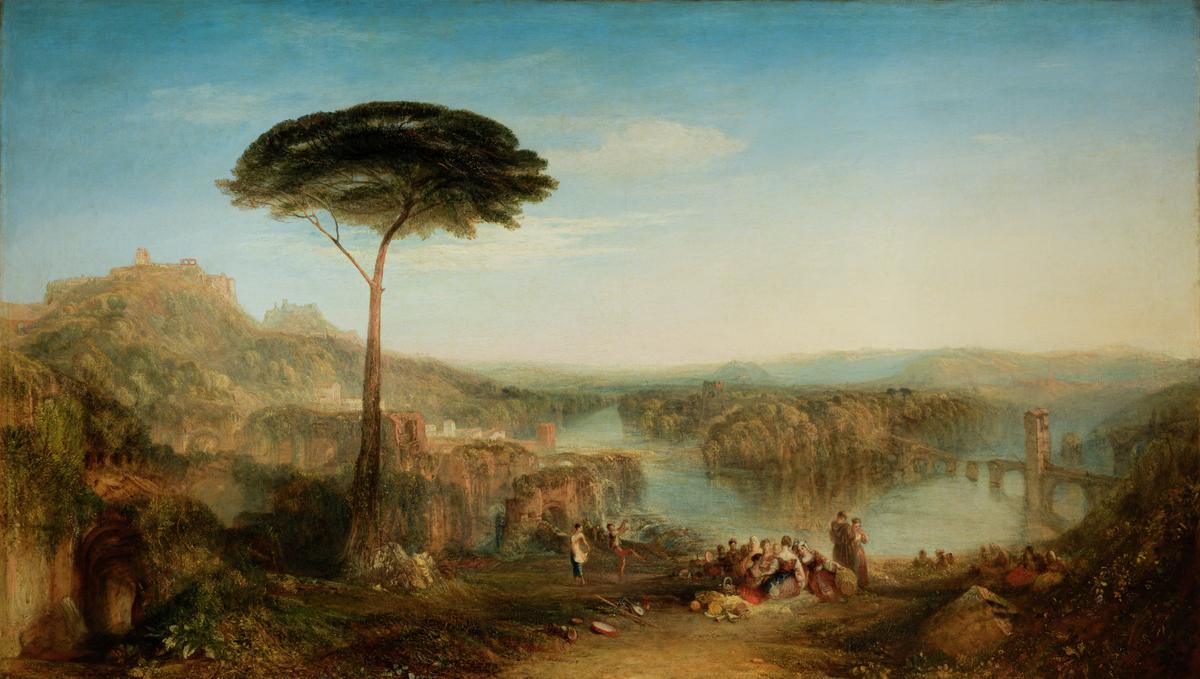
- Artist: Joseph Mallord William Turner
- Date: exhibited 1832
- Medium: Oil paint on canvas
- Dimensions: support: 1422 x 2483 mm
- Museum: Tate Britain
- Collection record: Tate Britain website
Listen to the free audio guide
About this artwork
This is the “Childe Harold’s Pilgrimage – Italy” by Joseph Mallord William Turner. Painted in 1832 as an oil on canvas, the work exploded in popularity at the Royal Academy – people were told to arrive at opening time just to beat the crowd. Turner's signature luminosity, that “red glow” that some critics found fatiguing, immediately made headlines. Yet others praised the bold, almost theatrical, colours, calling the scene a “poetry of art and nature” in the words of the Spectator. The painting even incorporates a fragment of Byron’s poem – “and now, fair Italy! / Thou are the garden of the world… ” – lending a lyrical frame to the landscape. Beneath the dramatic sky, a ruined bridge spans a river, and a small vase, once pasted on paper, is painted over, hinting at the layered process Turner employed. Critics debated whether the intense hues were “monotonous” or “gorgeous”, but all agreed the work captured the spirit of Italy in a way that was both visionary and evocative. Accepted by the nation as part of the Turner Bequest in 1856, it remains a vivid testament to the Romantic obsession with light and place.
See it in person
Childe Harold’s Pilgrimage - Italy is in the collection of Tate Britain on Millbank, London — free to enter. Point your phone at any artwork there and audioguide.london plays a free audio guide in six languages — no app download needed.