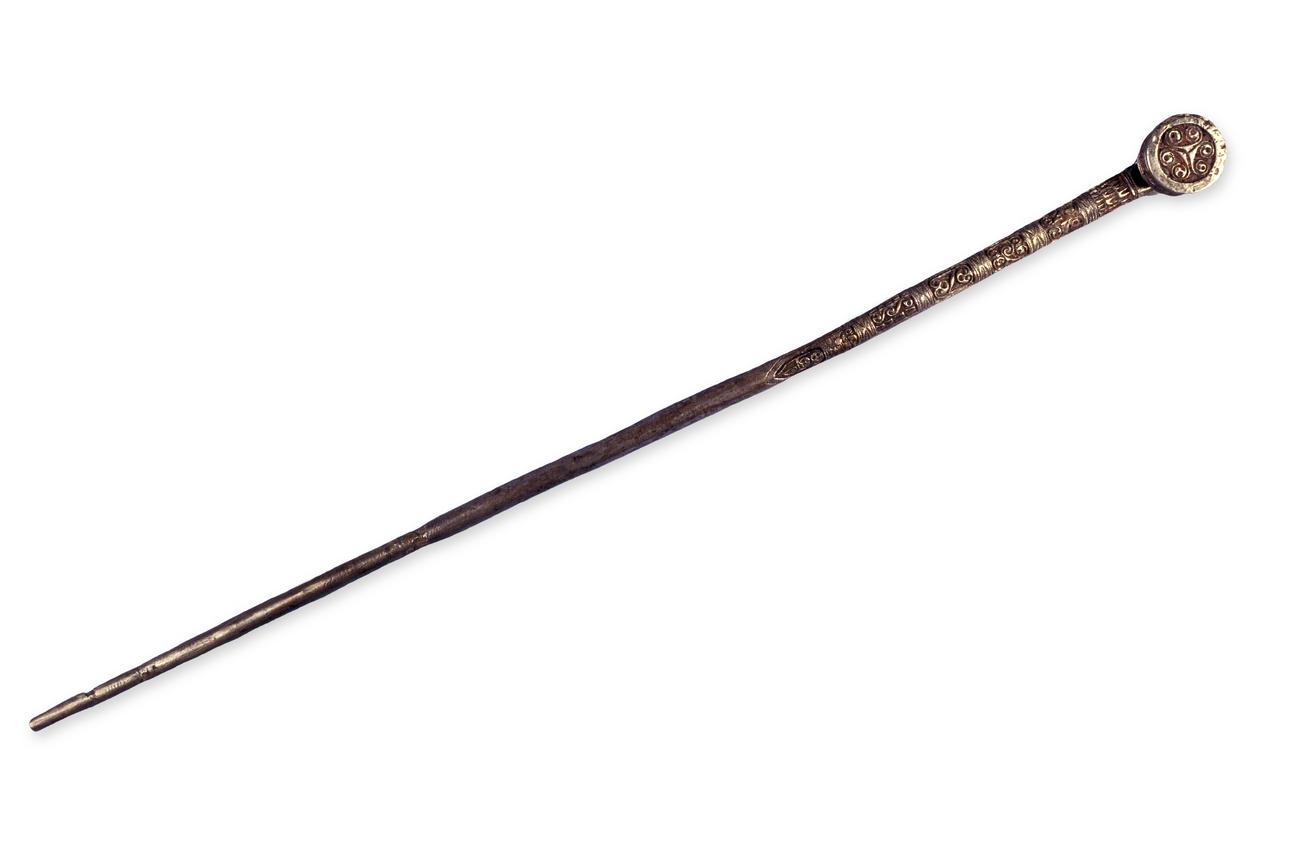
Celtic pin
- Gallery: Room 41
- Culture: Celtic
- Date: 5thC
- Object type: pin
- Materials: silver; enamel
- Museum number: 1888,0719.100
- Museum: The British Museum
- Collection record: British Museum website
- Image © The Trustees of the British Museum, shared under a CC BY-NC-SA 4.0 licence.
Listen to the free audio guide
About this object
This is a Celtic pin, dated to the fifth century. It is made of silver, with a disc-like head and a right-angled projection at the top of the shank. The topmost parts feature incised decoration—small panels filled with toothed and curving patterns, alternating with plainer designs of saltires, triangles, and circular stamps.
You may notice red enamel filling some of the incised designs. Scientific analysis confirms that the enamel was crucially important in early medieval metalwork. The pin also has three ancient repair marks, showing it has endured over time.
Though found in Ireland, the pin's use of silver and its design features, like saltires and stamped motifs, suggest links to Scotland’s Pictish styles. Art historians connect it to an unknown workshop known for similar ornamental details.
This pin is not only a functional artifact but also a finely crafted example of early medieval Celtic artistry.
See it in person
Celtic pin is on display in Room 41 at the British Museum on Great Russell Street, Bloomsbury, London — free to enter. Choose British Museum on audioguide.london and take a photo of it to hear this free audio guide in six languages — no app download needed.
New, in beta. British Museum support has just launched and is still improving: over 1,000 objects so far, with more added all the time.