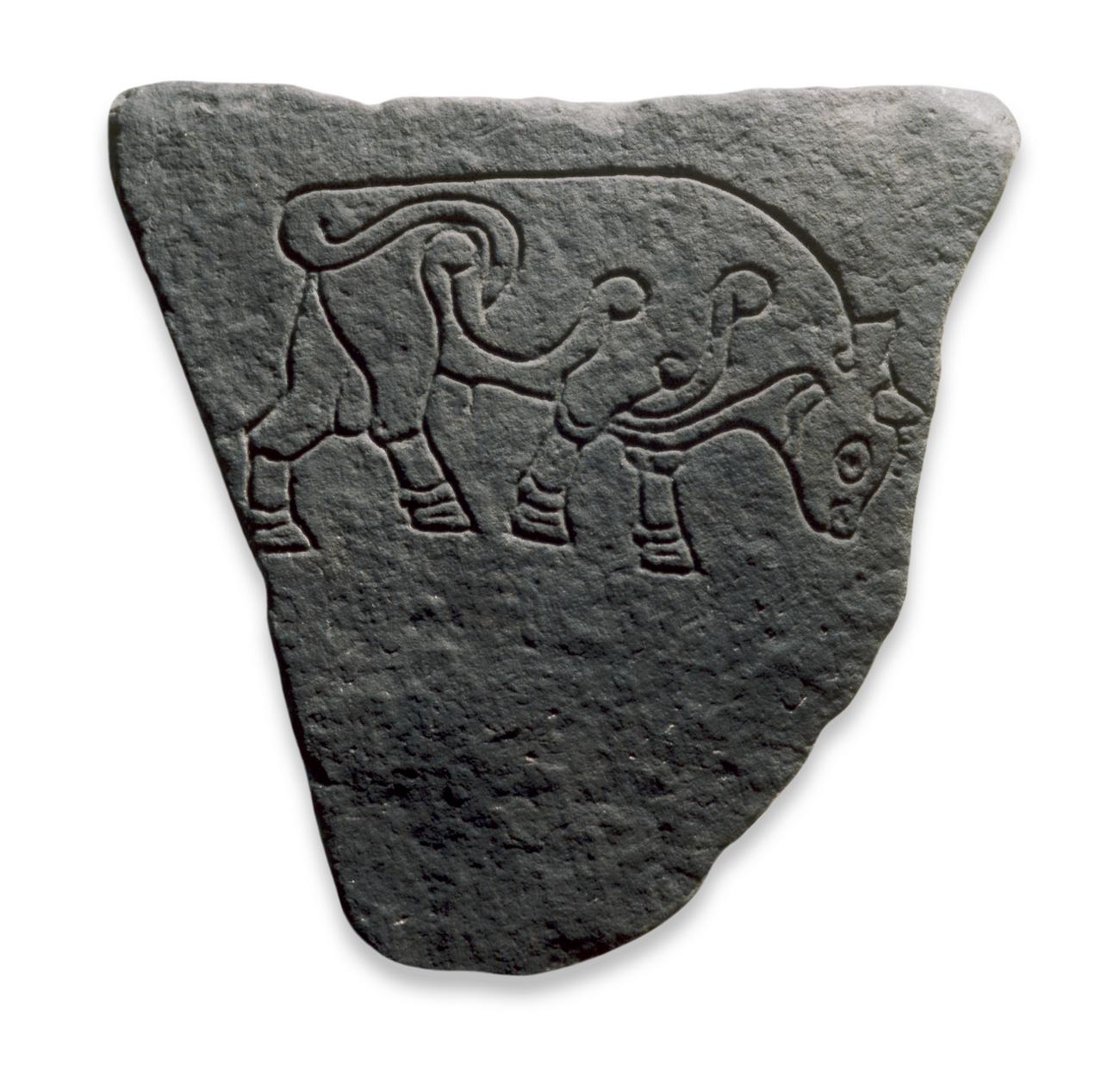
Carving of the Burghead bull
- Audio guide stop: 462
- Gallery: Room 41
- Culture: Pictish
- Date: 7thC-8thC
- Object type: symbol stone
- Materials: stone
- Museum number: 1861,1024.1
- Museum: The British Museum
- Collection record: British Museum website
- Image © The Trustees of the British Museum, shared under a CC BY-NC-SA 4.0 licence.
Listen to the free audio guide
About this object
Before you is "The Burghead Bull," a symbol stone dating from the 7th to 8th century. Created by Pictish artists, this roughly triangular stone is a striking dark brown and features a carved bull at its center.
Look closely at the bull’s body—you'll notice decorative scrolls at the hip and shoulder, a signature style associated with Pictish symbol stones. The bull appears to be stylized rather than realistic, capturing the essence of the animal rather than its exact form.
This stone was discovered in Burghead, near the Moray Firth, and is carved in a simple yet powerful incised style. It belongs to the Romilly Allen Class I classification, which highlights its importance in the study of Pictish art.
The stone measures about 53 centimeters tall with a base of 55 centimeters, and it was donated long ago by James de Carle Sowerby. This artwork offers a window into the early medieval artistry of what is now Scotland’s north-eastern coast.
See it in person
Carving of the Burghead bull is on display in Room 41 at the British Museum on Great Russell Street, Bloomsbury, London — free to enter. Choose British Museum on audioguide.london and type its audio guide stop number, 462, from the gallery label, or take a photo of it, to hear this free audio guide in six languages — no app download needed.
New, in beta. British Museum support has just launched and is still improving: over 1,000 objects so far, with more added all the time.