Bathers (Les Grandes Baigneuses)
- Artist: Paul Cezanne
- Date: about 1894-1905
- Medium: oil on canvas
- Museum: The National Gallery
- Collection record: The National Gallery website
Listen to the free audio guide
About this artwork
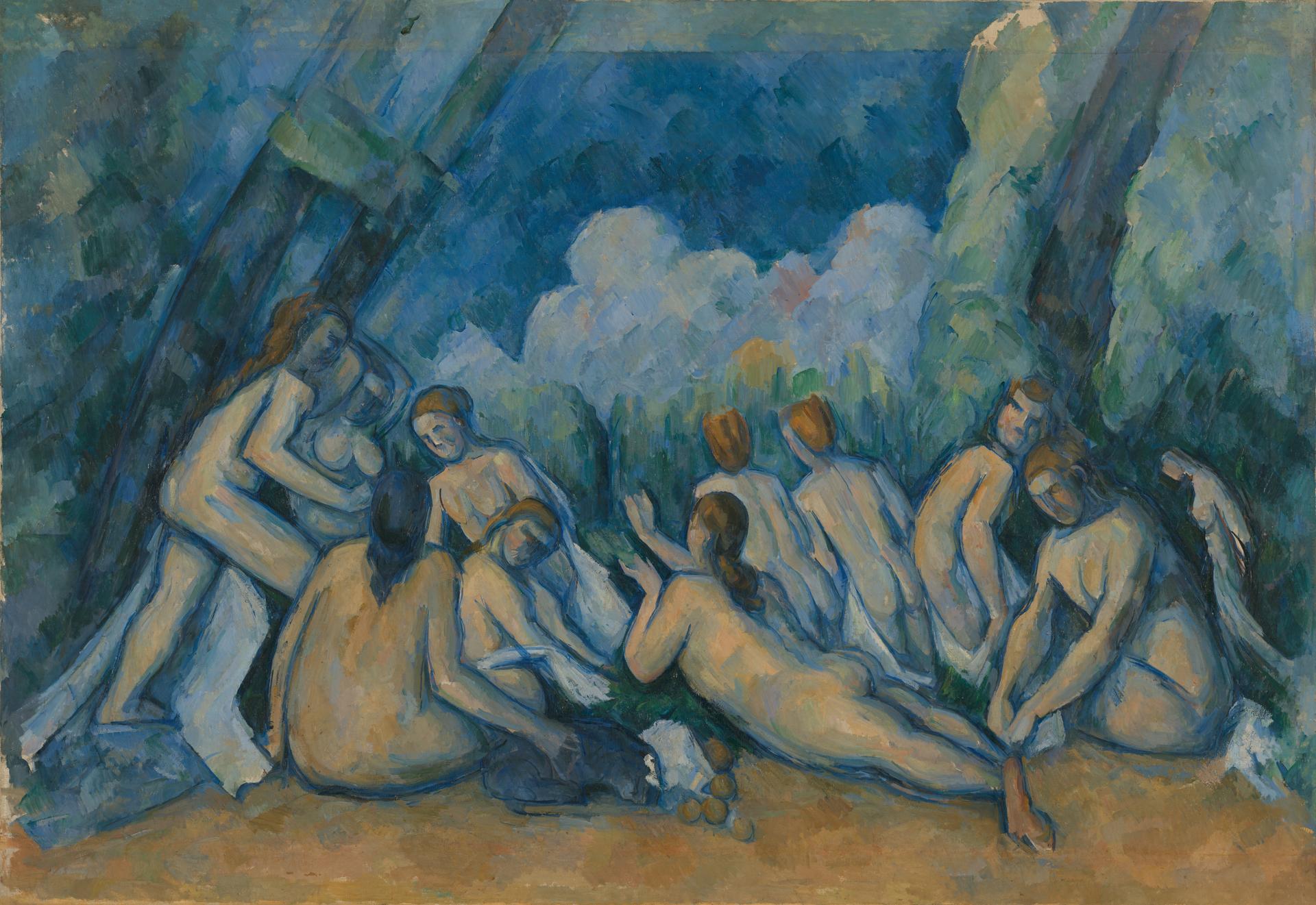
This is the "Bathers (Les Grandes Baigneuses)" by Paul Cezanne. Painted in the late 19th century, this large-scale work is one of three pictures of female bathers that Cezanne worked on during his final decade of life. They represent the culmination of his lifelong investigation of this subject and the climax of his entire career.
The painting depicts a group of 11 nude women relaxing in a woodland glade beneath an azure sky. The composition, which echoes the pyramidal base of a mountain, serves to integrate the women with the landscape. Cezanne's use of color is also noteworthy, as the brilliant blue of the sky is as intense as other areas of the picture.
The painting draws on a classical tradition of pastoral scenes, recalling pictures of bathing nymphs and goddesses from Renaissance art. However, Cezanne's work has no clear narrative or literary source, and the women are not depicted in a mythological context.
Cezanne's distortions of the human form may have been influenced by his awkwardness in figure drawing, as well as his decision to rely on memories rather than hiring models for these pictures. Despite this, the women in the painting take on an architectural quality that harmonizes with their surroundings.
The "Bathers (Les Grandes Baigneuses)" is considered one of Cezanne's most influential works, and its impact can be seen in early 20th-century art movements such as Cubism.
See it in person
Bathers (Les Grandes Baigneuses) hangs in The National Gallery on Trafalgar Square, London — free to enter. Point your phone at any artwork there and audioguide.london plays a free audio guide in six languages — no app download needed.