Aztec cuauhxicalli
- Gallery: Room 27
- Culture: Aztec
- Made in: Mexico
- Date: 1300-1521 (between)
- Object type: cuauhxicalli
- Materials: basalt
- Museum number: Am,+.6185
- Museum: The British Museum
- Collection record: British Museum website
- Image © The Trustees of the British Museum, shared under a CC BY-NC-SA 4.0 licence.
Listen to the free audio guide
About this object
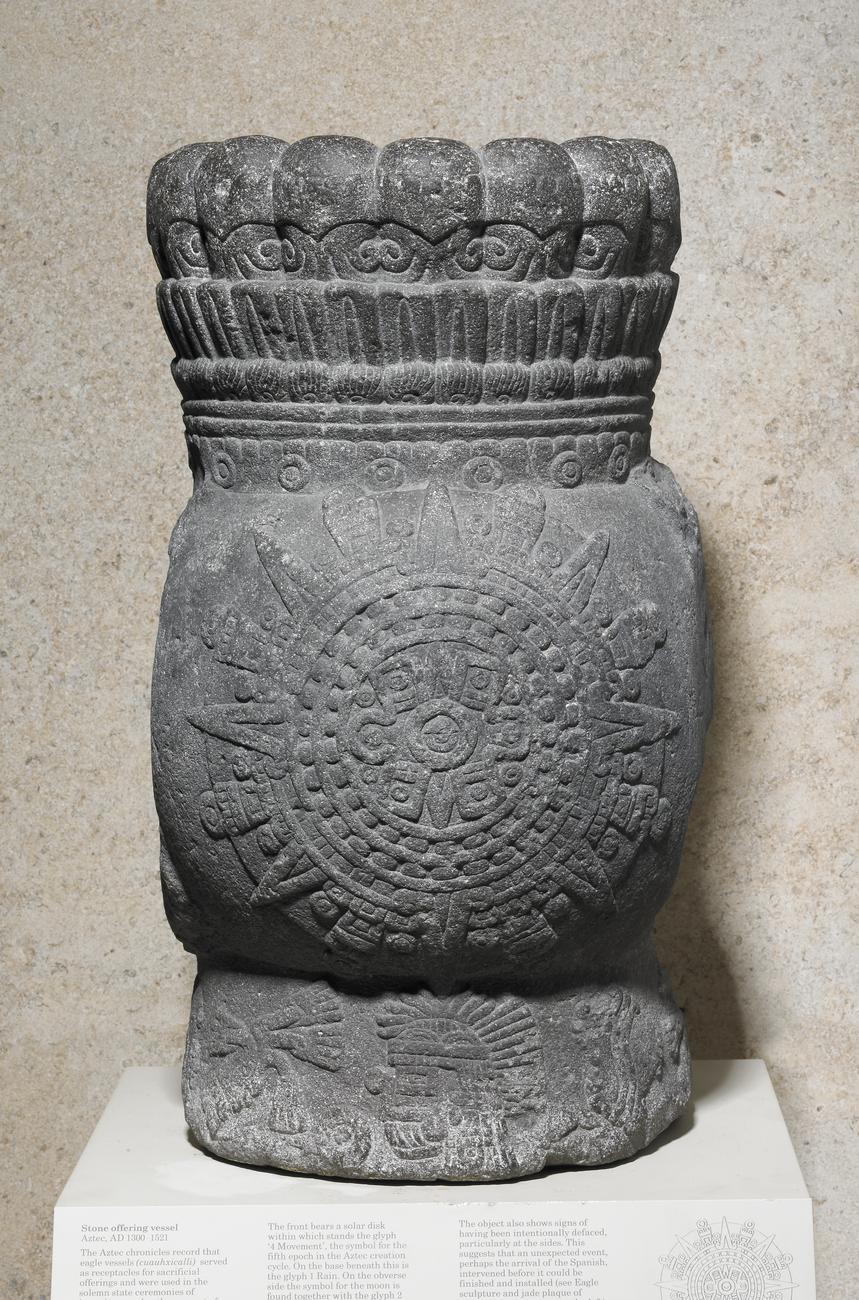
Before you stands an Aztec offering vessel known as a cuauhxicalli. This object, carved from smooth basalt, was never fully completed, with some areas left unworked. Its shape resembles large storage jars typically used for pulque, a sacred drink in Mesoamerican culture.
Looking closely at the exterior, you'll notice rows of human hearts, feathers, and jade-like ornaments, all carefully arranged. On the front is a striking solar disk paired with the glyph "4 Movement," which refers to the fifth phase of the Aztec creation cycle. Beneath it, another glyph, "1 Rain," appears. On the opposite side, the image of the moon is combined with the glyph "2 Rabbit," a name associated with a pulque deity.
This piece was deliberately damaged, likely during a major disruption—perhaps the Spanish arrival. Used in ceremonies involving the investiture of rulers, cuauhxicalli reveal the intricate cosmology and ritual intensity of the Aztec world.
See it in person
Aztec cuauhxicalli is on display in Room 27 at the British Museum on Great Russell Street, Bloomsbury, London — free to enter. Choose British Museum on audioguide.london and take a photo of it to hear this free audio guide in six languages — no app download needed.
New, in beta. British Museum support has just launched and is still improving: over 1,000 objects so far, with more added all the time.