The Normans Land at Pevensey
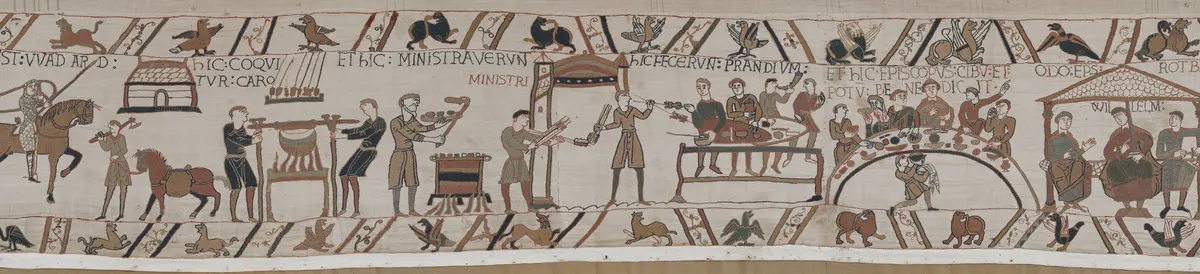
For a few metres the tapestry stops being about kings and shows you how an army actually ate.
The Normans forage, and a man named Wadard rides through it — another of the tapestry's oddly specific minor figures, and one known from Kentish records as a tenant of Bishop Odo. Meat is cooked on spits and in a cauldron, bread is baked, servants carry it out on skewers, and a horn is blown for dinner.
Then the meal itself, eaten at a curved table, with Odo blessing the food and drink. Odo, Bishop of Bayeux, was William's half-brother, and he appears here and later at the battle in a way no other churchman does — one of the strongest reasons for thinking he commissioned the whole thing. He sits in council with William and their other half-brother Robert.
A motte is dug at Hastings. A house is burned, and a woman leads a child away from it — a rare glimpse of the people the campaign was happening to. Scouts report on each side, and William tells his men to prepare themselves manfully and wisely for battle against the English army.
Listen while you walk — free
Our free walking guide keeps pace with you along the cloth: open audioguide.london/bayeux-tapestry on your phone before you go in. It needs no app and no sign-up.
Photography is not permitted in the Bayeux Tapestry exhibition, so the camera on the audioguide.london home page will not work there. Open audioguide.london/bayeux-tapestry instead and keep your phone in your hand.
audioguide.london now covers the British Museum’s permanent galleries too, in beta. This walking guide is separate, made for the Bayeux Tapestry exhibition, where photography is not allowed.
What the audio guide says here
The narration for these scenes, word for word, as you hear it in the walking guide — 12:20 to 15:36 into the 20-minute walk. It was written with reference to Wikipedia, whose text is available under CC BY-SA 4.0.
Ashore at last, William’s army turns its attention to the fire. Soldiers haul pots to the coals, turning the shore into a makeshift kitchen where the smell of roasting meat drifts through the salt air. Nearby, Bishop Odo stands before a table laden with dishes, raising his hands in a blessing over the food and drink. In the lower border, a seated figure holds a scroll, while Odo and Robert sit together, sharing the meal.
William sits in chain mail, staff upright, as men swing mallets to raise a fort at Hastings. News of Harold’s approach reaches him. Then, two soldiers set fire to a house. In the lower border, smaller figures show a woman holding her boy’s hand, pleading for mercy.
The Norman soldiers march out from Hastings, leaving their newly built fort behind them. They move toward the English army, where King Harold waits on the hill.
From the opposite ridge, William watches the English lines from his horse. He turns to a man named Vital, asking if he has seen the army of King Harold. Then the message travels the other way. A rider gallops through the English camp, bringing word of William’s position to Harold. Both leaders now know exactly where the other stands. There is no more time for hiding or maneuvering. The armies are close enough to see each other’s banners.
The duke sits on a horse, his hand raised in a sharp gesture that cuts through the air. He speaks to his men, urging them to prepare manfully and wisely for the coming fight. The soldiers listen, their faces set with the grim focus of men about to break against a shield wall. In the lower border, a smaller figure holds a staff, his gaze fixed on the duke’s command.
The inscriptions in these 10 scenes
The embroidered Latin, letter for letter, with translations. Positions are measured from the start of the cloth.
-
Scene 42
hIC COQVITVR CARO ET hIC MINISTRAVЄRVNT MINISTRI
Here the meat is cooked, And here it has been served ; The servants
Ici on cuit la viande et ici les serviteurs servent
42.5 m along the cloth
-
Scene 43
hIC FECЄRVNT PRANDIVM ET hIC EPISCOPVS CIBVM ET POTVM BENEDICIT
Here they made a meal, And here the bishop blesses the food and drink
Ici ils firent un déjeuner et ici l’évêque bénit la nourriture et la boisson
43.3 m along the cloth
-
Scene 44
ODO EPISCOPVS VVILLEM ROTBERT
Bishop Odo, William, Robert
L'évêque Odon, Guillaume, Robert
44.1 m along the cloth
-
Scene 45
ISTE IVSSIT VT FODERЄTVR CASTELLVM AD HESTENGA CEASTRA
This man has commanded that a fortification should be thrown up at Hastings
Ceux-ci ordonnent de faire les terrassements d’un château à Hastings
44.8 m along the cloth
-
Scene 46
HIC NVNTIATVM EST VVILLELM DE HAROLD
Here news is brought to William about Harold
Ici on donne à Guillaume des nouvelles de Harold
45.5 m along the cloth
-
Scene 47
hIC DOMVS INCENDITVR
Here a house is burned
Ici une maison est incendiée
46.4 m along the cloth
-
Scene 48
hIC MILITES EXIERVNT DE hESTENGA ET VENERVNT AD PRЄLIVM CONTRA hAROLDVM REGЄ
Here the soldiers went out of Hastings and came to the battle against King Harold
Ici les chevaliers sortirent de Hastings et vinrent se battre contre le roi Harold
46.8 m along the cloth
-
Scene 49
HIC VVILLELM DVX INTERROGAT VITAL SI VIDISSЄT EXERCITVM HAROLDI
Here Duke William asks Vital whether he has seen Harold’s army
Ici le duc Guillaume demande à Vital s’il a vu l’armée de Harold
48.6 m along the cloth
-
Scene 50
ISTE NVNTIAT HAROLDVM RЄGEM DE EXERCITV VVILLILMI DVCIS
This man tells King Harold about Duke William’s army
Celui-ci annonce au roi Harold l’armée du duc Guillaume
50.6 m along the cloth
-
Scene 51
HIC VVILLELM DVX ALLOQVITVR SVIS MILITIBVS VT PREPARARENT SE VIRILITER ET SAPIENTER AD PRELIVM CONTRA ANGLORVM EXERCITVM
Here Duke William exhorts his soldiers that they prepare themselves manfully and wisely for the battle against the army of the English
Ici le duc Guillaume harangue ses chevaliers pour qu’ils se préparent courageusement et sagement au combat contre l’armée des Anglais
52.1 m along the cloth
See it in person
The Bayeux Tapestry is at the British Museum from 10 September 2026 to 11 July 2027 — the first time it has been in Britain in roughly 950 years. Entry is by timed ticket, booked in advance and separate from the museum's free general admission, and each slot is short, so it is worth knowing what you are looking at before you arrive.