The Battle of Hastings
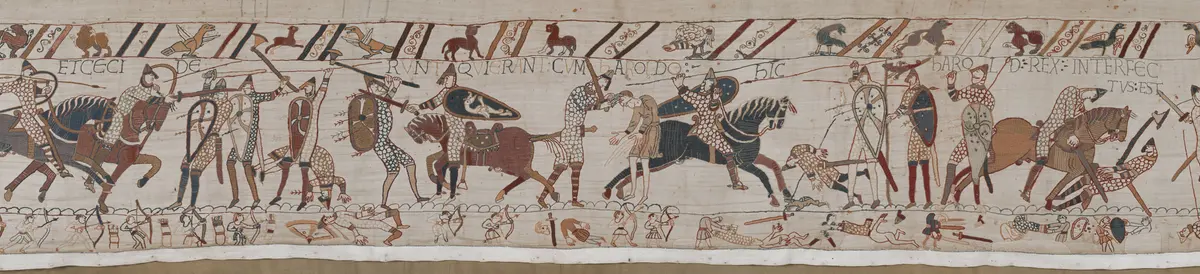
Fourteen metres of battle, and then the cloth simply stops.
Harold's brothers Leofwine and Gyrth are killed first. The English fight on foot behind a shield wall on the ridge; the Normans come at them on horseback, and the lower border fills with the dead and with men stripping mail from bodies. It is the longest sustained action anywhere on the cloth.
Two scenes address a crisis in the Norman line. Odo, holding a baculum, rides in to steady the young men, and William pushes his helmet back off his face — with Eustace pointing at him — so his own troops can see he is alive. A rumour that the duke had fallen was, by every account, the moment the battle nearly went the other way.
Then the inscription HAROLD REX INTERFECTVS EST, "King Harold has been killed", spread above two figures: one clutching at something near his helmet, one falling under a horseman's sword. Which is Harold, and whether the first is pulling an arrow from his eye, has been argued over for centuries and is not settled by the stitching itself — the cloth was heavily restored in the nineteenth century. The English turn and flee, and there the tapestry ends. Its final section was lost long ago; what would have followed, almost certainly William's coronation, is gone.
Listen while you walk — free
Our free walking guide keeps pace with you along the cloth: open audioguide.london/bayeux-tapestry on your phone before you go in. It needs no app and no sign-up.
Photography is not permitted in the Bayeux Tapestry exhibition, so the camera on the audioguide.london home page will not work there. Open audioguide.london/bayeux-tapestry instead and keep your phone in your hand.
audioguide.london now covers the British Museum’s permanent galleries too, in beta. This walking guide is separate, made for the Bayeux Tapestry exhibition, where photography is not allowed.
What the audio guide says here
The narration for these scenes, word for word, as you hear it in the walking guide — 15:36 to 20:00 into the 20-minute walk. It was written with reference to Wikipedia, whose text is available under CC BY-SA 4.0.
The two armies find each other at last, and the fighting begins. Horses rear against shield walls, and steel meets steel in a chaotic tangle of limbs and weapons. The air is thick with dust and the smell of blood, as the initial charge turns into a desperate melee that will last for hours. No one can see the end of it yet, only the immediate, terrifying violence of the first moment.
Leofwine and Gyrth fall in the thick of the melee, their bodies joining the growing pile of the slain. Swords swing and spears thrust, but the tide of combat shifts as the English line begins to crack under the relentless pressure. The dust settles briefly, leaving only the grim reality of the carnage before the next phase of the slaughter begins.
English and French men fall together in the mud and blood.
Bishop Odo rides through the smoke, his baton raised high to shout encouragement to the young men fighting nearby. He does not draw a sword; instead, he rallies them from the rear with the weight of his voice and the authority of his office. Just behind him, Duke William lifts his helmet. The gesture is simple but vital: it shows his face to the terrified knights, proving he is still alive and leading from the front. The battle rages on around them, but that single raised visor holds the Norman line together.
Harold stands alone in the crush of men. An arrow pierces his eye, or perhaps a sword finds his skull; the accounts disagree, but the result is the same. He falls. The name Harold hangs above the fallen figure, marking the end of the English line. The Norman claim rests on this death, proving the oath was broken and the crown rightfully seized.
The men drop their shields and turn their backs on the ridge, running down the slope in a desperate scramble for survival. The dust of their flight kicks up behind them as the Norman cavalry closes in. It is the end of the day, but it is not the end of the story, for the cloth itself ends here. The final words, stitched in a later hand, declare that the English have fled. Yet the true conclusion of the battle, the fate of the king, and the dawn of a new reign remain forever lost to the frayed edge of the linen.
The last stretch of the cloth is a nineteenth-century restoration.
The inscriptions in these 7 scenes
The embroidered Latin, letter for letter, with translations. Positions are measured from the start of the cloth.
-
Scene 52
hIC CЄCIDЄRVNT LEVVINE ЄT GYRÐ FRATRES hAROLDI REGIS
Here were killed Leofwine and Gyrth, the brothers of King Harold
Ici tombèrent Leofwine et Gyrth frères du roi Harold
54.6 m along the cloth
-
Scene 53
hIC CЄCIDERVNT SIMVL ANGLI ЄT FRANCI IN PRELIO
Here at the same time English and French fell in battle
Ici tombèrent ensemble au combat Anglais et Français
59.3 m along the cloth
-
Scene 54
HIC ODO EPISCOPVS BACVLVM TЄNЄNS CONFORTAT PVEROS
Here Bishop Odo holding a wand encourages the young men
Ici l’évêque Odon tenant son bâton encourage les jeunes
61.1 m along the cloth
-
Scene 55
hIC EST DVX VVILLELM / E[...]TIVS
Here is Duke William / E…tius (Eustace?)
Ici est le Duc Guillaume / E…tius (Eustache ?)
62.3 m along the cloth
-
Scene 56
hIC FRANCI PVGNANT ET CЄCIDЄRVNT QVI ЄRANT CVM hAROLDO
Here the French fight and have killed those who were with Harold
Ici les Français combattent et ceux qui étaient avec Harold tombèrent
63.1 m along the cloth
-
Scene 57
hIC Harold REX INTERFЄCTVS EST
Here King Harold has been killed
Ici le roi Harold fut tué
64.5 m along the cloth
-
Scene 58
ET FVGA VERTERVNT ANGLI
And the English have turned to flight
Et les Anglais prirent la fuite
66.2 m along the cloth
See it in person
The Bayeux Tapestry is at the British Museum from 10 September 2026 to 11 July 2027 — the first time it has been in Britain in roughly 950 years. Entry is by timed ticket, booked in advance and separate from the museum's free general admission, and each slot is short, so it is worth knowing what you are looking at before you arrive.