Harold's Coronation and Halley's Comet
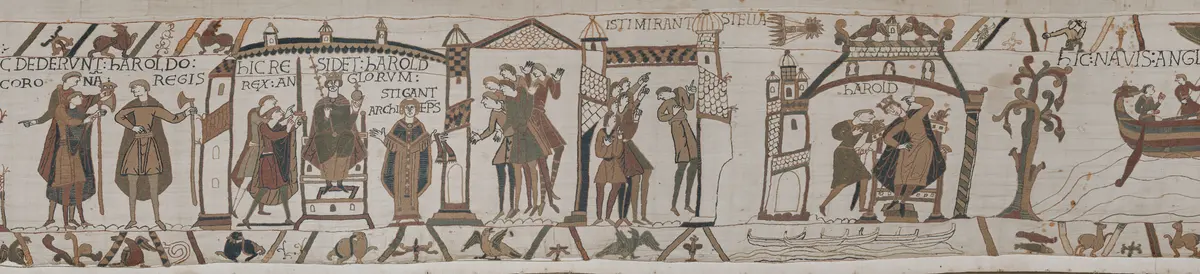
A new king, a burning star, and a fleet going up in the forests of Normandy.
Harold is crowned and sits enthroned with orb and sceptre. Beside him the embroidery names Stigand, Archbishop of Canterbury — a pointed choice, because Stigand's appointment was regarded as uncanonical and naming him quietly taints the coronation. English accounts say Ealdred of York performed it.
Then five men point upward at a streaking object and the inscription reads ISTI MIRANT STELLA, "these men marvel at the star". This is Halley's Comet, which passed in late April 1066, and it is the earliest depiction of it we have. Harold is told, and in the lower border beneath him a line of empty ships waits — the tapestry's only piece of open prophecy.
The news crosses the Channel. Trees are felled, planks shaped, hulls built and dragged to the water; men carry hauberks slung on poles and haul a wagon loaded with a barrel of wine and spears. Then William crosses in a great ship and comes to Pevensey, and the horses step off the boats onto English ground.
Listen while you walk — free
Our free walking guide keeps pace with you along the cloth: open audioguide.london/bayeux-tapestry on your phone before you go in. It needs no app and no sign-up.
Photography is not permitted in the Bayeux Tapestry exhibition, so the camera on the audioguide.london home page will not work there. Open audioguide.london/bayeux-tapestry instead and keep your phone in your hand.
audioguide.london now covers the British Museum’s permanent galleries too, in beta. This walking guide is separate, made for the Bayeux Tapestry exhibition, where photography is not allowed.
What the audio guide says here
The narration for these scenes, word for word, as you hear it in the walking guide — 8:31 to 12:20 into the 20-minute walk. It was written with reference to Wikipedia, whose text is available under CC BY-SA 4.0.
The excommunicated archbishop Stigand stands nearby, as the new ruler takes his place on the throne. Above them, a star with a burning tail streaks across the sky, and men below marvel at its light. In the lower border, ghost-like ships wait in the dark, hinting at the invasion to come.
Word of Harold's crown reaches William. He orders ships built, yet it is Bishop Odo who issues the commands. In the lower border, men haul ropes and handle tools, preparing the fleet that will soon cross the Channel.
The planning gives way to labor. Men haul heavy wooden frames toward the water’s edge, dragging the new vessels into the sea. In the lower border, figures stand over logs, swinging axes with both hands raised high against the sky. Others carry branches across their shoulders, moving steadily toward the trees on land. The effort is relentless, a physical manifestation of William’s will. The scene changes. Men carry swords, shields, and axes toward the decks. A wagon is pulled along the shore, its wheels creaking under the weight of wine and more arms. The men on the deck hold reins, their faces turned upward, perhaps toward the wind or perhaps toward the distant English coast. The tension in the cloth is palpable, the air thick with the anticipation of war.
The fleet is loaded. The Channel is crossed. Duke William sits in his great ship, hands resting on the deck as he stares toward the English coast. The wind fills the sails. Men in chain mail grip the oars, their faces set against the spray. The journey is long, but the purpose is clear. Pevensey waits. The land is close. The invasion has begun.
The horses step out of the boats. The inscription calls it a simple exit, but the weight of the invasion lands with them. Men on the decks gesture toward smaller vessels, coordinating the chaotic unloading. The air is thick with the promise of war, and the ground shakes under the hooves of the arriving Norman cavalry.
Men rush toward the shore to seize food. Soldiers strip the countryside bare, taking what they need by force. Then the eye catches a name in the border: Wadard. He rides his horse, axe raised high, a nobleman sent from Normandy to help feed the army. His land in Kent would later belong to Odo, but here he is just another man with a weapon, ready for the fight that follows.
The inscriptions in these 12 scenes
The embroidered Latin, letter for letter, with translations. Positions are measured from the start of the cloth.
-
Scene 30
hIC RЄSIDET hAROLD RЄX ANGLORVM
Here sits throned Harold, King of the English
Ici siège Harold roi des Anglais
28.5 m along the cloth
-
Scene 31
STIGANT ARChIEPISCOPVS
Stigand, archbishop
L'archevêque Stigand
29.0 m along the cloth
-
Scene 32
ISTI MIRANT STELLA
These men marvel at the star
Ceux-ci admirent l’étoile
29.2 m along the cloth
-
Scene 33
hAROLD
Harold
Harold
29.8 m along the cloth
-
Scene 34
hIC NAVIS ANGLICA VЄNIT. IN TЄRRAM VWILLELMI DVCIS
Here an English ship came to the country of Duke William
Ici un navire anglais vint dans la terre du duc Guillaume
30.1 m along the cloth
-
Scene 35
HIC VVILLЄLM DVX IVSSIT NAVЄS EDIFICARE
Here Duke William ordered ships to be built
Ici le duc Guillaume donna l’ordre de construire des navires
31.0 m along the cloth
-
Scene 36
hIC TRAhVNT NAVЄS AD MARЄ
Here ships are hauled to the sea
Ici les navires sont tirés vers la mer
32.0 m along the cloth
-
Scene 37
ISTI PORTANT ARMAS AD NAVЄS ЄT hIC TRAhVNT CARRVM CVM VINO ET ARMIS
These men carry arms to the ships, and here they pull a wagon with wine and arms
Ceux-ci portent des armes aux navires et ici ils tirent un chariot avec du vin et des armes
34.1 m along the cloth
-
Scene 38
† hIC VVILLELM DVX IN MAGNO NAVIGIO MARЄ TRANSIVIT ET VENIT AD PЄVЄNЄSÆ
Here Duke William in a great ship crossed the sea and came to Pevensey
Ici, le duc Guillaume, dans une grande navigation, franchit la mer et vint à Pevensey
35.3 m along the cloth
-
Scene 39
hIC ЄXЄVNT CABALLI DE NAVIBVS
Here the horses leave the boats
Ici les chevaux sortent des navires
38.0 m along the cloth
-
Scene 40
ЄT hIC MILITЄS FESTINAVERVNT hЄSTINGA VT CIBVM RAPERENTVR
And here soldiers have hurried to Hastings to seize food
Et ici les chevaliers se hâtent vers Hastings pour y prendre de la nourriture
40.2 m along the cloth
-
Scene 41
HIC EST VVADARD
Here is Wadard
Ici est Wadard
41.5 m along the cloth
See it in person
The Bayeux Tapestry is at the British Museum from 10 September 2026 to 11 July 2027 — the first time it has been in Britain in roughly 950 years. Entry is by timed ticket, booked in advance and separate from the museum's free general admission, and each slot is short, so it is worth knowing what you are looking at before you arrive.