Wreath
- Gallery: British Galleries, Room 125, Edwin and Susan Davies Gallery
- Maker: William Morris (designer)
- Made in: England
- Date: 1876
- Object type: Wallpaper
- Materials: Print on paper
- Style: Arts and Crafts (movement)
- Dimensions: Height (size of volume) 68.5 cm; Width (size of volume) 53.3 cm
- Museum: V&A South Kensington
- Collection record: V&A website
- Image © Victoria and Albert Museum, London.
Listen to the free audio guide
In the museum now? Point your phone at the next object and hear its guide.
About this object
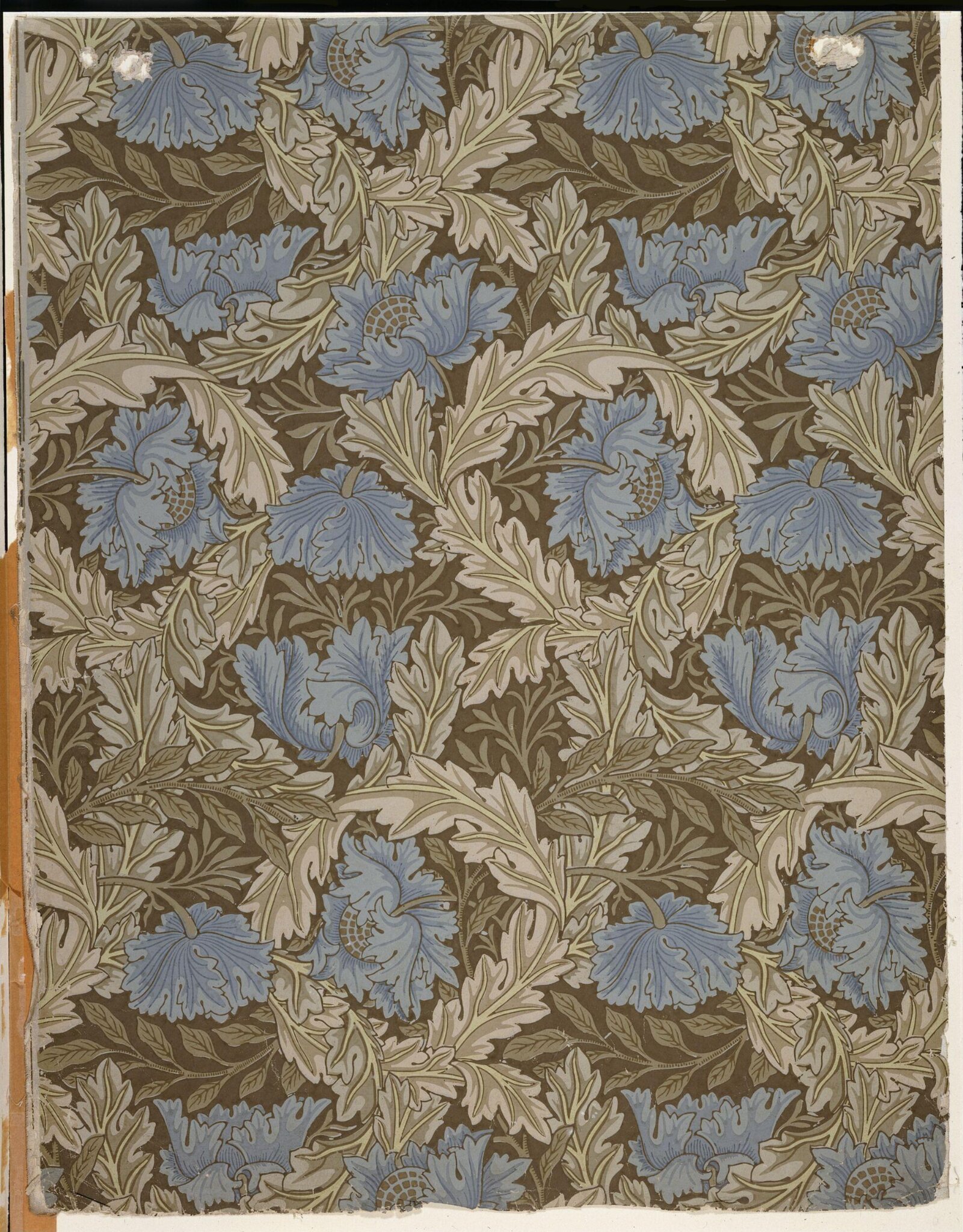
Before you is a specimen of "Wreath" wallpaper, created in 1876 by the English designer William Morris. As you look closely, you can see a delicate foliate pattern consisting of entwined green leaves and blue flowers. This design was printed on paper using wood-blocks and water-based distemper colours, which created a thick, chalky effect.
William Morris was a major figure in the Arts and Crafts movement, believing that art should be available to everyone. While his firms produced many different designs for various budgets, "Wreath" was a premium option, sitting in the top price bracket.
Morris often designed repeating patterns based on natural forms. He believed that the more mechanical the printing process, the less direct the imitation of nature should be. Even with the small hatching lines used here to add a sense of three-dimensionality, the focus remains on the beautiful surface pattern. This piece comes from a pattern book that helped homeowners decorate their spaces in a coordinated way.
See it in person
Wreath is on display in British Galleries, Room 125, Edwin and Susan Davies Gallery at the V&A South Kensington on Cromwell Road, London — free to enter. Choose V&A South Kensington on audioguide.london and take a photo of it to hear this free audio guide in six languages — no app download needed.
New, in beta. V&A support has just launched and is still improving: 1,000 objects with audio so far, with more added all the time.