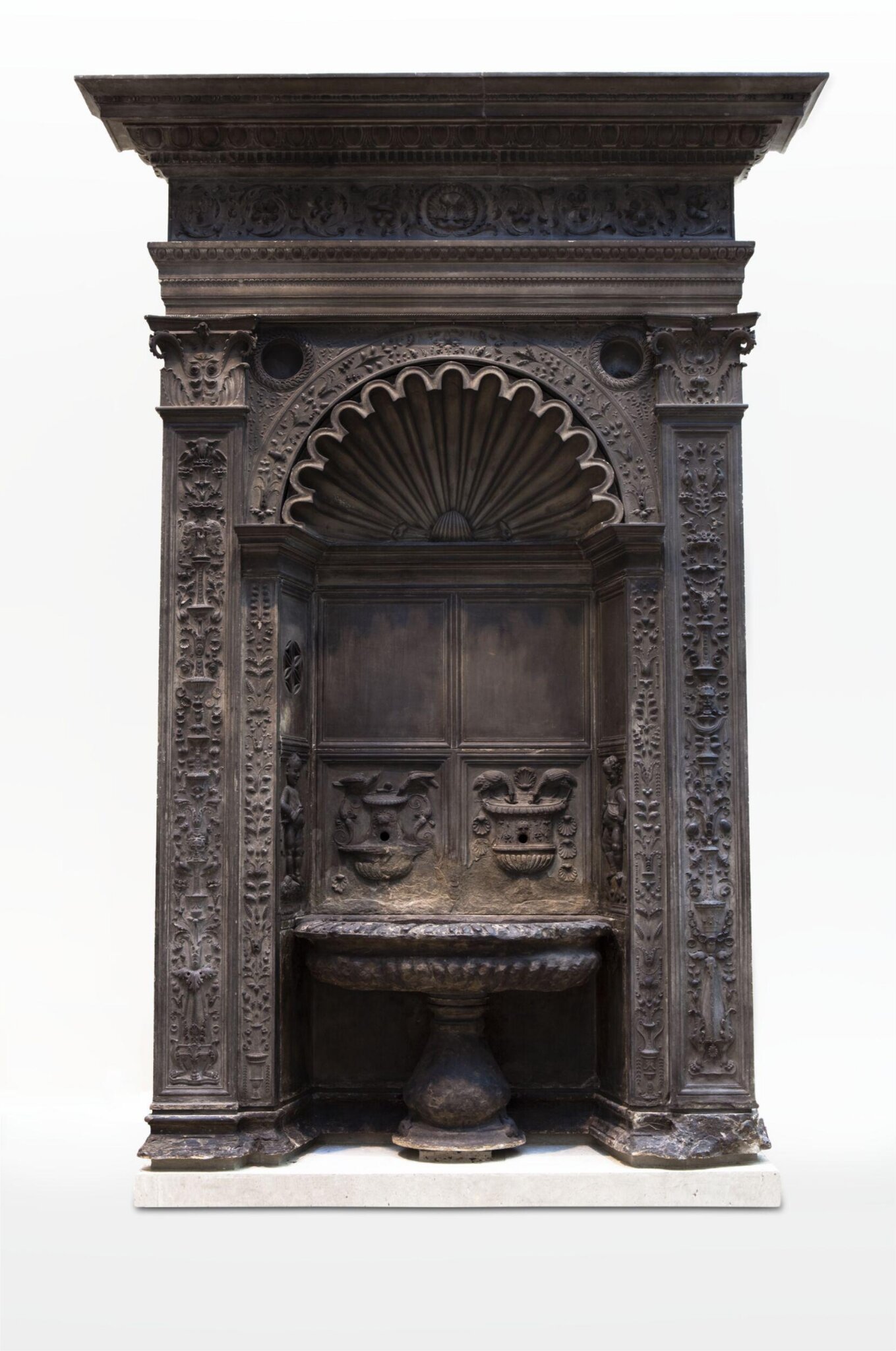
Wall fountain
- Gallery: Medieval & Renaissance, Room 50a, The Paul and Jill Ruddock Gallery
- Maker: Benedetto da Rovezzano (Style of)
- Made in: Florence
- Date: ca. 1520
- Object type: Wall fountain
- Materials: Grey sandstone carved
- Dimensions: Height 421 cm; Width 299 cm; Depth 91 cm
- Museum: V&A South Kensington
- Collection record: V&A website
- Image © Victoria and Albert Museum, London.
Listen to the free audio guide
In the museum now? Point your phone at the next object and hear its guide.
About this object
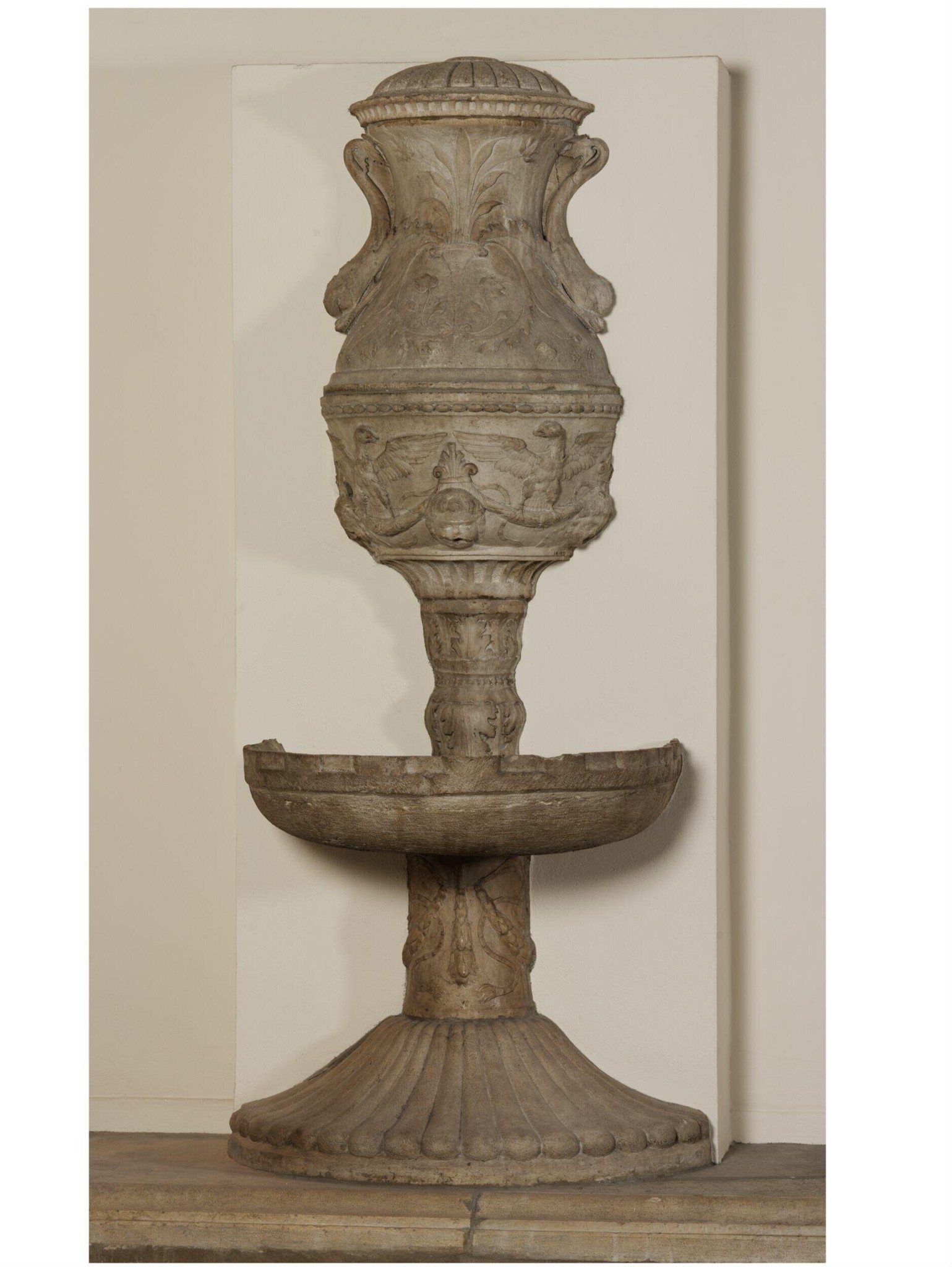
Before you is a "Wall fountain," also known as an acquaio, carved from grey sandstone. This elaborate structure comes from Florence and dates back to around the early sixteenth century. It is created in the style of the sculptor Benedetto da Rovezzano.
In a Florentine palace, an acquaio like this was a practical yet beautiful feature used for washing hands or filling vessels. Unlike a continuous fountain, the water flow was controlled by taps. If you look at the wall above the basin, you can see two urns that once housed these taps. Water would have poured from the mouths of masks on these urns into the elliptical basin below.
Notice the fine details in the carvings. On the side panels, two children stand in the sea, one supported by a dolphin and shells, and the other by a turtle. Above them, in the center of the frieze, is an enigmatic beast inside a shell. This creature is identified as a beaver, which, according to tradition, saved itself by self-castration.
See it in person
Wall fountain is on display in Medieval & Renaissance, Room 50a, The Paul and Jill Ruddock Gallery at the V&A South Kensington on Cromwell Road, London — free to enter. Choose V&A South Kensington on audioguide.london and take a photo of it to hear this free audio guide in six languages — no app download needed.
New, in beta. V&A support has just launched and is still improving: 1,000 objects with audio so far, with more added all the time.