Throne of the Buddha
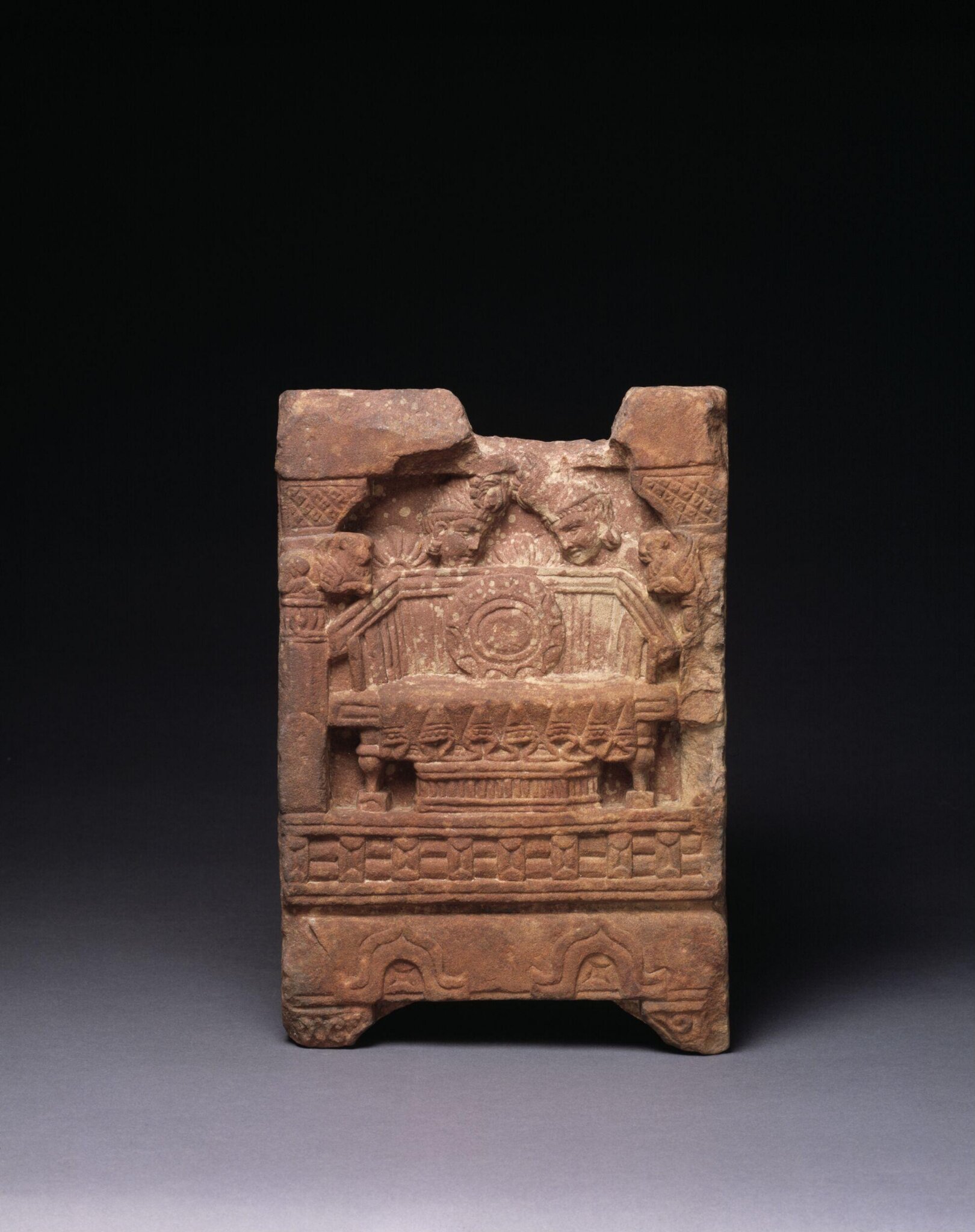
- Gallery: Buddhism, Room 47f, The Robert H. N. Ho Family Foundation Galleries of Buddhist Art
- Made in: Mathura
- Date: 2nd century - 3rd century
- Object type: Sculpture
- Materials: Red carved sandstone
- Style: Kushan
- Dimensions: Width 22 cm; Height 33 cm; Width 9 cm
- Museum: V&A South Kensington
- Collection record: V&A website
- Image © Victoria and Albert Museum, London.
Listen to the free audio guide
In the museum now? Point your phone at the next object and hear its guide.
About this object
Before you is "Throne of the Buddha", a red sandstone carving from the second or third century. This relief probably once formed part of a temple or shrine in Mathura, in northern India.
Take a closer look at the central scene. You can see an empty throne resting on a footstool, which is flanked by two attendants holding fly-whisks. These whisks are emblems of a world sovereign. Resting on the seat of the throne is a small disc. This is often interpreted as a symbol of the sun, representing the radiance of the Buddha.
In this era, many Buddhist artists were reluctant to represent the Buddha in human form. Instead, they used symbols like this empty throne to indicate his presence. You can also see winged-lion capitals on either side of the niche. This artwork plays on the idea of the Buddha as a spiritual king, a ruler of the whole world.
See it in person
Throne of the Buddha is on display in Buddhism, Room 47f, The Robert H. N. Ho Family Foundation Galleries of Buddhist Art at the V&A South Kensington on Cromwell Road, London — free to enter. Choose V&A South Kensington on audioguide.london and take a photo of it to hear this free audio guide in six languages — no app download needed.
New, in beta. V&A support has just launched and is still improving: 1,000 objects with audio so far, with more added all the time.