The Virgin of Sorrows
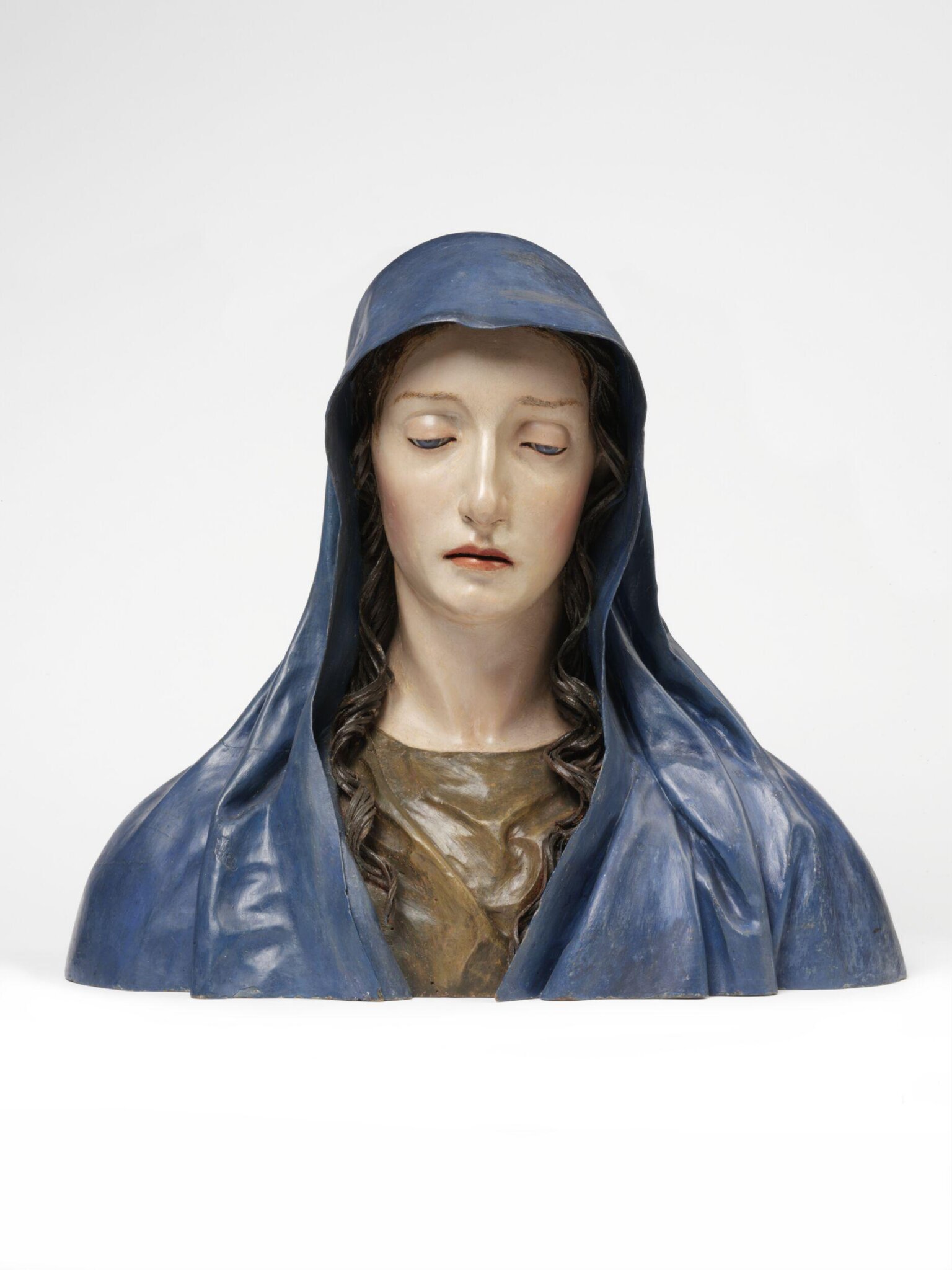
- Gallery: Europe 1600-1815, Room 7, The Sheikha Amna Bint Mohammed Al Thani Gallery
- Maker: José de Mora (maker)
- Made in: Granada (City)
- Date: ca. 1680-1700
- Object type: Bust
- Materials: Painted pinewood bust with ivory and glass
- Dimensions: Height 48.35 cm; Width 49 cm; Depth 29 cm
- Museum: V&A South Kensington
- Collection record: V&A website
- Image © Victoria and Albert Museum, London.
Listen to the free audio guide
In the museum now? Point your phone at the next object and hear its guide.
About this object
Before you is "The Virgin of Sorrows", a striking painted wood bust attributed to the Spanish sculptor José de Mora. Created in Granada between approximately 1680 and 1700, this work is a masterpiece of technical skill designed to evoke deep religious emotion.
If you look closely at the face, you can see how the artist achieved such a lifelike appearance. The eyes may be made of glass, and the teeth are crafted from ivory. Even the ringlets of hair are incredibly detailed, fashioned from small corkscrews of wood shavings. While time has changed the surface, the original colors would have been vibrant. The blue veil likely contained lapis lazuli for a deep hue, and the robe probably had a lustrous olive green sheen enhanced by gold powder.
During this period in Spain, such busts were often paired with a figure of Christ to help worshippers connect with his suffering. Through this realistic and mournful expression, the artist captures the intense, quiet power of devotion.
See it in person
The Virgin of Sorrows is on display in Europe 1600-1815, Room 7, The Sheikha Amna Bint Mohammed Al Thani Gallery at the V&A South Kensington on Cromwell Road, London — free to enter. Choose V&A South Kensington on audioguide.london and take a photo of it to hear this free audio guide in six languages — no app download needed.
New, in beta. V&A support has just launched and is still improving: 1,000 objects with audio so far, with more added all the time.