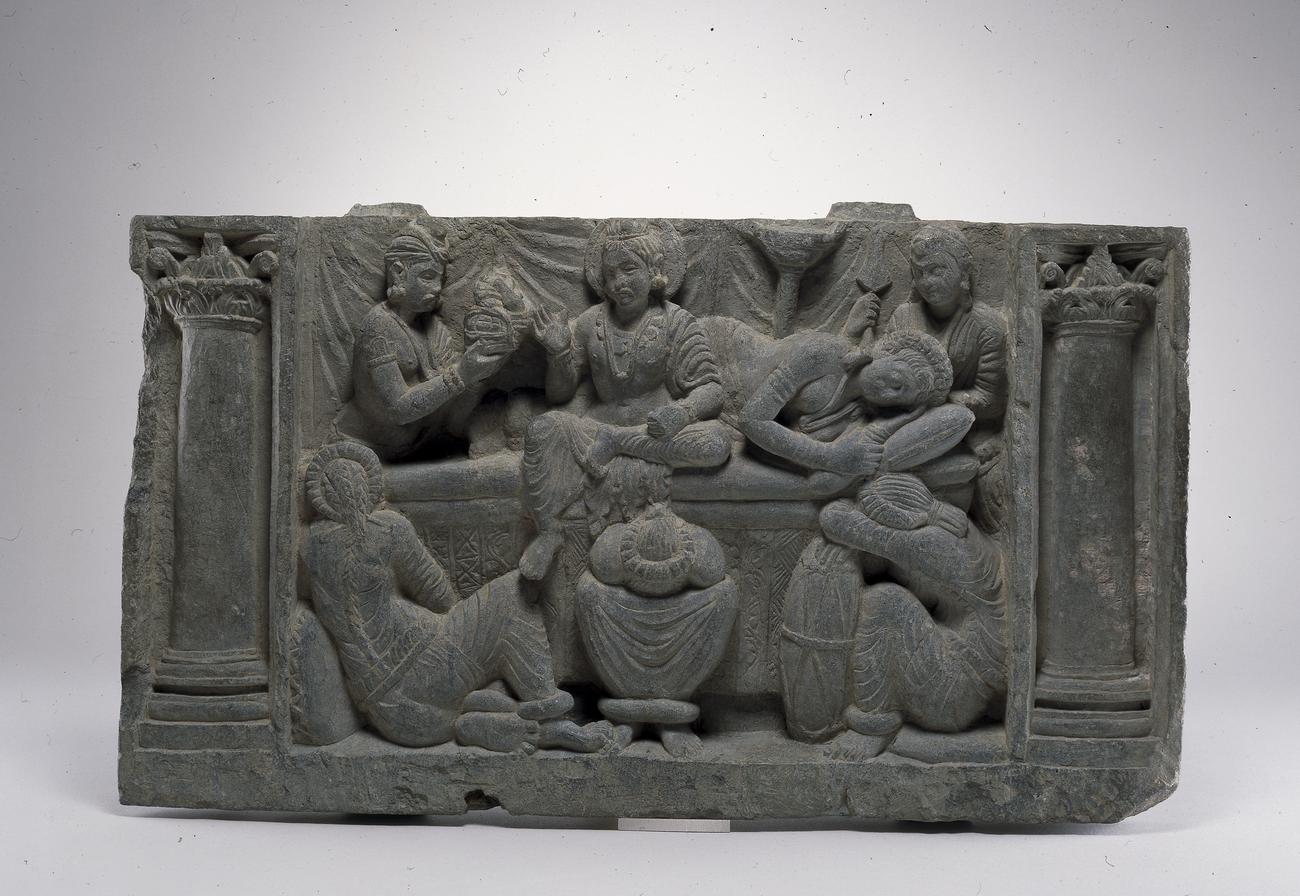
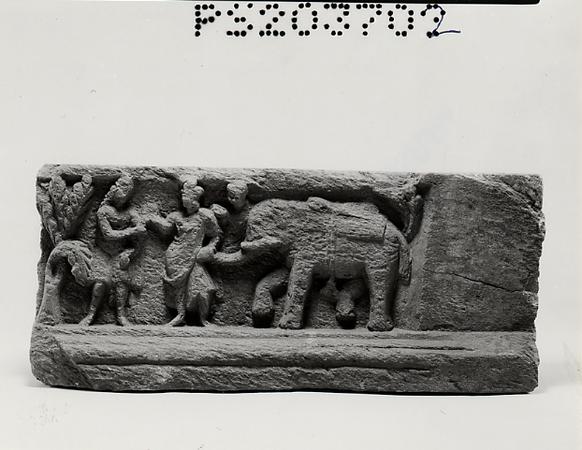
The Viśvaṃtara jātaka.
- Gallery: Room 33
- Culture: Kushan
- Made in: Gandhara (historic - Pakistan)
- Date: 2ndC-3rdC
- Object type: stair-riser
- Materials: schist
- Museum number: 1880.42
- Museum: The British Museum
- Collection record: British Museum website
- Image © The Trustees of the British Museum, shared under a CC BY-NC-SA 4.0 licence.
Listen to the free audio guide
In the museum now? Point your phone at the next object and hear its guide.
About this object
This is The Viśvaṃtara jātaka, a carved schist stair-riser created in the Kushan period, likely in ancient Gandhara, present-day Pakistan. The scene shows Viśvaṃtara, a bodhisattva known for his generosity. He is depicted offering an object to a young ascetic in return for a white elephant he had given away. The elephant appears in mid-motion with a richly decorated harness. The figure of Viśvaṃtara wears a turban, layered robes, and is shown in a pose of giving, which symbolizes his selfless nature. Nearby, a tree and an indistinct figure offering flowers frame the moment. This artwork is made from schist, a type of rocky stone well-suited for detailed carving. The piece was once part of a larger set that formed a stairway at Jamalgarhi, a site linked to ancient Buddhist stupas.
See it in person
The Viśvaṃtara jātaka. is on display in Room 33 at the British Museum on Great Russell Street, Bloomsbury, London — free to enter. Choose British Museum on audioguide.london and take a photo of it to hear this free audio guide in six languages — no app download needed.
New, in beta. British Museum support has just launched and is still improving: over 1,000 objects so far, with more added all the time.