The Tudor Heart
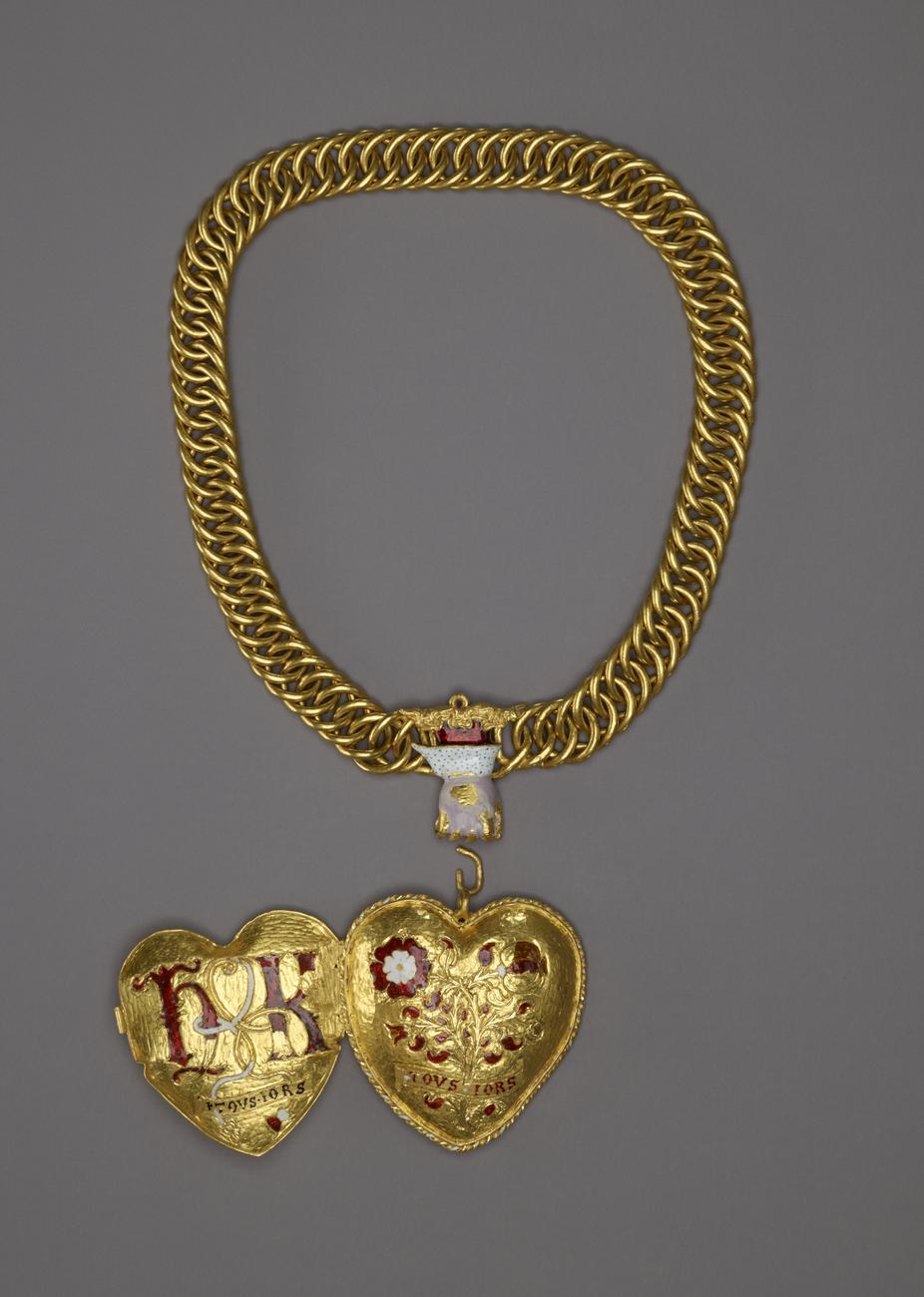
- Audio guide stop: 110
- Gallery: Room 2
- Culture: England
- Made in: England (Neither the names of the maker/makers nor the place of making are definitively known; high material purity and different applied skills suggests a range of established craftspeople with access to bullion gold and equipment for enamelling, wire drawing, fusion soldering etc. Chain, clasp and heart may have been made to be united, but qualitative differences speak for a marriage of separately conceived components; possibly after existing for some time or use in another form. Portions have been hastily worked. A missive of 1517 documents the huge volume of embellishment prepared in the four months before such an event, possibly explaining qualitative issues despite high purity. Other sources document the return of embellishment to goldsmiths for reuse after events, possibly explaining the minimal application of enamels. A genre of objects for which appearance at distance was key without any expectation of endurance clearly existed. In this context it is reasonable to suggest the involvement of the King’s preferred goldsmiths and his Master of Revels.)
- Date: 1515-1520 (CHAIN: Type first documented from the mid-15th-century onwards in the visual arts of the Burgundian Netherlands and Iberia. CLASP: Design based on device of Basle-based printer Johann Froben, developed by Hans Holbein the Younger first used in via Erasmus’s Novum Instrumentum (1516) and popularised in England via Thomas More’s Epigrammata (editions of March and December 1518). PENDANT: The heart-shaped pendant with twisted wire border documented in early 16th-century manuscript illustrations from Flanders; letters H and K, heraldic Tudor roses and pomegranates, relate the piece to King Henry VIII and his first wife Katherine of Aragon (m. 1509); first known use of entwined roses and pomegranates emerging from single stem is 1511; motto TOUS IORS not yet located, but the spelling found in contemporary Henrician sources. Katherine exiled from Henry’s court in 1531, marriage annulled in 1533. SCIENCE: Analysis puts the making of the clasp and pendant before about 1530. SUITE: The objects were discovered together as a suite and appear to be broadly contemporaneous; a combination of the hand-and-cloud, entwined branch, letters H&K, knots and heart motifs is documented in use on the third day of jousting at Greenwich in October 1518 in tournament staged to celebrate Treaty of Universal Peace (also known as the Treaty of London, a non-aggression and mutual aid pact between 20 European countries against perceived threat of Ottoman Empire) and betrothal of Princess Mary (2 years) to French dauphin (8 months). This may explain TOUS IORS, which not only means always in French, but fuses French (tous) with English (yours) in an aural pun.)
- Object type: pendant, collar, clasp
- Materials: gold; enamel
- Museum number: 2025,8026.1
- Museum: The British Museum
- Collection record: British Museum website
- Image © The Trustees of the British Museum, shared under a CC BY-NC-SA 4.0 licence.
Listen to the free audio guide
About this object
Before you is a remarkable 16th-century gold pendant known as "The Warwickshire Jewel" or "The Tudor Heart." Created in England, this beautifully crafted suite includes a chain, clasp, and heart-shaped pendant that symbolically connects King Henry VIII and his first wife, Katherine of Aragon.
Look closely at the pendant’s gold surface: it holds enamels in red, white, amber, and black, with engraved Tudor roses and pomegranates — Katherine’s emblem — emerging from a shared stem. A banner on the front reads "TOUS IORS," Old French for "always," suggesting enduring love or commitment. The reverse side features engraved initials H and K, entwined in a ribbon and knotted tassels, reinforcing the couple’s bond.
Crafted with exceptional skill, the chain comprises 75 gold links, intricately linked in a dense, flexible pattern called a curb-chain. The clasp is shaped like a hand emerging from a cloud, echoing artistic designs from the time.
This piece not only dazzles with its craftsmanship but also serves as a rare witness to important historical events, including the 1518 Treaty of London and celebrations for Princess Mary’s betrothal. The Tudor Heart offers lasting insight into England’s royal history and the artistry of the early 1500s.
See it in person
The Tudor Heart is on display in Room 2 at the British Museum on Great Russell Street, Bloomsbury, London — free to enter. Choose British Museum on audioguide.london and type its audio guide stop number, 110, from the gallery label, or take a photo of it, to hear this free audio guide in six languages — no app download needed.
New, in beta. British Museum support has just launched and is still improving: over 1,000 objects so far, with more added all the time.