The Oceanus Mosaic
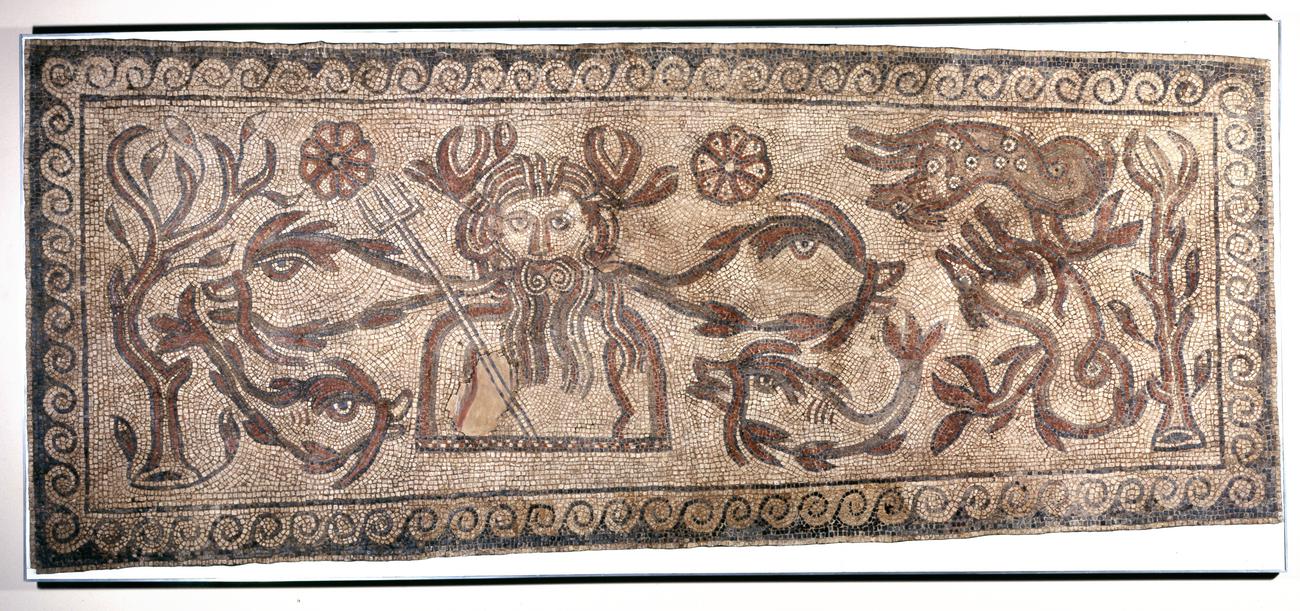
- Gallery: Room 49
- Culture: Romano-British
- Date: AD300-400
- Object type: mosaic pavement
- Materials: stone
- Museum number: 1812,0613.1
- Museum: The British Museum
- Collection record: British Museum website
- Image © The Trustees of the British Museum, shared under a CC BY-NC-SA 4.0 licence.
Listen to the free audio guide
About this object
Before you is "The Oceanus Mosaic," a remarkable Romano-British mosaic pavement from around AD 300 to 400. Created in Withington, this artwork includes five fragments, with the most complete panel showing a powerful figure of Oceanus, often linked to Neptune. His strong, detailed face is framed by a swirling wave motif. Around him are dolphins, sea creatures, and ornate floral and geometric patterns in a mix of white, red, and grey stones.
Oceanus' trident rests across his body, and his facial features—like a wild beard and shell-like claws at his temples—are finely crafted. The mosaic also extends into nearby fragments that feature animals, birds, and scenes from a hunt, all embedded in a rich tapestry of guilloché and meander patterns.
This work was donated in 1812 by Henry Brooke, and it offers a glimpse into the artistic sophistication of Romano-British society. The vivid colors and intricate patterns reveal a world filled with myth, nature, and Roman design influences.
See it in person
The Oceanus Mosaic is on display in Room 49 at the British Museum on Great Russell Street, Bloomsbury, London — free to enter. Choose British Museum on audioguide.london and take a photo of it to hear this free audio guide in six languages — no app download needed.
New, in beta. British Museum support has just launched and is still improving: over 1,000 objects so far, with more added all the time.