The Brooks Jug
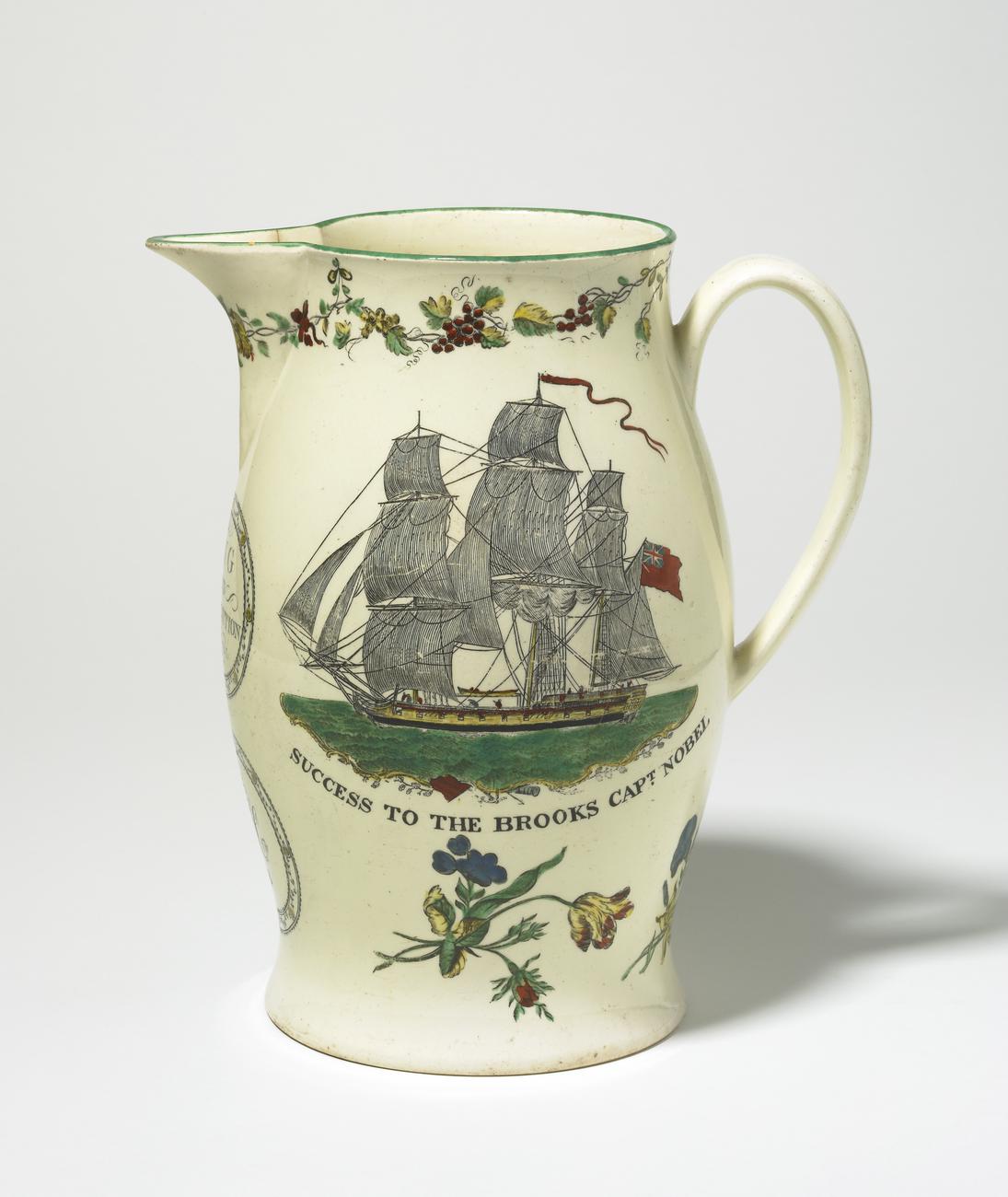
- Gallery: Room 46
- Maker: Herculaneum Factory
- Made in: Liverpool
- Date: 1793 (Dated given in applied text, representing terminus postquem.)
- Object type: jug
- Materials: earthenware
- Museum number: 1994,0718.2
- Museum: The British Museum
- Collection record: British Museum website
- Image © The Trustees of the British Museum, shared under a CC BY-NC-SA 4.0 licence.
Listen to the free audio guide
About this object
Before you is "The Brooks Jug," a creamware vessel crafted in Liverpool in 1793 by the Herculaneum Factory. Its design includes a slightly waisted body and a loop handle. One side shows a detailed scene of a sailing ship with the royal ensign flying, while the other features a group of ropemakers inside a shield, set in a wooded landscape.
The inscriptions are key. Below the ship is the phrase “SUCCESS TO THE BROOKS CAPT. NOBEL,” marking the ship and its commander. Further down, “KING / AND / CONSTITUTION” appears along with a monogram WH and the year 1793. The reverse includes “SUCCESS TO THE ROPE MAKERS AND THE GLORIOUS 10TH OF MARCH,” a reference to the recovery of King George III in 1789.
This piece connects to the 18th-century slave trade, possibly as pro-slavery propaganda. The Brooks was a Liverpool ship used in the transatlantic slave trade and became a symbol in abolitionist campaigns.
See it in person
The Brooks Jug is on display in Room 46 at the British Museum on Great Russell Street, Bloomsbury, London — free to enter. Choose British Museum on audioguide.london and take a photo of it to hear this free audio guide in six languages — no app download needed.
New, in beta. British Museum support has just launched and is still improving: over 1,000 objects so far, with more added all the time.