Stele
- Gallery: Ceramics, Room 137, The Curtain Foundation Gallery
- Made in: Iznik
- Date: 1560-1600
- Object type: Tile
- Materials: Fritware, polychrome underglaze painted, glazed
- Style: Ottoman
- Dimensions: Height (height of object without stand) 42.2 cm; Width (maximum width of object without stand) 29 cm; Depth (depth of object without stand) 3 cm
- Museum: V&A South Kensington
- Collection record: V&A website
- Image © Victoria and Albert Museum, London.
Listen to the free audio guide
In the museum now? Point your phone at the next object and hear its guide.
About this object
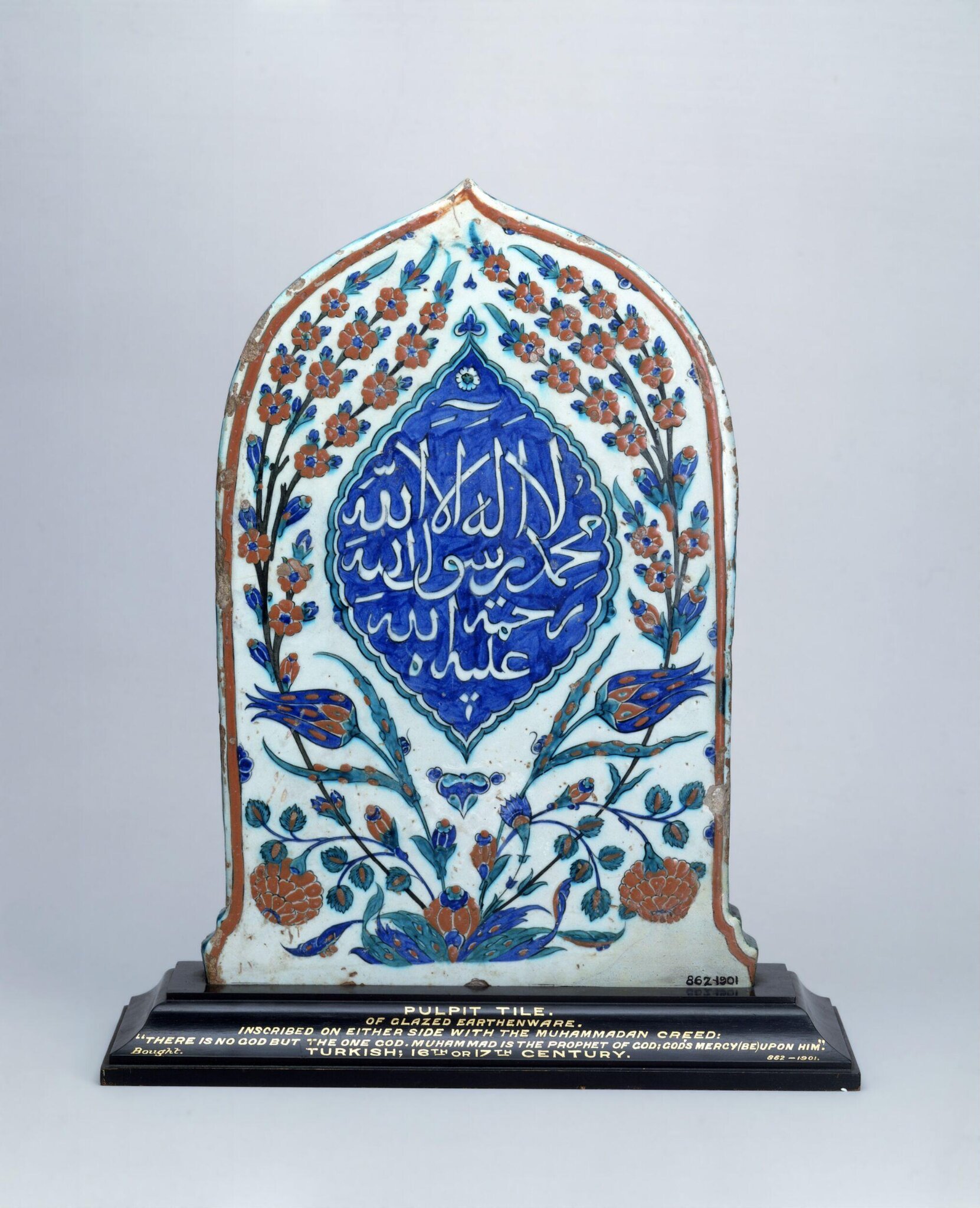
Before you is a "Stele", a striking upright slab made of fritware ceramic. This piece comes from Iznik, Turkey, and was created during the latter half of the sixteenth century.
Notice the clear white background, which provides a bright canvas for the vibrant blue, green, and red colors. These colors were a signature of Iznik pottery during this time. On both sides, you can see a beautiful floral border featuring roses, tulips, and blossoms arranged around a central space.
Inside that central space is an Arabic inscription. It begins with the Shahadah, a key expression of Muslim belief, which translates to: There is no god but God. Muhammad is the prophet of God. Following this is a short prayer asking for God's mercy.
While the shape of this tile resembles a tombstone, it lacks the name of a deceased person, which suggests it may have served a different purpose. Some suggest it could have functioned as a portable niche to indicate the direction of prayer, though its exact use remains a mystery.
See it in person
Stele is on display in Ceramics, Room 137, The Curtain Foundation Gallery at the V&A South Kensington on Cromwell Road, London — free to enter. Choose V&A South Kensington on audioguide.london and take a photo of it to hear this free audio guide in six languages — no app download needed.
New, in beta. V&A support has just launched and is still improving: 1,000 objects with audio so far, with more added all the time.