Scylla
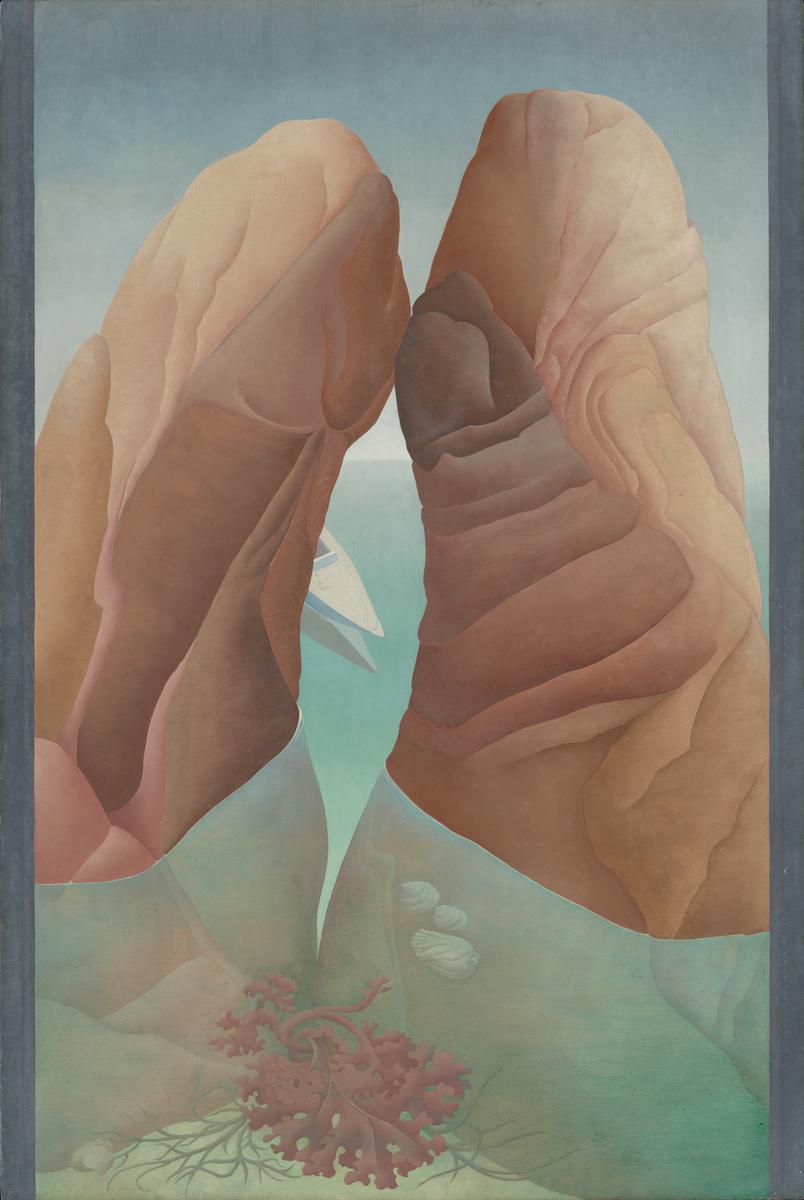
- Artist: Ithell Colquhoun
- Date: 1938
- Medium: Oil paint on board
- Dimensions: support: 914 x 610 mm
- Museum: Tate Britain
- Collection record: Tate Britain website
Listen to the free audio guide
About this artwork
This is “Scylla” by Ithell Colquhoun, painted in 1938 with oil on board. At first glance it looks like a dramatic seascape: rugged cliffs in ochre and pink, a small boat pushing toward a dark, stormy horizon. But Colquhoun gives it a much more intimate double meaning. The jagged rocks on the left are actually a stylised pair of knees, and the seaweed curling along the shore is meant to be her own pubic hair. It’s a visual pun, a surrealist trick of the “double image” that reminds us of Dalí’s paranoiac‑critical method.
The title itself points us to the Greek myth of Scylla, the six‑headed sea monster who stalked a narrow channel. Colquhoun’s version turns that monster into a female body, a poetic re‑imagining of myth and desire. She says the idea came from seeing herself in a bath—what becomes a landscape, what becomes a body. It’s a clever, sensual play that shows how the artist could merge landscape with self‑portrait, myth with modernity.
You’ll notice the subtle use of light: a thin band of pale sky above the horizon, the water’s green tinted with a glaze that feels almost translucent. The composition is balanced by the curved line of the sea and the sharp edges of the cliffs. It’s a small painting—just under a meter wide—but its layers of meaning make it feel huge. Colquhoun’s work invites you to look twice, to find the body in the rocks and the myth in the sea.
See it in person
Scylla is in the collection of Tate Britain on Millbank, London — free to enter. Point your phone at any artwork there and audioguide.london plays a free audio guide in six languages — no app download needed.