Sasanian ossuary
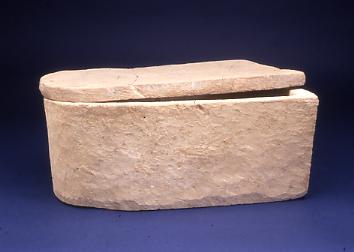
- Gallery: Room 52
- Culture: Sasanian
- Date: 3rdC-6thC
- Object type: ossuary, human skeletal remains
- Materials: limestone; human bone
- Museum number: 91933
- Museum: The British Museum
- Collection record: British Museum website
- Image © The Trustees of the British Museum, shared under a CC BY-NC-SA 4.0 licence.
Listen to the free audio guide
In the museum now? Point your phone at the next object and hear its guide.
About this object
This is a Sasanian ossuary, a stone container for human remains. Carved from limestone, it once held skeletal fragments inside. The shape narrows at both ends, with one side rounded and one more angular. Notice the lid, which has a carefully drilled hole running diagonally through it and into the ossuary wall—an unusual feature for such an object.
The remains inside belonged to at least one adult male with signs of aging and possible arthritis. Some bones were fragmented, possibly intentionally, before being placed in the ossuary. Alongside them was a younger individual, with less complete remains. These findings tell us about burial practices and perhaps the role of scavengers in disturbing exposed remains.
This ossuary was donated in 1888 by T. J. Malcolm during British Museum expert Sir Ernest Budge's trip to Bushire. It reflects the cultural traditions of the Sasanian period, around the 3rd to 6th centuries. Its form and function offer rare insight into how people treated their dead in this ancient region.
See it in person
Sasanian ossuary is on display in Room 52 at the British Museum on Great Russell Street, Bloomsbury, London — free to enter. Choose British Museum on audioguide.london and take a photo of it to hear this free audio guide in six languages — no app download needed.
New, in beta. British Museum support has just launched and is still improving: over 1,000 objects so far, with more added all the time.