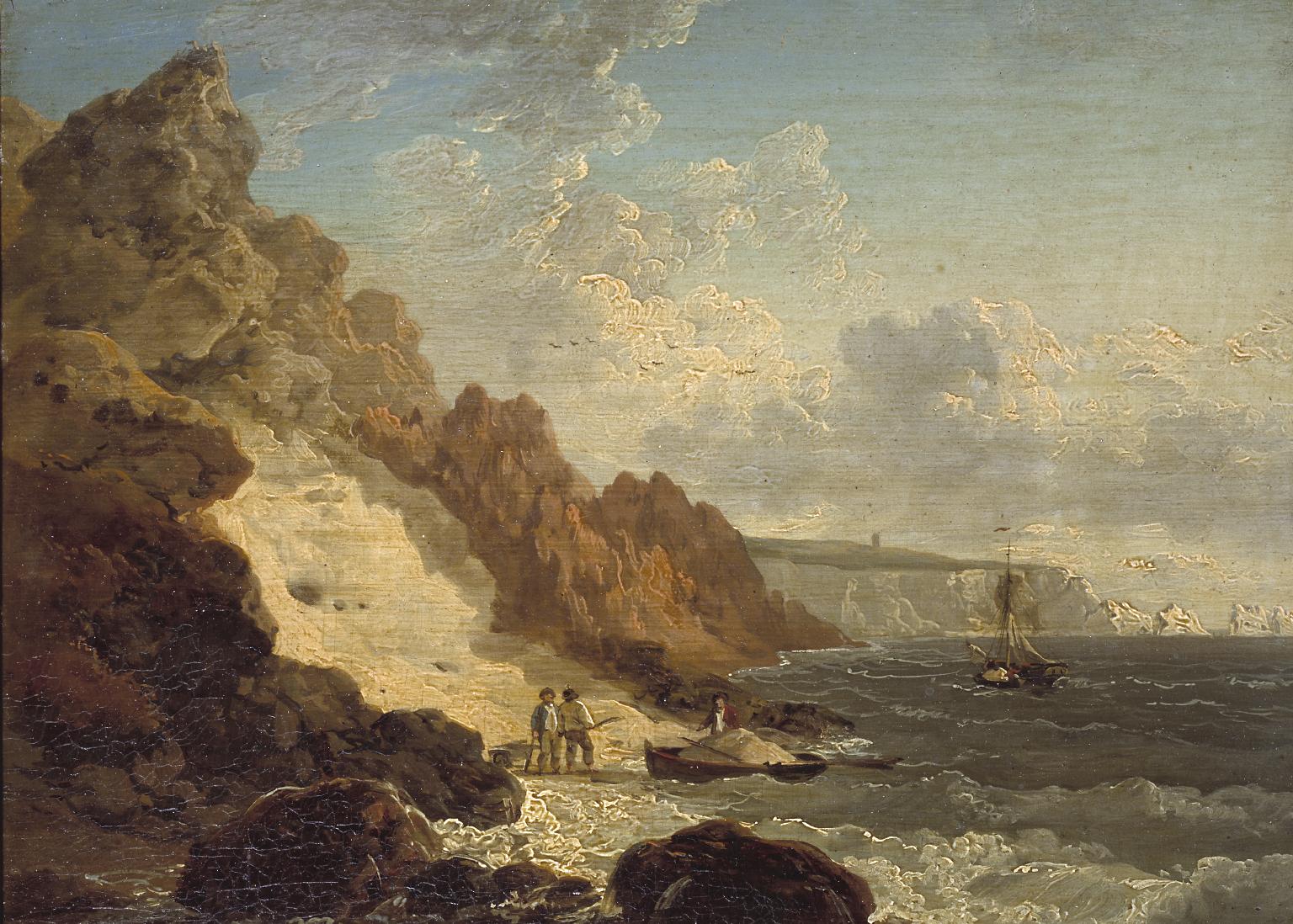
Sand Quarry at Alum Bay
- Artist: Julius Caesar Ibbetson
- Date: ?exhibited 1792
- Medium: Oil paint on wood
- Dimensions: support: 190 x 254 mm
- Museum: Tate Britain
- Collection record: Tate Britain website
Listen to the free audio guide
About this artwork
This is the “Sand Quarry at Alum Bay” by Julius Caesar Ibbetson, a small oil on wood from 1792 that captures a slice of the Isle of Wight’s dramatic coastline. In 1791 Ibbetson visited the island, and the rugged coves and chalk cliffs inspired a series of landscape works. Here he focuses on Alum Bay, with a group of quarrymen busy extracting the bright, sandy material that gives the beach its name. In the distance you can spot the famous Needles – those iconic chalk stacks rising from the sea – a reminder of the island’s unique geology.
The painting was exhibited at the Royal Academy between 1792 and 1796, showing the artist’s early engagement with the British art scene. Ibbetson didn’t just stay local; he travelled extensively, painting scenes from China and the Indonesian island of Java. That adventurous spirit shows in his attention to place – every coast, every cliff has a narrative. In this tiny canvas, the interplay of light on the sand, the movement of the quarrymen, and the distant sea all combine to give a lively snapshot of 18th‑century coastal industry and natural beauty.
See it in person
Sand Quarry at Alum Bay is in the collection of Tate Britain on Millbank, London — free to enter. Point your phone at any artwork there and audioguide.london plays a free audio guide in six languages — no app download needed.