Samurai armour
- Audio guide stop: 595
- Gallery: Room 93
- Culture: Edo Period
- Made in: Japan
- Date: 18thC
- Object type: jinbaori, do, fly-whisk
- Materials: paper; lacquer; wood; metal
- Museum number: 2017,3024.1.1-14
- Museum: The British Museum
- Collection record: British Museum website
- Image © The Trustees of the British Museum, shared under a CC BY-NC-SA 4.0 licence.
Listen to the free audio guide
About this object
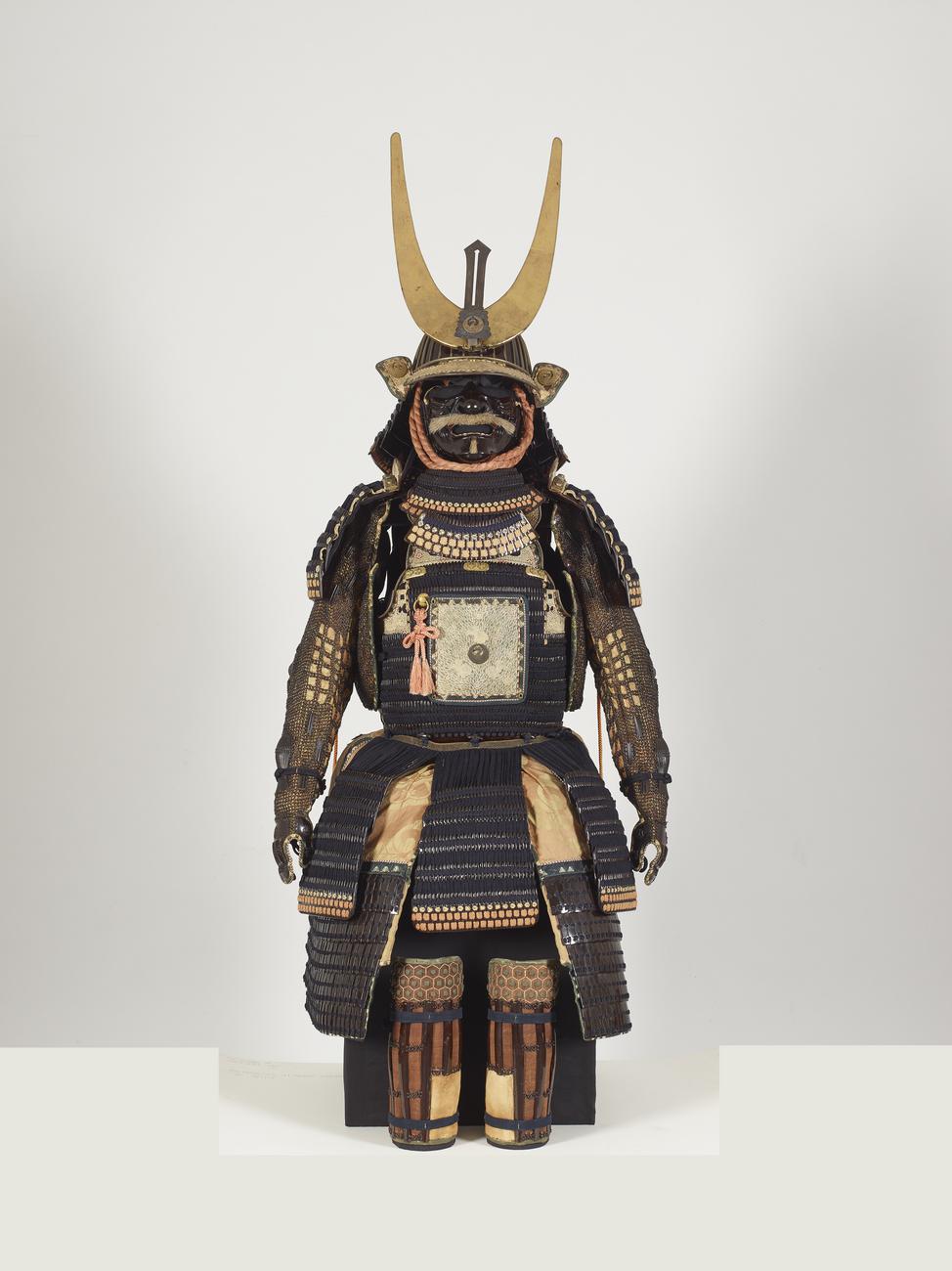
Before you is an elaborate set of samurai armor from Japan’s Edo Period, created in the 18th century. The armor includes a two-piece cuirass decorated with the crest of the influential Mori clan — a stylized crane inside a circle. Alongside the armor sit wooden storage boxes, lacquered and adorned with additional Mori crests, reflecting a strong sense of family identity.
The armor's cuirass has a hinged left side, elaborately trimmed in copper and gold alloy, with floral motifs and a detachable doeskin patch bearing the Mori symbol. The helmet features 32 overlapping plates, a dramatic arrow design, and three clan crests. The mask, made of lacquered iron, shows a fierce, wrinkled warrior expression.
This armor, rich in decorative details and symbols, served more as a display of wealth and status than for battle readiness. It's a striking example of how craftsmanship and style evolved during Japan’s peaceful Edo era.
See it in person
Samurai armour is on display in Room 93 at the British Museum on Great Russell Street, Bloomsbury, London — free to enter. Choose British Museum on audioguide.london and type its audio guide stop number, 595, from the gallery label, or take a photo of it, to hear this free audio guide in six languages — no app download needed.
New, in beta. British Museum support has just launched and is still improving: over 1,000 objects so far, with more added all the time.