Russian revolutionary plate
- Audio guide stop: 482
- Gallery: Room 48
- Maker: Imperial Porcelain Factory
- Made in: St Petersburg
- Date: 1912 (blank made); 1922 (decorated)
- Object type: plate
- Materials: porcelain
- Museum number: 1990,0506.7
- Museum: The British Museum
- Collection record: British Museum website
- Image © The Trustees of the British Museum, shared under a CC BY-NC-SA 4.0 licence.
Listen to the free audio guide
About this object
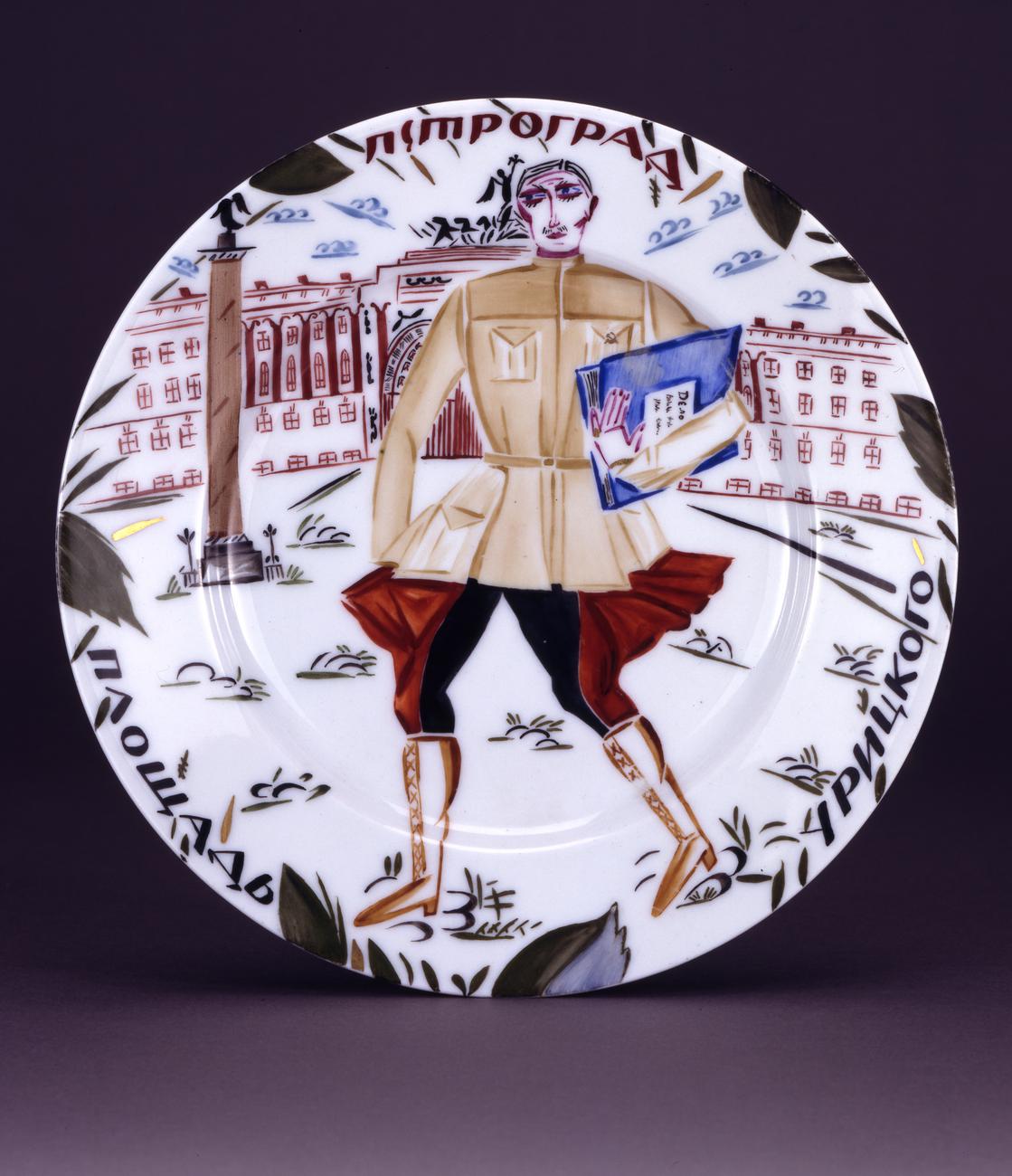
Here before you is a striking porcelain plate from a transformative moment in Russian history. This circular ceramic work features a vibrant painted scene at its center—depicting a revolutionary figure of the ChEKA, the Petrograd secret police, standing in front of the General Staff Building and the Alexander Column in Palace Square, which was later renamed Uritsky Square in memory of the revolutionary Moisei Uritsky.
The plate's edge is inscribed in Cyrillic, reading “Petrograd, Uritsky Square,” offering a tangible connection to the historical context. It was originally made in 1912 by the Imperial Porcelain Factory and later decorated in 1922. The painter, Ekaterina Yakimovskaya, used a design attributed to Alexander Shchekotikhina-Pototskaya—a designer known for bold, avant-garde touches.
This design was popular and reflects the revolutionary spirit of the early Soviet era, capturing key historical and political themes of the time through art.
See it in person
Russian revolutionary plate is on display in Room 48 at the British Museum on Great Russell Street, Bloomsbury, London — free to enter. Choose British Museum on audioguide.london and type its audio guide stop number, 482, from the gallery label, or take a photo of it, to hear this free audio guide in six languages — no app download needed.
New, in beta. British Museum support has just launched and is still improving: over 1,000 objects so far, with more added all the time.