Portrait of Derek Marlowe with Unknown Ladies
- Artist: Pauline Boty
- Date: 1962–3
- Medium: Oil paint on canvas
- Dimensions: support: 1222 × 1224 mm
- Museum: Tate Britain
- Collection record: Tate Britain website
Listen to the free audio guide
About this artwork
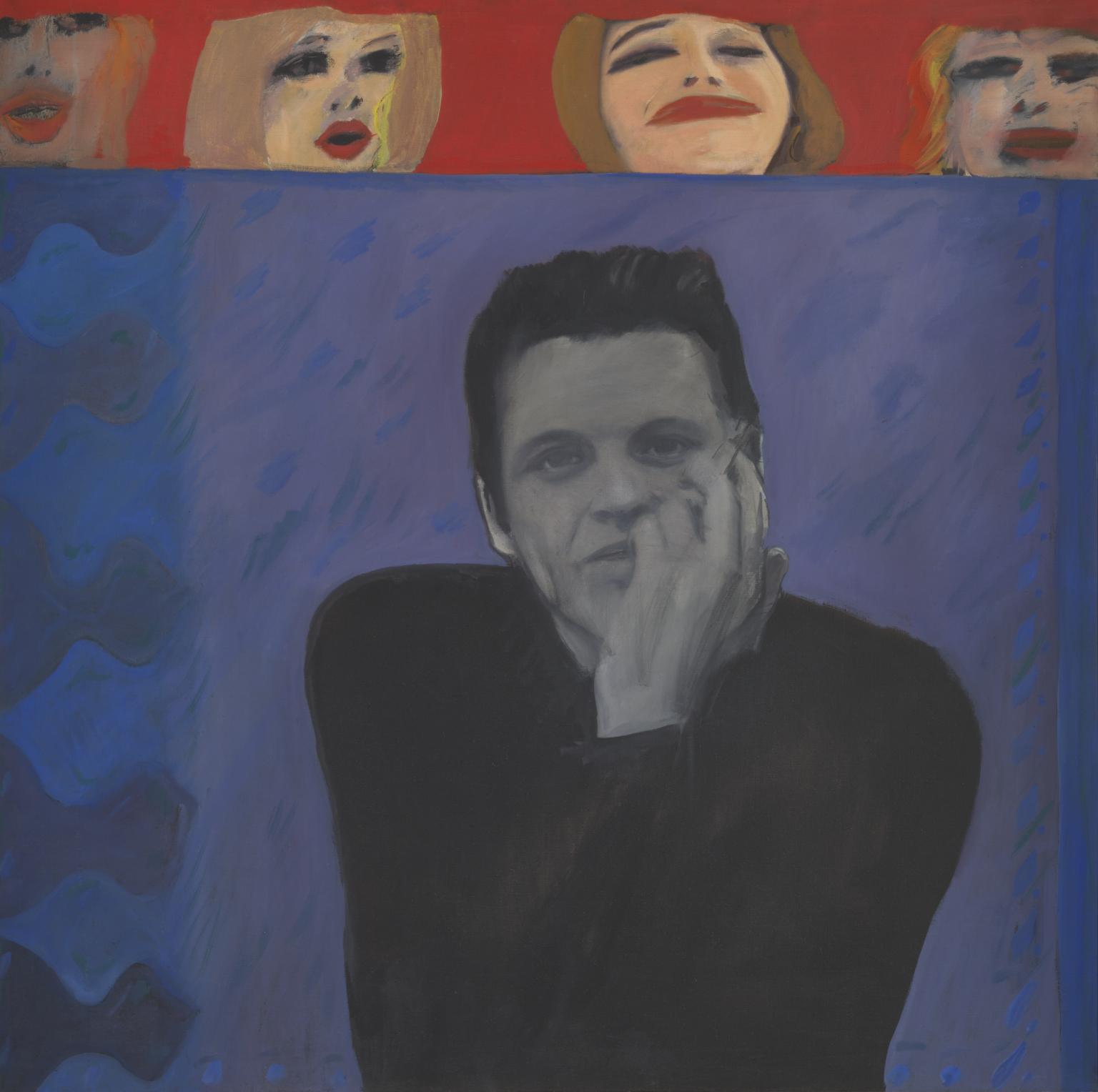
This is “Portrait of Derek Marlowe with Unknown Ladies” by Pauline Boty, painted in 1962‑63 in oil on canvas. The work shows Marlowe—English writer and painter—leaping forward, elbows resting on the frame, his face captured mid‑smile as if frozen from a black‑and‑white photo or film still. Boty layers a monochrome blue‑grey palette over an indigo background; the black jumper gives him a sharp outline that pulls attention to his face and hands. The portrait also hints at analog film: curved shapes along the left edge resemble perforations, while blue lines on the right echo audio waveforms. These details underscore the 1960s celebrity photography aesthetic, where Marlowe’s pose mirrors Audrey Hepburn’s famous “Breakfast at Tiffany’s” still.
Above him Boty adds a frieze‑like panel of four women on a red backdrop. Their heads are cropped at forehead and chin, with smudged mouths that suggest quick, painted brushstrokes. The faces shift from cool to decorative, illustrating how, in Boty's view, images of men and women were unbalanced—men named, women “kind of things.” This duality mirrors her other series (“It’s a Man’s World I” 1964) where she used contrasting styles to critique gender roles.
The piece sits on the square canvas; its blue‑film references reflect Boty’s fascination with pop culture imagery in early ‘60s London. It demonstrates how a single portrait can carry multiple layers of cultural commentary, all at once.
See it in person
Portrait of Derek Marlowe with Unknown Ladies is in the collection of Tate Britain on Millbank, London — free to enter. Point your phone at any artwork there and audioguide.london plays a free audio guide in six languages — no app download needed.