Portland Font
- Gallery: Room 47
- Maker: Workshop of Paul Storr
- Made in: London (England)
- Date: 1797
- Object type: font
- Materials: silk; silver
- Museum number: 1986,0403.1
- Museum: The British Museum
- Collection record: British Museum website
- Image © The Trustees of the British Museum, shared under a CC BY-NC-SA 4.0 licence.
Listen to the free audio guide
In the museum now? Point your phone at the next object and hear its guide.
About this object
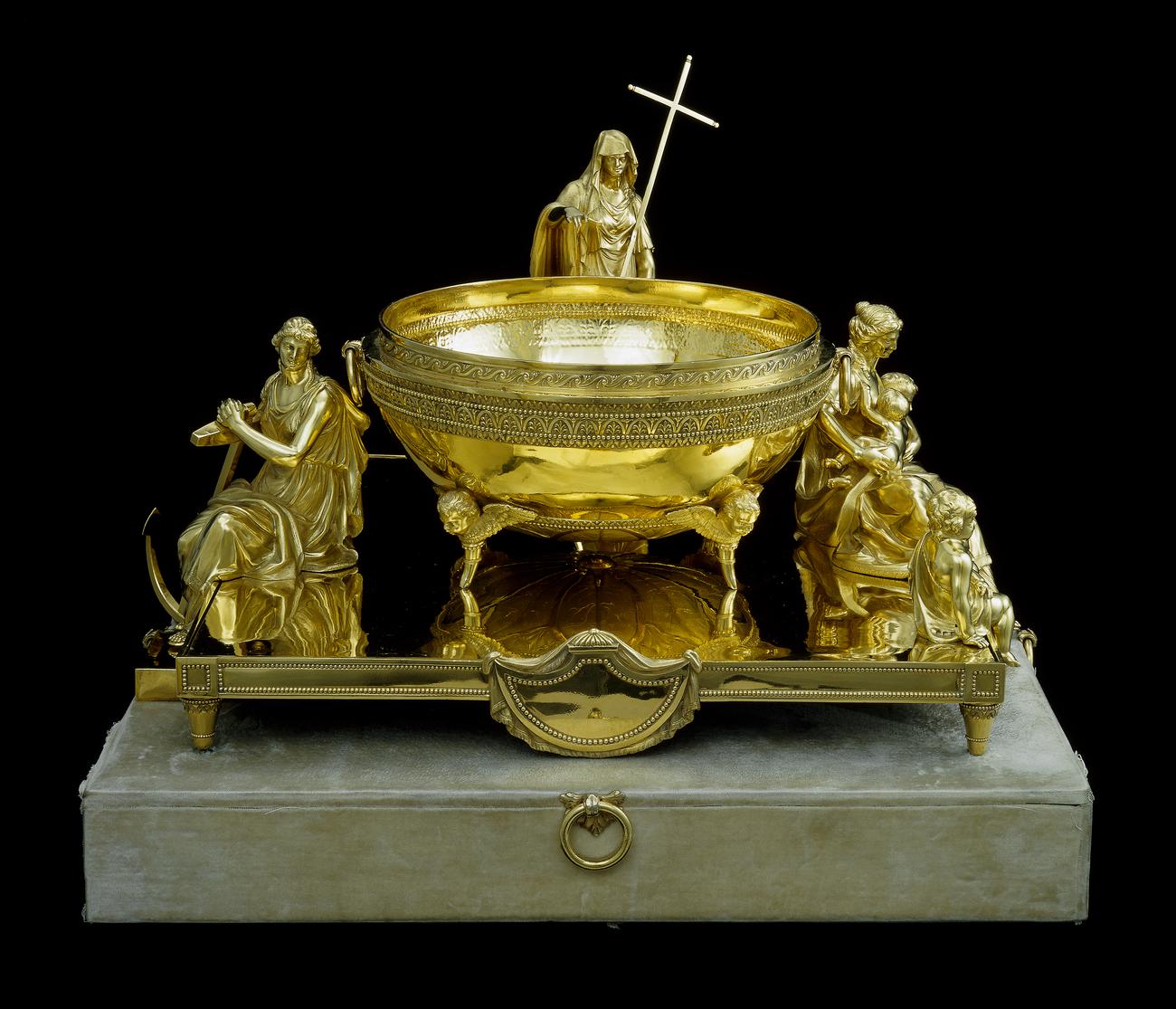
Before you is the Portland Font, a stunning 22-carat gold font crafted in the late 18th century in London. Designed by the landscape architect Humphrey Repton and made in the workshop of Paul Storr, this piece is a remarkable example of early 19th-century English goldsmithing.
At its center is a two-handled bowl nestled atop cherub legs, finely chased with intricate floral details and a band of low relief ornament. Around it stand three sculptural figures representing the cardinal virtues: Faith, Hope, and Charity. Faith holds a cross, Hope rests with an anchor, and Charity is shown with three children. Each figure is cast, chased, and bolted to the platform, forming a powerful yet elegant tableau.
This is the first known instance of freely standing sculptural figures in English goldsmithing. The rich textures contrast burnished and chased surfaces, adding depth to the figures' draperies and the lily motifs on the bowl. The entire piece rests on a square, velvet-covered plinth, giving the work a balanced, dignified presence.
See it in person
Portland Font is on display in Room 47 at the British Museum on Great Russell Street, Bloomsbury, London — free to enter. Choose British Museum on audioguide.london and take a photo of it to hear this free audio guide in six languages — no app download needed.
New, in beta. British Museum support has just launched and is still improving: over 1,000 objects so far, with more added all the time.