Paper Bales
- Artist: Prunella Clough
- Date: 1960
- Medium: Oil paint on canvas
- Dimensions: support: 870 × 1117 × 18 mm
- Museum: Tate Britain
- Collection record: Tate Britain website
Listen to the free audio guide
About this artwork
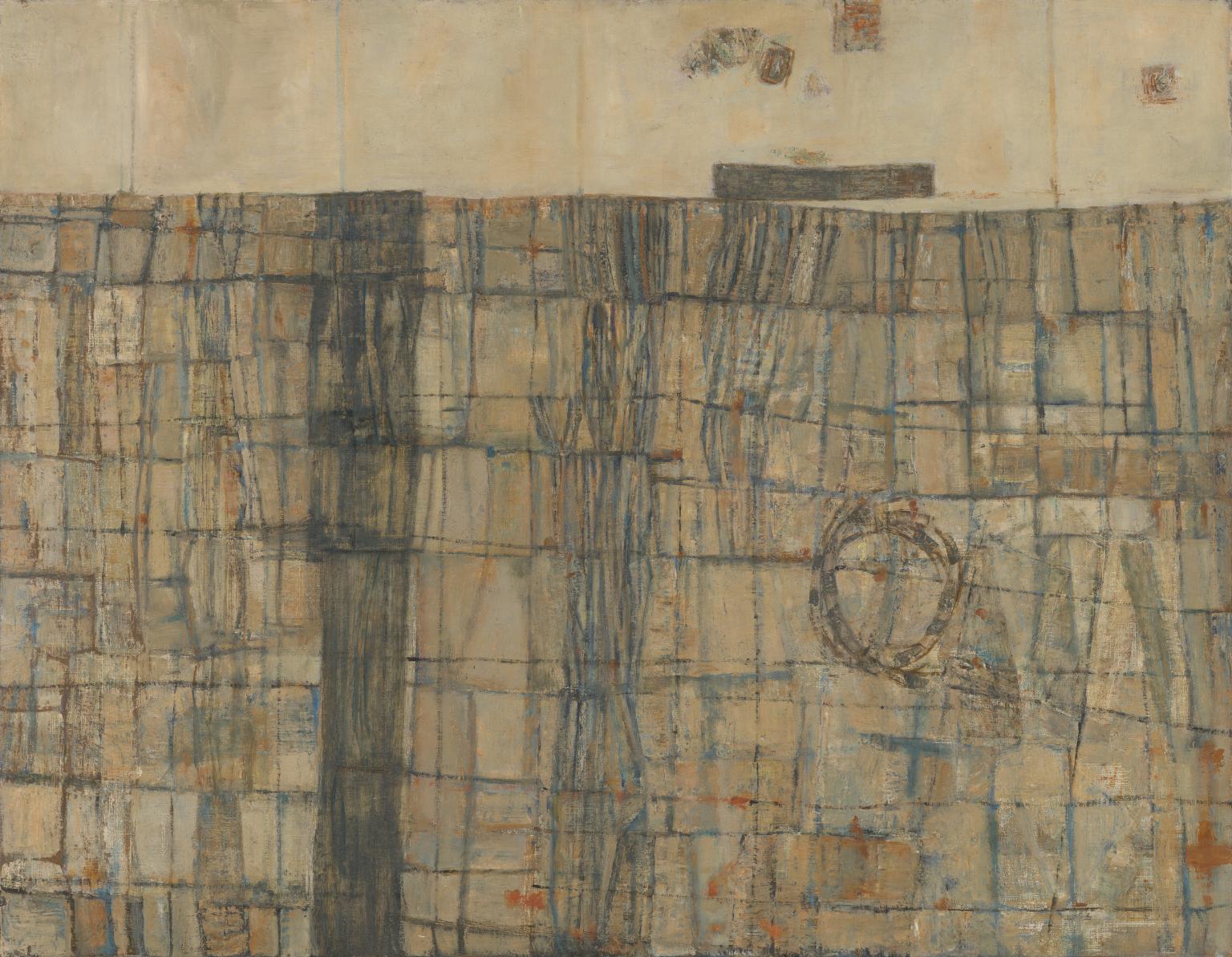
This is the “Paper Bales” by Prunella Clough, a 1960 oil on canvas that stretches across a wide, rectangular surface. It shows a geometric stack of paper bales rendered in Clough’s signature drab palette of greys, blues, creams and beiges, with sudden dabs of orange that punch through the otherwise flat field. The overlapping lines of the bales create a barbed‑wire‑like rhythm, almost like a concrete wall of paper.
In the mid‑right corner a circular swirl – probably a piece of string – breaks the linear pattern, anchoring four small abstract shapes that hover in the grim‑cream sky above. The whole composition feels like a moment frozen from an anonymous industrial landscape, a nod to Clough’s fascination with post‑industrial Britain and, in her words, a modern equivalent of the Italian love for immediate townscapes.
By 1960, Clough was shifting toward a more purely abstract language, influenced by the American “New Painting” movement that year. Yet she kept the industrial motif alive, keeping the work in conversation with earlier British landscape traditions, such as the hay‑bale paintings of Paul Nash, while stripping away any overt social message. The result is a stark, contemplative study of form and colour that still feels surprisingly fresh today.
See it in person
Paper Bales is in the collection of Tate Britain on Millbank, London — free to enter. Point your phone at any artwork there and audioguide.london plays a free audio guide in six languages — no app download needed.