Pandora
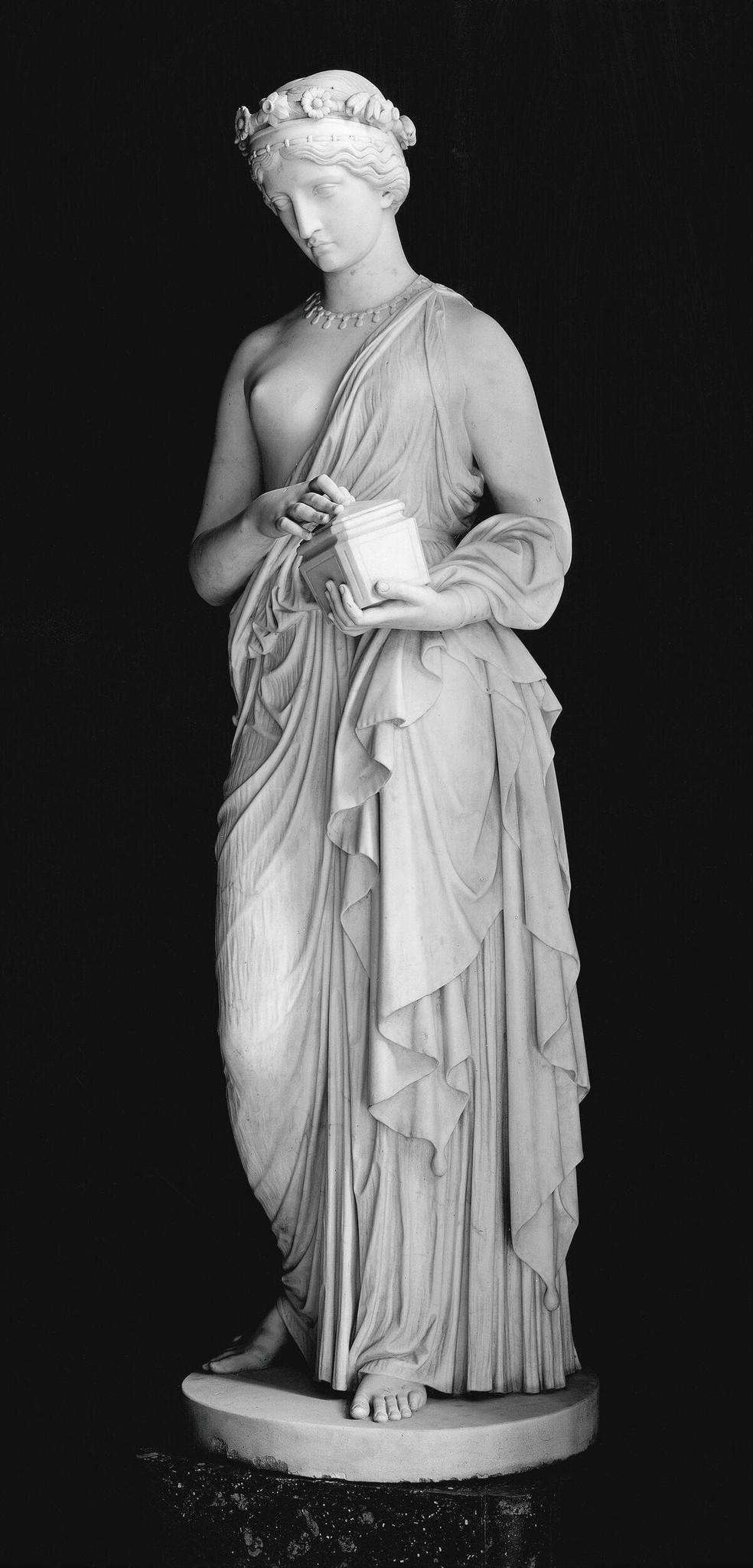
- Gallery: Sculpture, Room 22, The Dorothy and Michael Hintze Galleries
- Maker: John Gibson (sculptor)
- Made in: Rome
- Date: 1856
- Object type: Statue
- Materials: Marble, with red marble base with decorated moulding in bronzed wood, and siena and black marble plinth
- Dimensions: Height 173 cm; Weight 399 kg
- Museum: V&A South Kensington
- Collection record: V&A website
- Image © Victoria and Albert Museum, London.
Listen to the free audio guide
In the museum now? Point your phone at the next object and hear its guide.
About this object
Before you is "Pandora," a marble statue created by the English sculptor John Gibson in Rome in 1856.
As you look at the figure, notice her smooth marble surface and her downward gaze. She stands poised, holding a casket in her left hand. According to Greek mythology, Pandora was the first woman, created to bring misfortune to humankind. In this moment, she is about to open the box that released all the sorrows and evils of the world, leaving only hope behind. Look closely at her expression; there is a sense of gravity and foreboding, as if she is laboring under intense curiosity and fear.
This work is a perfect example of the Neo-classical style. You can see the influence of great Roman sculptors in her graceful posture and classical dress. The statue stands upon a red marble base with decorated moulding and a siena and black marble plinth. On the back of the figure, you can find the inscription, IOANNES GIBSON ME FECIT ROMAE.
See it in person
Pandora is on display in Sculpture, Room 22, The Dorothy and Michael Hintze Galleries at the V&A South Kensington on Cromwell Road, London — free to enter. Choose V&A South Kensington on audioguide.london and take a photo of it to hear this free audio guide in six languages — no app download needed.
New, in beta. V&A support has just launched and is still improving: 1,000 objects with audio so far, with more added all the time.