Orpheus (Maquette 2) (Version II)
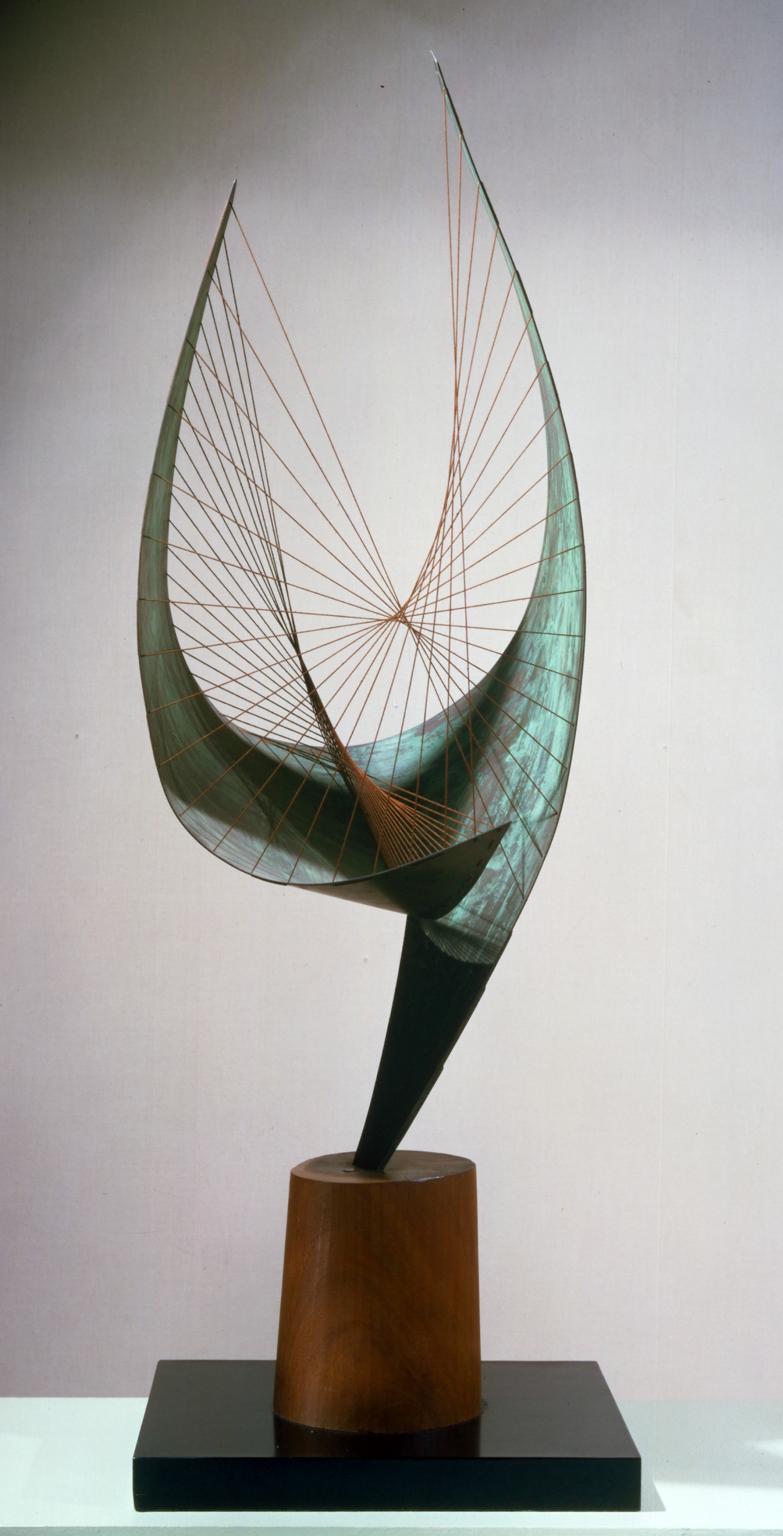
- Artist: Dame Barbara Hepworth
- Date: 1956, edition 1959
- Medium: Copper alloy and cotton string on wooden base
- Dimensions: Overall: 1224 x 430 x 467 mm
- Museum: Tate Britain
- Collection record: Tate Britain website
Listen to the free audio guide
About this artwork
This is “Orpheus (Maquette 2) (Version II)” by Dame Barbara Hepworth. Hepworth moved from carving to working with sheet metal in the mid‑1950s, and here she cuts a copper alloy plate into an irregular triangle that curls into an open conic shape. The metal is held in place by four strands of cotton string threaded through holes she drilled herself; the tension of those strings lifts the raised corners and gives the form its lightness.
The sculpture’s overall height is 1224 mm, with a wooden base 45 × 430 × 355 mm. The metal surface shows a lightly patinated green on the inside and soft pinkish‑brown brass outside—typical of her hand‑worked finish. It sits close to the floor, so the eye follows its rising corners across the empty space between them.
The title points directly to the Greek myth of Orpheus: the poet‑musician who travelled into the underworld to bring back his wife Eurydice by playing his lyre. In postwar Britain artists were fascinated by such stories of death and rebirth, and Hepworth’s form echoes that movement—metal rising like a figure in motion, strings suggesting sound.
She made this version in 1959 as part of an edition of three; the artist’s copy (2/3) is here. The piece was presented to us by Hepworth in 1967, and it has been shown in several solo exhibitions since her 1975 retrospective at Whitechapel.
In short, “Orpheus” combines metal and string to give a lyrical, airy shape that recalls mythic motion and the post‑war search for renewal in abstract sculpture.
See it in person
Orpheus (Maquette 2) (Version II) is in the collection of Tate Britain on Millbank, London — free to enter. Point your phone at any artwork there and audioguide.london plays a free audio guide in six languages — no app download needed.