No Woman, No Cry
- Artist: Chris Ofili
- Date: 1998
- Medium: Oil paint, acrylic paint, graphite, polyester resin, printed paper, glitter, map pins and elephant dung on canvas
- Dimensions: support: 2438 x 1828 x 51 mm
- Museum: Tate Britain
- Collection record: Tate Britain website
Listen to the free audio guide
About this artwork
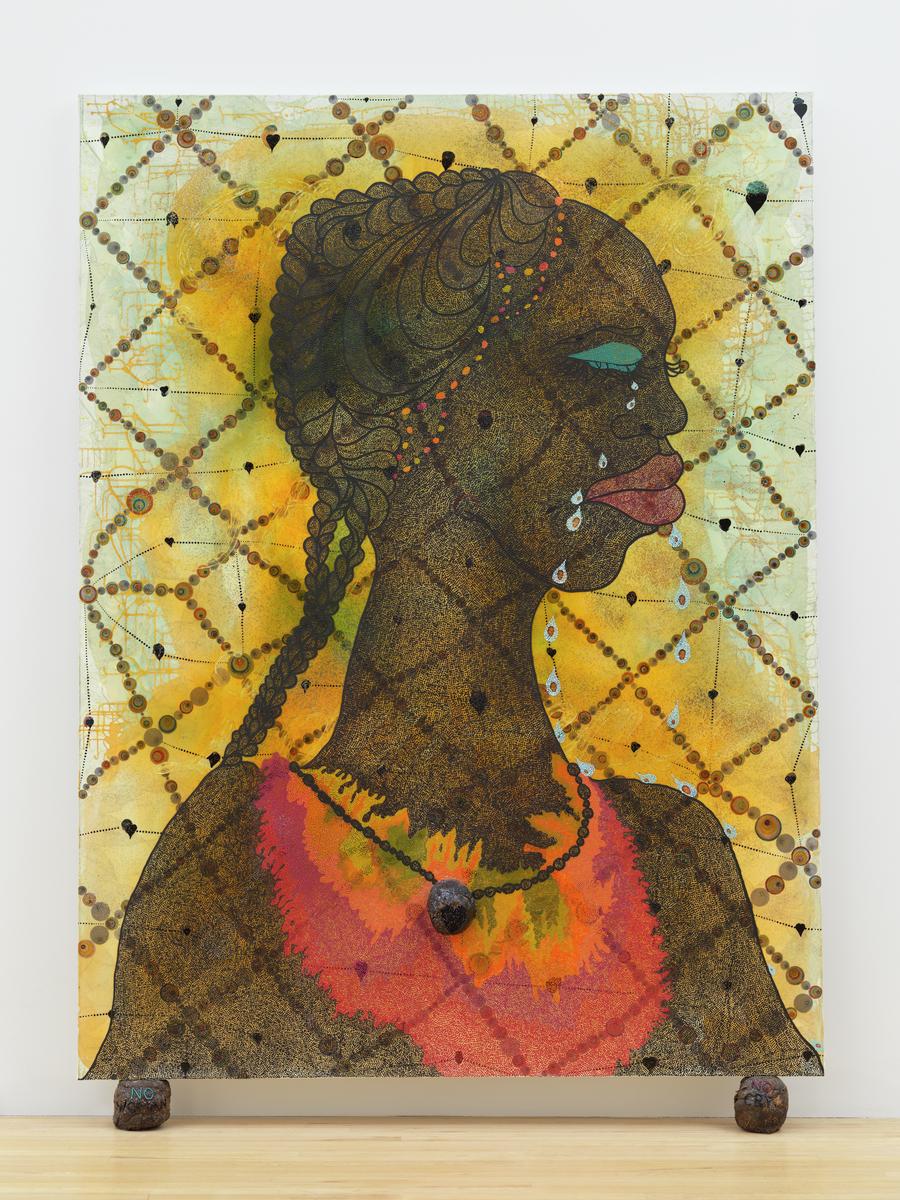
This is the No Woman, No Cry by Chris Ofili, painted in 1998. The work is a huge, densely layered canvas that uses oil, acrylic, graphite, polyester resin, printed paper, glitter, map pins and, quite strikingly, elephant dung. At the heart of the image is a woman in profile—dark‑haired, black skin—shaking with grief. In each of her tears we see a tiny collaged photograph of Stephen Lawrence, the teenage victim of a 1993 racially‑motivated murder in London. The words “R.I.P. Stephen Lawrence” are tucked beneath the layers of paint, barely visible, adding a quiet protest to the canvas.
The woman wears a string of beads, a thin black necklace whose pendant is made of sealed elephant dung with map pins stuck inside, and her chest is painted in fiery red and orange with yellow flame‑like strokes. The background swirls with pale green and bright yellow, dotted with concentric circles that form crude diamond shapes and black heart‑shaped marks. On the lower edge, faintly, a four‑line inscription repeats the phrase “RIP Stephen Lawrence 1974–1993.”
Ofili chose the title from Bob Marley’s 1974 song, but the painting is a universal meditation on loss and institutional injustice. The heavy, textured surface—layered with resin, glitter, and dung—creates a tactile memory of pain, while the embedded photographs keep Stephen’s face in the viewer’s eye. The piece is a powerful reminder that grief can be both personal and political, captured in a single, monumental canvas.
See it in person
No Woman, No Cry is in the collection of Tate Britain on Millbank, London — free to enter. Point your phone at any artwork there and audioguide.london plays a free audio guide in six languages — no app download needed.