Napoleon I
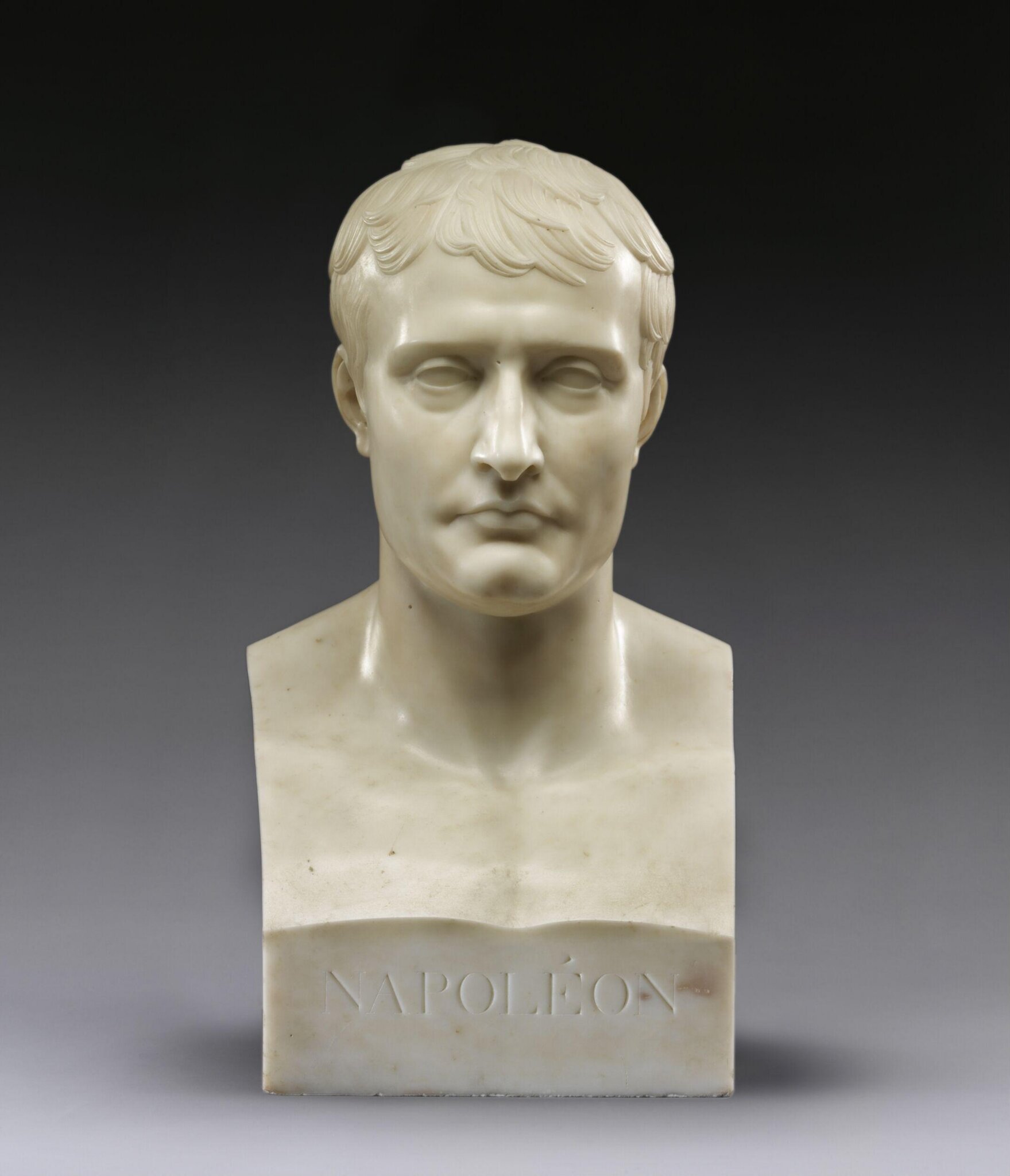
- Gallery: Europe 1600-1815, Room 1
- Maker: Antoine-Denis Chaudet (after)
- Made in: Carrara
- Date: 1807-1809
- Object type: Bust
- Materials: Marble, carved
- Dimensions: Height 59 cm; Width 28.5 cm; Depth 26.0 cm
- Museum: V&A South Kensington
- Collection record: V&A website
- Image © Victoria and Albert Museum, London.
Listen to the free audio guide
In the museum now? Point your phone at the next object and hear its guide.
About this object
Before you is a marble bust of Napoleon the First, carved from white marble from Carrara, Italy. This sculpture was created between 1807 and 1809, following a model by the French sculptor Antoine-Denis Chaudet.
If you look at the shape, you will notice the shoulders are cut off with straight sides. This is known as a herm form, a style used to imitate the imperial portraits of ancient Rome. By using this style, Napoleon sought to link his reign to the great civilizations of the past.
This specific image was the preferred portrait of Napoleon himself. It was incredibly popular, and no less than 1,200 marble versions were carved by workshops in Carrara during this time. This particular piece was likely one of those official portraits intended for public buildings in France. While many of these marble versions were destroyed when the Bourbon monarchy was restored in 1814, this example remains as a striking testament to the Empire style.
See it in person
Napoleon I is on display in Europe 1600-1815, Room 1 at the V&A South Kensington on Cromwell Road, London — free to enter. Choose V&A South Kensington on audioguide.london and take a photo of it to hear this free audio guide in six languages — no app download needed.
New, in beta. V&A support has just launched and is still improving: 1,000 objects with audio so far, with more added all the time.