Longshan culture blade
- Gallery: Room 33b
- Culture: Longshan culture
- Made in: China
- Date: 2500BC-2000BC
- Object type: blade, ceremonial equipment
- Materials: jade
- Museum number: 2022,3034.79
- Museum: The British Museum
- Collection record: British Museum website
- Image © The Trustees of the British Museum, shared under a CC BY-NC-SA 4.0 licence.
Listen to the free audio guide
In the museum now? Point your phone at the next object and hear its guide.
About this object
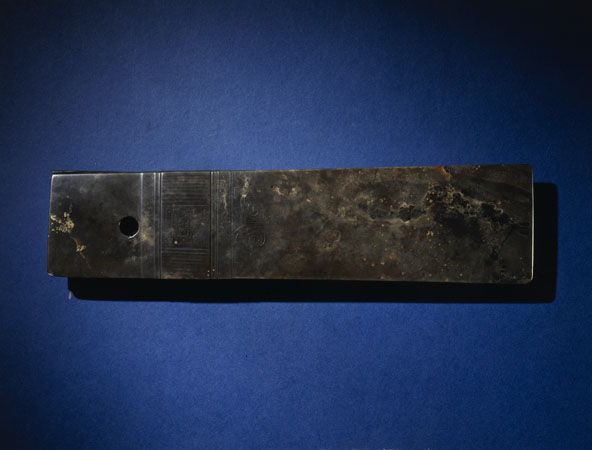
Before you is a stunning blade from the Longshan culture of ancient China, dating to around 2500 to 2000 BCE. This ceremonial blade is carved from dark olive green jade with rich brown mottling and finished to a smooth, almost perfect shine. Though its shape resembles a blade, with a bevelled edge and a central hole near the base, its highly polished surface and elaborate decoration make it clearly ceremonial, not a tool for use.
The blade is remarkable for its decorative details. Running along the sides are twisted rope patterns in fine incisions, framing stylised masks at the centre. These masks feature spiral eyes and arc-like designs, familiar from only a few similar pieces found in Shandong and now housed in museums like the NPM in Taipei. The surface also carries intricate geometric patterns and scroll-like designs, showing great artistry.
Such beautifully carved jade objects are rare survivals from the late Neolithic period, linking Longshan culture to other jade traditions across ancient China.
See it in person
Longshan culture blade is on display in Room 33b at the British Museum on Great Russell Street, Bloomsbury, London — free to enter. Choose British Museum on audioguide.london and take a photo of it to hear this free audio guide in six languages — no app download needed.
New, in beta. British Museum support has just launched and is still improving: over 1,000 objects so far, with more added all the time.