Kesa
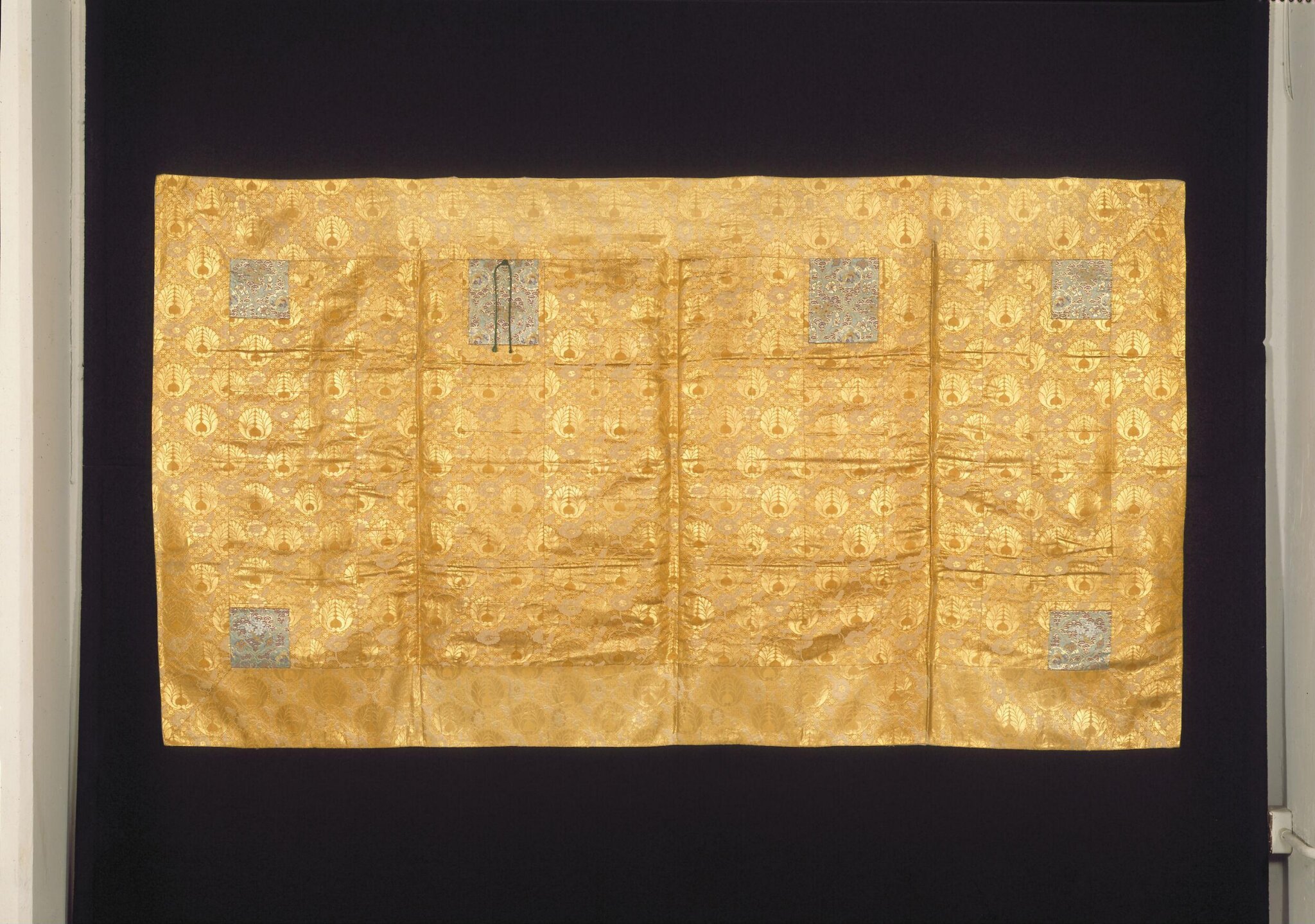
- Gallery: Japan, Room 45, The Toshiba Gallery
- Made in: Japan
- Date: 19th century
- Object type: Kesa
- Materials: Polychrome figured silk
- Style: Edo, Meiji
- Dimensions: Length 117 cm; Width 272 cm
- Museum: V&A South Kensington
- Collection record: V&A website
- Image © Victoria and Albert Museum, London.
Listen to the free audio guide
In the museum now? Point your phone at the next object and hear its guide.
About this object
Before you is a "Kesa", a rectangular robe worn by Japanese Buddhist priests during the nineteenth century. This garment is made of polychrome figured silk, featuring repeating leaf medallions and flower scrolls. Notice how the fabric is woven with gold, which would have shimmered beautifully in the light of temple candles.
The design is a patchwork of cloth arranged into specific columns. This layout acts as a mandala, a symbolic rendering of the universe. The central column represents the Buddha, while the two square patches on either side represent his attendants. The blue patches at the corners represent the four kings of heaven and the cardinal directions.
In Japan, these mantles were worn over a kimono-style robe. The patchwork style served a symbolic purpose, representing rags of poverty to align the wearer with the ascetic teachings of the Buddha. Most of the fabrics used here were specially woven in the Nishijin textile district of Kyoto.
See it in person
Kesa is on display in Japan, Room 45, The Toshiba Gallery at the V&A South Kensington on Cromwell Road, London — free to enter. Choose V&A South Kensington on audioguide.london and take a photo of it to hear this free audio guide in six languages — no app download needed.
New, in beta. V&A support has just launched and is still improving: 1,000 objects with audio so far, with more added all the time.