Industrial Landscape
- Artist: Prunella Clough
- Date: 1954
- Medium: Oil paint on canvas
- Dimensions: support: 510 × 410 × 20 mm
- Museum: Tate Britain
- Collection record: Tate Britain website
Listen to the free audio guide
About this artwork
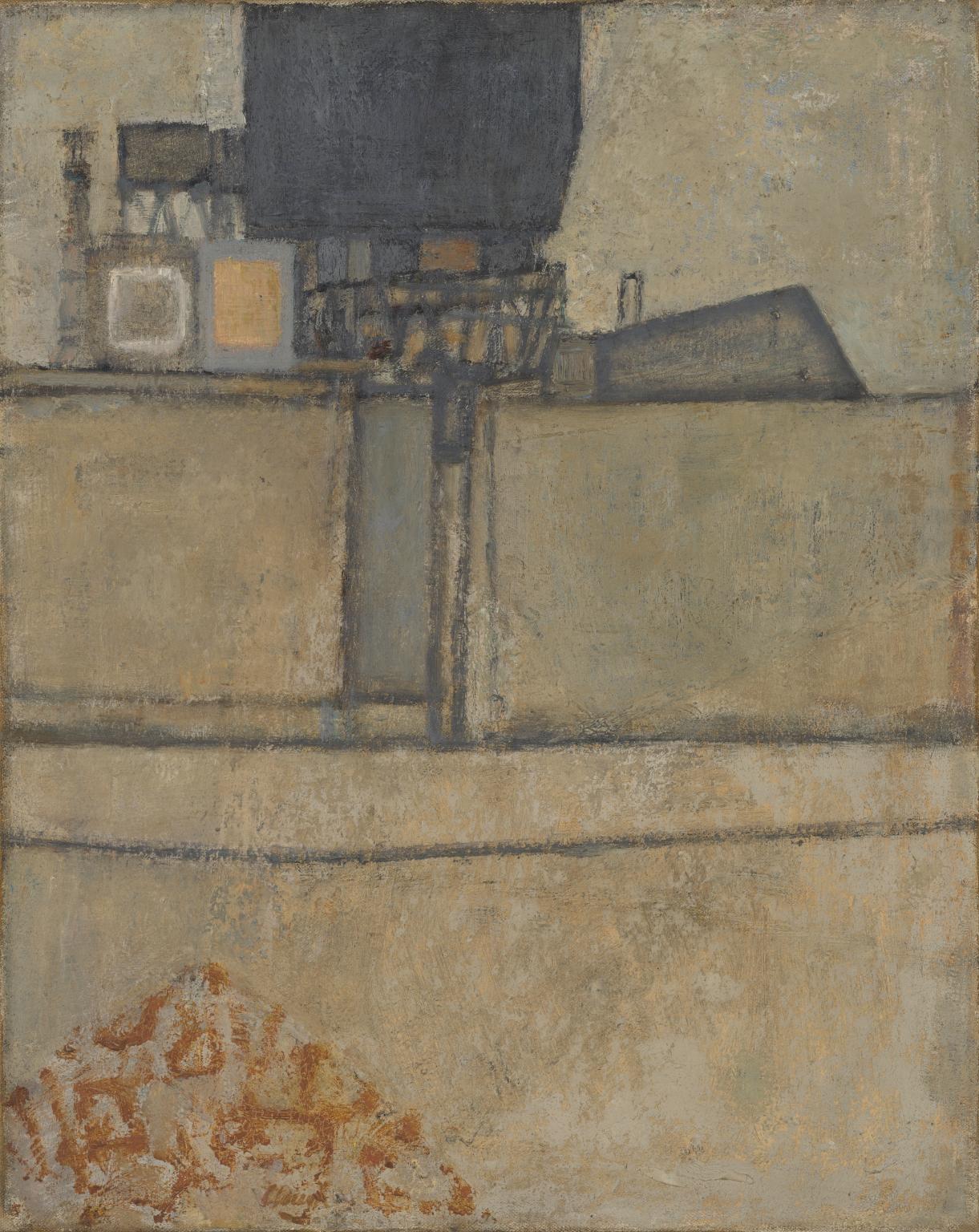
This is the “Industrial Landscape” by Prunella Clough. Created in 1954, the portrait‑oriented oil on canvas immediately draws you in with its flat, expansive surface and mottled colouring that dominate the upper background. A lightly maculated grey ground frames the foreground, punctuated by textured orange swirls that rise from the lower left corner, hinting at the dynamism of industrial life.
Moving up, you’ll spot a band of horizontal rectangular grey shapes, interwoven by a thinner, darker vertical grey stripe that slices through the middle of the composition. In the upper third, blue and grey rhombuses and looser rectangles mingle with tight black lines, producing a motley array of contours against a beige‑grey ground that extends to the canvas edges.
Clough’s technique is all about balance and reduction. She was wrestling with how to render urban chaos in a way that wasn’t visually overloaded. Her work from this period shows a clear tripartite structure, each sector exploring different forms and their interactions. It reflects her background in wartime map‑making and commercial design, where she honed a spare, graphic language.
Notice there are no human figures—this piece, like her other 1950s works, is a memory of places and events rather than a literal scene. The abstract shapes capture the rhythm of an industrial landscape, translating the mechanical into a subtle visual dialogue.
See it in person
Industrial Landscape is in the collection of Tate Britain on Millbank, London — free to enter. Point your phone at any artwork there and audioguide.london plays a free audio guide in six languages — no app download needed.