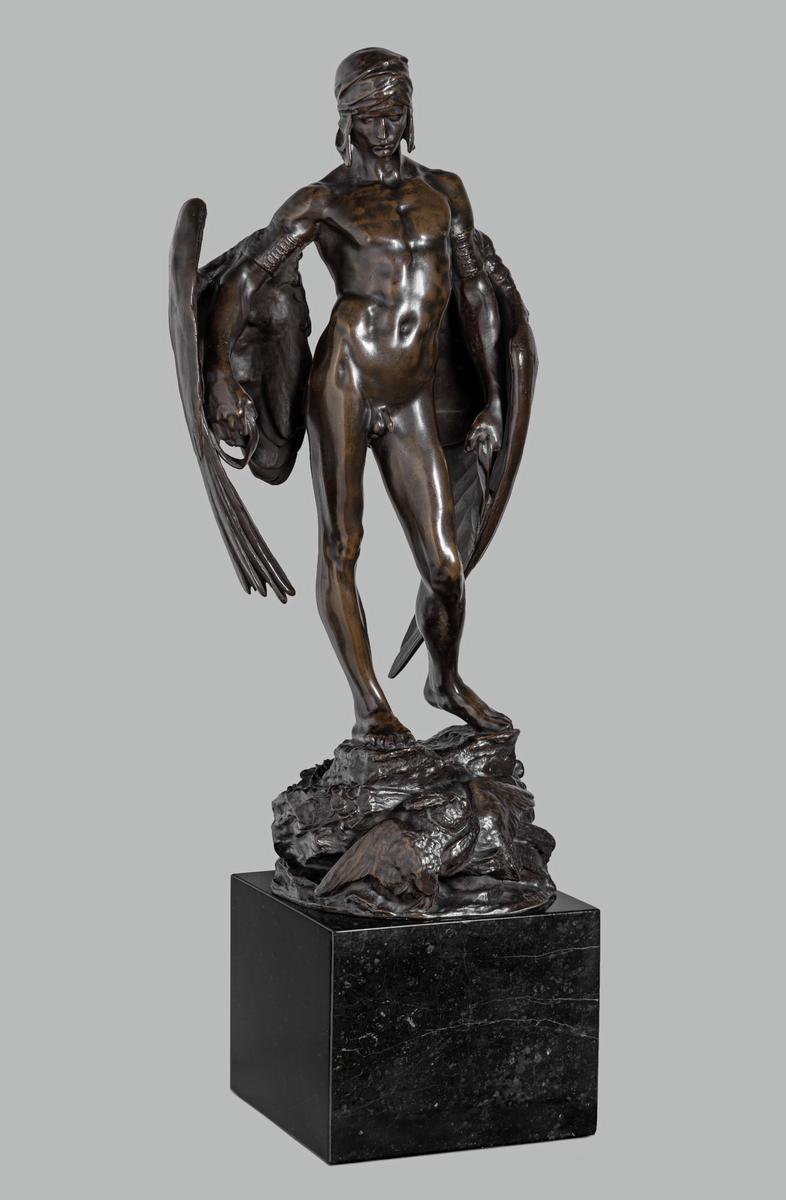
Icarus
- Artist: Sir Alfred Gilbert
- Date: 1882–4
- Medium: Bronze
- Dimensions: object with integral stone base: H 630 x W 240 x D 190 mm
- Museum: Tate Britain
- Collection record: Tate Britain website
Listen to the free audio guide
About this artwork
This is the “Icarus” by Sir Alfred Gilbert, created between 1882 and 1884. It’s a bronze cast measuring roughly 495 mm tall without its base – with the integral stone base it rises to about 630 mm. The sculpture shows Icarus poised at the edge of a rock, wings made of feathers and wax on his back. In the myth he flies too close to the sun; the wax melts and he falls into the sea. Gilbert chose this theme because “it flashed across me that I was very ambitious,” using the figure to mirror his own reach for flight. The work appears as a reduced version of an original 40‑inch figure, cast in Rome by the cire‑perdué process. It first exhibited at the Royal Academy in 1884, after which Gilbert was elected a member of the Royal Academy. Bequeathed to this collection by Frederick Harrison in 1936, “Icarus” combines mythic drama with sensual nudes and a vibrant surface that echoes both triumph and tragedy.
See it in person
Icarus is in the collection of Tate Britain on Millbank, London — free to enter. Point your phone at any artwork there and audioguide.london plays a free audio guide in six languages — no app download needed.