Hylas Surprised by the Naiades
- Artist: John Gibson
- Date: 1827–?36, exhibited 1837
- Medium: Marble
- Dimensions: object: 1600 x 1194 x 718 mm
- Museum: Tate Britain
- Collection record: Tate Britain website
Listen to the free audio guide
About this artwork
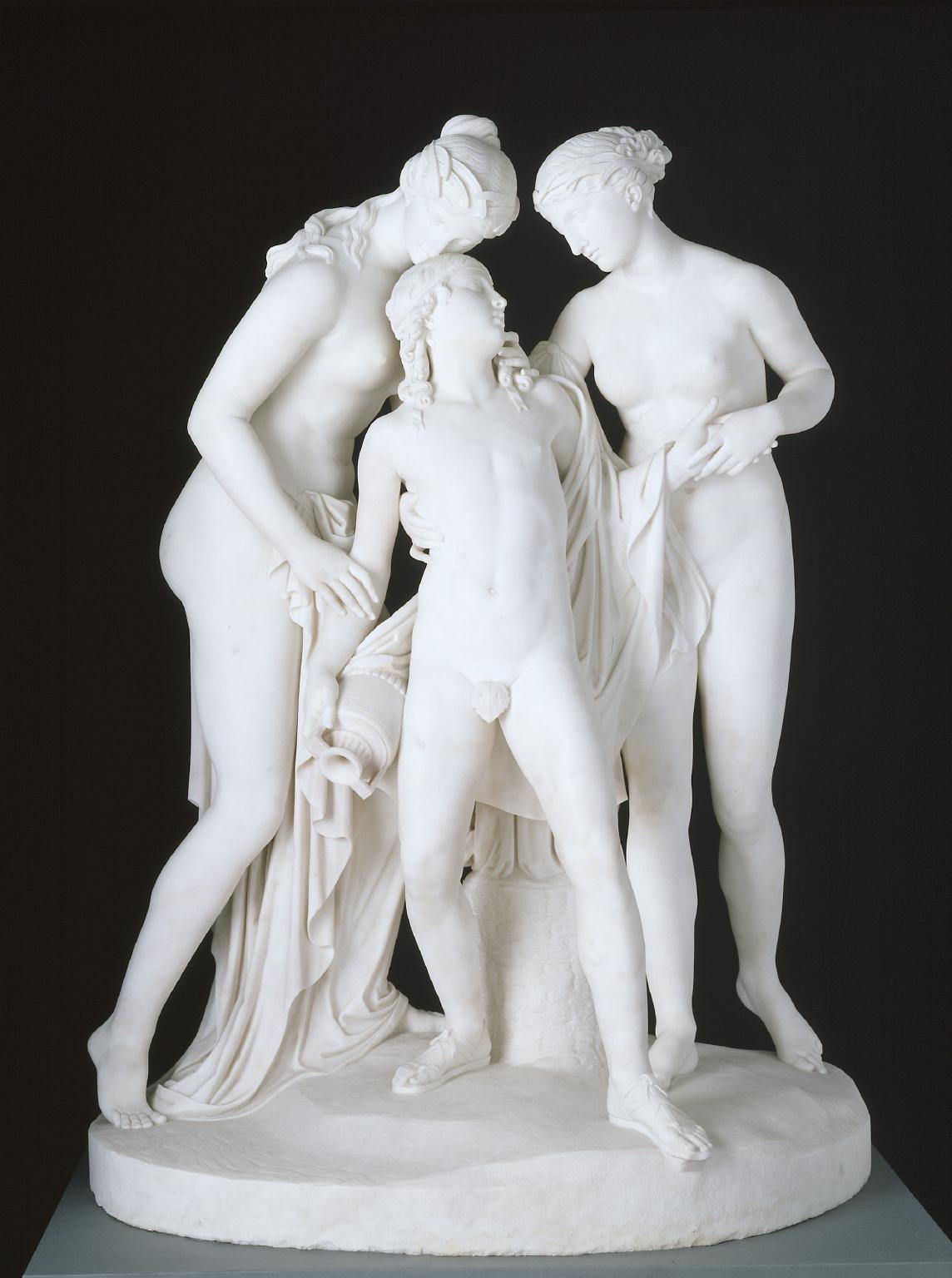
This is the *Hylas Surprised by the Naiades* by John Gibson. A life‑size marble group created between 1826 and 1837 in Rome, it captures a moment from the Greek myth that was popular among neoclassical artists of the time.
The scene unfolds as Hylas, the youthful companion of Hercules, reaches for water with a jug inscribed “Beautiful Hylas” in Greek. Two naiads appear on either side—one presses her cheek against his head, the other wraps a hand around his waist. Their graceful poses and light drapery echo the ideal beauty of classical sculpture that Gibson admired, while Hylas’s startled expression and slightly open leg show him caught mid‑action.
Gibson had trained under Antonio Canova and was influenced by Bertel Thorvaldsen, who also rendered this myth. The composition balances three figures in a triangular scheme, giving the group rhythm and dynamism. Displayed at the Royal Academy in 1837, it entered the national collection through Robert Vernon’s gift in 1847.
The marble surface is fine; the jug’s Greek lettering is visible, linking the work directly to its classical source. The sculpture shows Gibson’s skill in translating myth into a dramatic marble moment that feels both familiar and fresh.
See it in person
Hylas Surprised by the Naiades is in the collection of Tate Britain on Millbank, London — free to enter. Point your phone at any artwork there and audioguide.london plays a free audio guide in six languages — no app download needed.