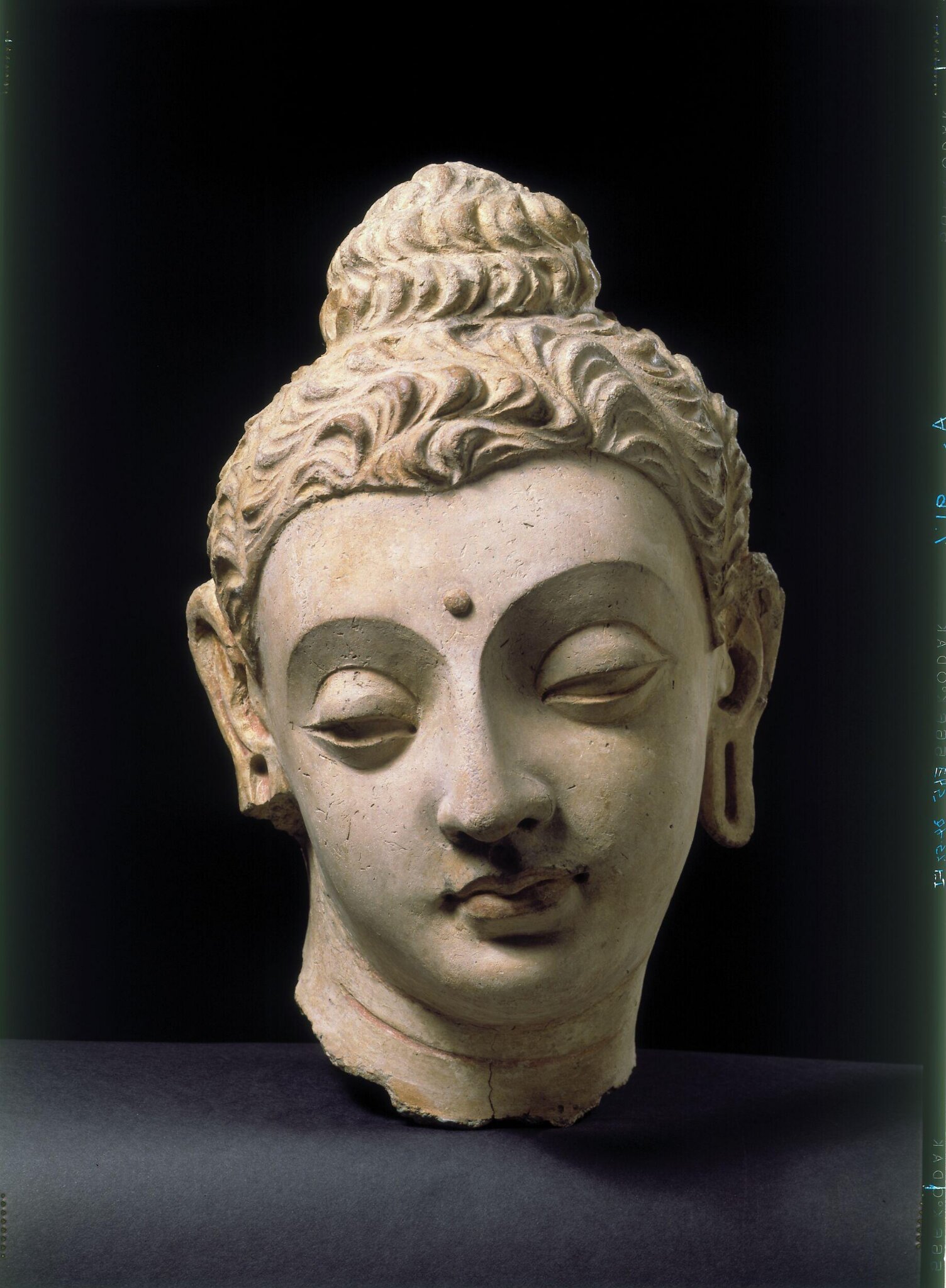
Head of the Buddha
- Gallery: Buddhism, Room 20, The Robert H. N. Ho Family Foundation Galleries of Buddhist Art
- Made in: Pakistan
- Date: 4th century-5th century
- Object type: Sculpture
- Materials: Stucco with polychrome
- Style: Gandhara style
- Dimensions: Height 29.2 cm; Width 18 cm; Depth 19 cm
- Museum: V&A South Kensington
- Collection record: V&A website
- Image © Victoria and Albert Museum, London.
Listen to the free audio guide
In the museum now? Point your phone at the next object and hear its guide.
About this object
Before you is the "Head of the Buddha," a graceful sculpture made of polychrome stucco. Created between the fourth and fifth centuries, likely in Taxila, Pakistan, this piece belongs to the Gandhara style.
This head was once part of a life-size figure, possibly depicting Gautama the Buddha as a young man. It was originally part of a large narrative panel, and you can still see traces of red pigment on the lips, eyelids, and hair. While the face was shaped using a mould, the hair and other fine details were carefully modeled by hand.
As you look closely, notice the specific marks that identify him as the Buddha. There is the prominent hair-knot on top of the head, styled here in a Graeco-Roman manner, and the mark on the forehead. You can also see elongated earlobes, which allude to his former status as a prince who wore heavy earrings. The head bends slightly to the left with a gentle, downward gaze.
See it in person
Head of the Buddha is on display in Buddhism, Room 20, The Robert H. N. Ho Family Foundation Galleries of Buddhist Art at the V&A South Kensington on Cromwell Road, London — free to enter. Choose V&A South Kensington on audioguide.london and take a photo of it to hear this free audio guide in six languages — no app download needed.
New, in beta. V&A support has just launched and is still improving: 1,000 objects with audio so far, with more added all the time.